 One platform connecting startups, corporations, research institutions, regions and investors
 Southeast Asia Innovation Landscape 2026
 ESG Data-as-a-Service (DaaS) A game-changer for resource-constrained SMEs

5 Creative Startup Ideas In Fintech
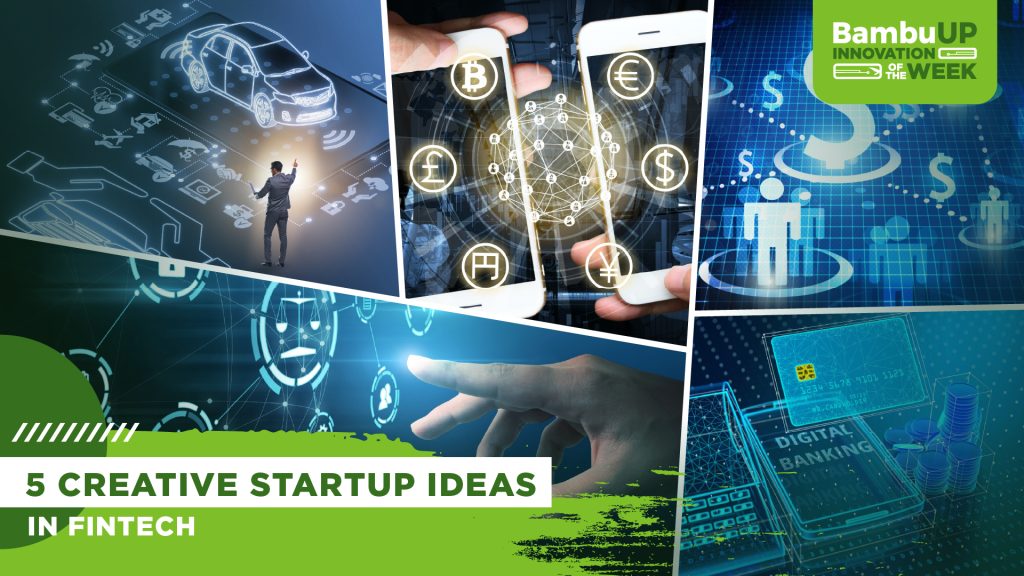
1. Application of insurance technology
Fintech has made a strong impact on the insurance industry. In fact, insurtech (as it’s called) already covers everything from car insurance to home insurance and data protection.
Because of the global pandemic, we are witnessing a surge in new fintech apps focusing on affordable insurance plans. Insurtech apps use AI and data science to collect, process, and evaluate the customer data, identify the risks involved and facilitate the insurance underwriting process. Using fintech app solutions, insurance companies can accelerate operations and boost the quality of their customer service.
In addition, insurance technology startups are attracting more and more investors. In the first six months of 2021, $7.1 billion was invested in Insurtech Startups around the world. 41% of consumers are willing to switch their insurance providers for more tech-savvy ones.
2. Peer-to-Peer (P2P) Transactions
P2P trading is the act of buying and selling cryptocurrencies directly between users, without a third party or intermediary. P2P trading gives you more control over who buys your cryptocurrencies and who you buy from, the pricing and settlement time. While P2P trading gives users finer control over the process, it is vital to note that peer-to-peer transactions carry some risks when there is no third party to broker the deal.
The P2P payment apps like Venmo, Google Pay, Zelle, and PayPal are providing consumers with an unmatchable facility to transfer money between bank holders instantly – even when registered with different banks and payment systems. They are cutting down the need for any third-party intermediaries or paying any commission fee for performing any transaction.
3. Digital bank
Digital Banking is a form of banking that digitizes all traditional banking activities and services. In other words, everything you can do at a regular bank branch, has now been digitized and integrated into a single digital banking application. Digital banking integrates the full functions of a traditional bank such as withdraw money, transfer money, deposit for term, no term with interest rate; manage checking accounts and savings accounts, bill payment, bank loan…
Typically, a fintech banking app grants users digital access to operations like closing and opening accounts, deposits, making online transactions, ordering credit cards, etc. It also integrates AI chat bots for quick consultation and financial advice
4. Regtech
RegTech or Regulatory Technology is an innovative technology based on artificial intelligence (AI) and machine learning (ML). Regtech’s key functions include monitoring, reporting and regulatory compliance, helping to solve regulatory and compliance requirements more effectively and efficiently. The objective of RegTech is to enhance transparency as well as consistency and standardize regulatory processes for delivering sound interpretations of ambiguous regulations and provide higher quality at low cost.
The most common areas of application of RegTech technology are:
- Check compliance with regulatory or compliance control requirements
- Customer identification
- Transaction monitoring
- Information security, system audit
- Company manager
- Risk management
5. Crowdfunding Platform
A crowdfunding app is a virtual environment where people may donate to a cause or generate funds for a specific person. A big number of people donate the finances required to get a project off the ground. Crowdfunding apps help budding entrepreneurs raise money for their initiatives. They also provide them with invaluable proof-of-concept capabilities: by posting their startup idea on a crowdfunding platform, they can quickly see if investors are interested. Surely, Kickstarter has the larger user base in this app segment, and can be an excellent example of a top-notch crowdfunding app.
Companies like Kickstarter, Patreon, GoFundMe, and some others are demonstrating the scope of fintech outside of traditional banking. Crowdfunding platforms allow internet users to send money to or receive money from others on the platform. This is a form of raising capital through small individual contributions from the masses and is done mainly via the internet. Instead of going to a traditional bank to get a loan, startups can now “go straight” to investors for financial support.