 One platform connecting startups, corporations, research institutions, regions and investors
 Southeast Asia Innovation Landscape 2026
 ESG Data-as-a-Service (DaaS) A game-changer for resource-constrained SMEs

China’s silent rise in the AI battlefield
📖 TABLE OF CONTENTS 📖
The AI industry is evolving at an unprecedented pace, with OpenAI at the forefront of machine learning and natural language processing. Yet, China’s rapid advancements—marked by the rise of DeepSeek—are reshaping the global landscape and intensifying the U.S.-China tech rivalry. By leveraging cutting-edge techniques like Mixture-of-Experts (MoE) and reinforcement learning, DeepSeek signals China’s growing capability to challenge American dominance in AI. As both nations push the boundaries of innovation, the race for global AI leadership is more competitive than ever. But will China’s bold approach be enough to overtake the U.S., or will OpenAI maintain its edge in this high-stakes battle for the future?
We are in the battlefield of technology and a new commercial landscape, where constant disruptions are reshaping the rules of the game. You may remain a Peacetime CEO in the long run, but transforming into a Wartime CEO for the next three years is essential. BambuUP organizes global trips to equip leaders with the right tools and readiness to navigate upcoming challenges. Learn more at: Global Unlock – BambuUP
1. THE BATTLE FOR AI SUPREMACY
OpenAI as a major force (Source: Internet)
Since its inception, OpenAI has been a major force in shaping the AI landscape. However, despite its strong influence, it currently holds an 11.05% share of the broader AI market – trailing behind industry leaders like Optimole (28.06%) and Drift (23.53%). While OpenAI continues to drive innovation, these numbers highlight the fierce competition in the rapidly evolving AI space [1]. Yet, when it comes to foundational models and AI platforms, OpenAI is in a league of its own, commanding an impressive 39% market share [1]. OpenAI’s valuation has surged to an astonishing $157 billion, fueled by massive funding rounds that signal unwavering investor confidence. This meteoric rise not only cements its position as a key player in AI but also underscores its potential to redefine the future of artificial intelligence [2][3]. By late 2024, OpenAI’s annual recurring revenue soared to $4 billion, fueled by the runaway success of its flagship product, ChatGPT. Dominating the AI subscription market, ChatGPT commands an impressive 69.9% share, solidifying OpenAI’s grip on the industry’s most lucrative segment [1][3].
The surprise emergence of DeepSeek (Source: Internet)
As OpenAI strengthens its foothold in AI through innovation and market dominance, the global competition continues to escalate. China, in particular, has emerged as a formidable contender, leveraging state-backed initiatives, vast consumer data, and record-breaking investments to accelerate its AI advancements and challenge U.S. leadership in the field. Evidently, China has firmly positioned itself as the world’s second-largest AI powerhouse, trailing just behind the United States. Recognizing AI as a cornerstone of military and economic progress, the Chinese government is aggressively investing in the sector, leveraging its vast consumer data to close the technological gap. With the world’s highest AI research output, patent filings, and venture capital investments, China’s AI ecosystem thrives under a powerful synergy between state-backed initiatives and private sector innovation [4][5].
The intensifying tech rivalry between China and the U.S. has become a defining struggle for global leadership, with AI emerging as the key battleground. Both nations are aggressively investing in research and innovation to gain a strategic edge, shaping the future of economic and military power [44]. This “clash of titans” is shaping the global landscape, with both nations racing to outpace each other in innovation and influence [4][6]. China is betting big on open-source AI – with the birth of Deepseek as their most recent innovative model – a strategy that fuels rapid innovation and sidesteps the limitations faced by U.S. firms locked into proprietary models. By fostering a highly collaborative ecosystem, China has fast-tracked AI advancements, strengthening its position as a global leader in the race for technological dominance [5][6].
2. CHINA’S AI REVOLUTION
2.1. China’s AI ecosystem
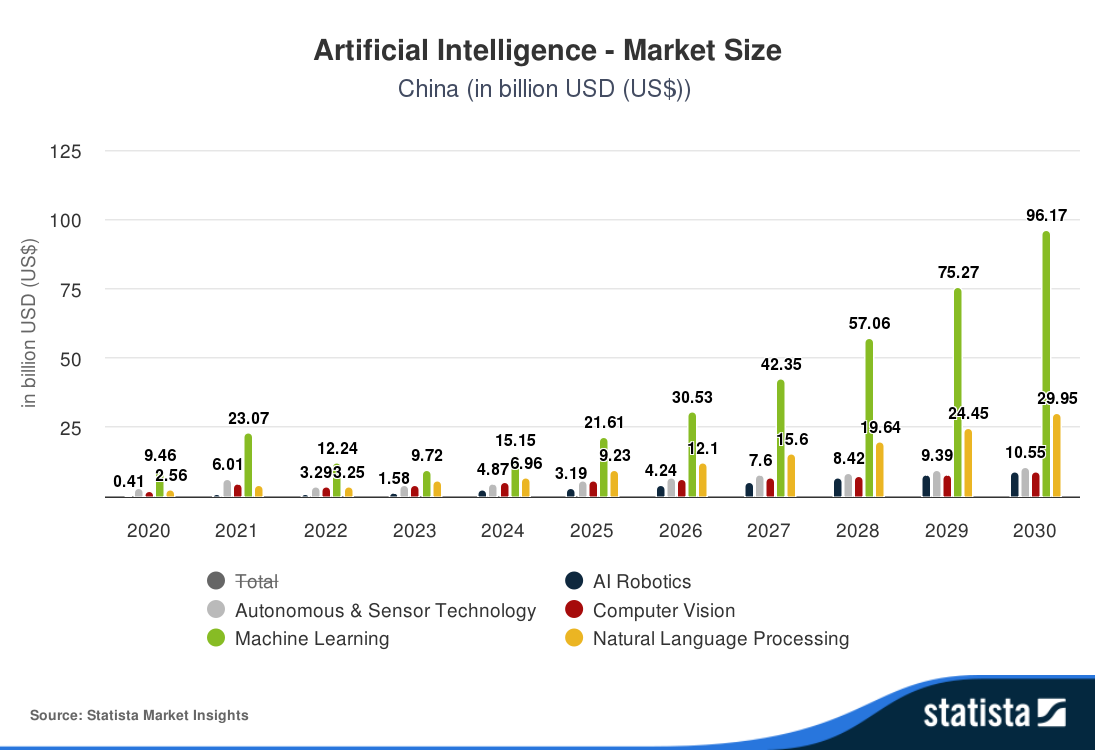
China’s AI market size (Source: Statista 2024)
China’s AI ecosystem thrives on a blend of infrastructure, data, talent, and innovation, essential for scaling AI applications. Investments in 5G networks and energy-efficient data centers support the high computing power needed for large-scale model training [8]. With over 700 million internet users, China has a wealth of data to fuel AI algorithms, complemented by fewer privacy laws, granting broad access to consumer data for AI development [13].
Furthermore, China has strategically cemented its role as a powerhouse in the global AI arena by leveraging substantial investments, forward-thinking policies, and a distinctive innovation strategy [7][8][9]. The country’s approach is deeply rooted in government-backed AI initiatives, an industrial AI roadmap, and a robust strategy for AI resource development [10]. No longer operating on the fringes of AI progress, China has steadily transitioned from an emerging player to a central force shaping the future of artificial intelligence [9].
Notably, within this ecosystem, Chinese AI startups like Zhipu AI, Baichuan AI, Moonshot AI, and Minimax are at the forefront of revolutionizing AI, particularly in the realm of generative technologies. These companies are driving cutting-edge advancements and pushing the limits of what’s possible in AI innovation [10]. Additionally, Tencent’s Hunyuan-Large model has surged ahead of Meta’s Llama 3.1 across various benchmarks, highlighting China’s growing prowess in AI and its ability to compete at the highest level globally, even in the face of hardware limitations [7]. Last but not least, the Chinese startup DeepSeek has recently made waves in the AI race with its highly efficient, open-source models like the DeepSeek R1, challenging industry giants like OpenAI and pushing the boundaries of what’s possible with resource-conscious innovation [7][11].
2.2. What Is Contributing To The Development Of China’s AI Innovation

Chinese government’s focus on AI development (Source: Internet)
China isn’t just supporting AI, it’s engineering the future. The government plays a crucial role in fueling innovation, particularly in underdeveloped regions, by nurturing high-potential startups and strengthening ties with top institutions like Tsinghua University. Through ambitious initiatives like “AI+” and the “Next Generation Artificial Intelligence Development Plan,” China is making massive investments in big data and AI research. Launched in 2017, this strategy sets a bold vision: to establish China as a global AI powerhouse by 2030. By blending long-term planning with flexible regulations, the country is accelerating AI development while ensuring a balance between innovation and safety—reshaping the global tech landscape in the process [8][10][12][13].
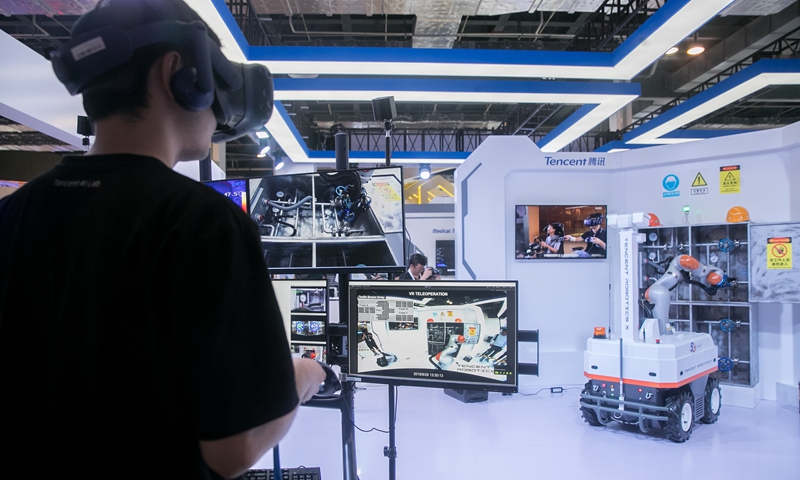
China’s focus on industry-specific applications (Source: Internet)
On the other hand, China is not just advancing general-purpose AI but is strategically focusing on industry-specific applications, particularly in finance and healthcare, where AI’s impact is most tangible. In finance, AI is transforming risk assessment, fraud detection, algorithmic trading, and personalized banking services, enabling institutions to operate more efficiently and securely. Meanwhile, in healthcare, AI is revolutionizing medical diagnostics, drug discovery, and patient care management, enhancing both accessibility and accuracy in treatment. This targeted approach ensures that AI adoption is not just about technological advancement but about delivering real-world solutions that drive productivity, reduce costs, and create sustainable competitive advantages in key sectors [14]. Not only so, the government’s “AI Plus” initiative also boosts the development of industry-specific innovations, while AI is transforming key sectors—optimizing manufacturing, enhancing healthcare systems, and advancing autonomous driving. Additionally, China emphasizes cross-disciplinary fusion, integrating AI with technologies like 5G and robotics to amplify its impact. With the growing energy demands of AI, the country is prioritizing sustainable energy solutions and developing greener data infrastructures to minimize environmental impact [8][15][16][17].

New wave of China AI startups (Source: Internet)
Furthermore, unlike earlier Chinese AI firms centered on facial recognition, a new wave of startups is reshaping the landscape—pushing boundaries in generative AI instead of simply replicating existing tech. ModelBest, for example, is leading the charge with efficient small language models designed for on-device processing, enhancing privacy while significantly cutting costs. These innovators are not just following trends; they’re rewriting the AI playbook [10]. These startups are reshaping industries by prioritizing practical, cost-effective AI solutions tailored for both domestic and global markets. Their focus extends beyond cutting-edge innovation to real-world applications that enhance efficiency, automation, and scalability across key sectors like manufacturing, healthcare, and education [8][11]. For example, Zhipu AI partners with local governments and state-owned enterprises to automate tasks such as form-filling and financial report analysis [11]. However, to stand out as the AI race intensifies, smaller innovators like Minimax and Moonshot are carving out specialized niches, focusing on high-impact applications or cutting-edge research areas. This strategic focus allows them to stay competitive alongside industry giants like Alibaba and ByteDance, not by outscaling them, but by offering targeted, high-value AI solutions that larger firms may overlook. Meanwhile, startups like DeepSeek and ModelBest are shifting their approach—moving beyond foundational model training to focus on building consumer-facing applications on top of existing models. By leveraging pre-trained AI, they cut costs, accelerate development, and deliver practical, scalable solutions tailored for real-world use. This approach not only democratizes AI adoption but also makes innovation more accessible and impactful, solidifying China’s position as a global AI powerhouse [18].
Overall, China’s AI boom is driven by strong government backing, industry-focused applications, and cutting-edge startups moving beyond replication. Initiatives like “AI+” and the “Next Generation AI Plan” fuel innovation, while AI integration with 5G, robotics, and sustainable infrastructure accelerates growth. Unlike earlier firms, new startups like ModelBest and Zhipu AI prioritize practical, cost-effective AI solutions in finance, healthcare, and manufacturing. Furthermore, the arrival of Deepseek signals a major shift, positioning China to challenge U.S. dominance in AI. By developing foundational models and scalable applications, Deepseek and its peers are setting new global benchmarks, reshaping AI’s trajectory, and influencing Western institutions.
3. WHO IS DEEPSEEK?
3.1. Background
Who is DeepSeek? (Source: Internet)
DeepSeek was founded in late 2023 by Liang Wenfeng, a seasoned entrepreneur and co-founder of the Chinese hedge fund High-Flyer [19][20]. The company is headquartered in Hangzhou, Zhejiang, and originated from High-Flyer’s strategic vision of integrating artificial intelligence into quantitative stock trading [19][20]. Unlike the U.S. AI firms’ reliant on consumer tech revenue, DeepSeek was funded directly through High-Flyer’s trading profits, enabling independent AI research [20]. In early 2025, the company launched its first AI model, DeepSeek-R1, developed with a cost-efficient approach using fewer computing resources than its American counterparts [19][21]. This approach allowed DeepSeek to operate independently without the need for venture capital or external investments, enabling the company to focus purely on advancing AI research and development [19][21].
By early 2025, DeepSeek had launched its first large-scale AI model, DeepSeek-R1, designed with a cost-efficient architecture that required significantly fewer computational resources than its American competitors. This efficiency was achieved through optimized training techniques, specialized hardware configurations, and proprietary model compression strategies. Unlike the closed-source approach taken by leading Western AI firms such as OpenAI, Google DeepMind, and Anthropic, DeepSeek took a bold step by open-sourcing its models under the MIT License. This move not only fostered global accessibility and collaboration but also positioned DeepSeek as a disruptive force in the AI industry, challenging U.S. dominance in large language models (LLMs) and foundation AI research [19][21][22].
DeepSeek’s rapid rise has drawn global attention, particularly as China continues to prioritize AI as a strategic industry. The company’s unique approach—combining financial backing from High-Flyer, resource-efficient AI training, and open-source accessibility—has sparked discussions about the future of AI leadership, with some analysts viewing DeepSeek as a potential game-changer in the evolving AI landscape [19][21][22].
3.2. Differences Compared to America’s OpenAI
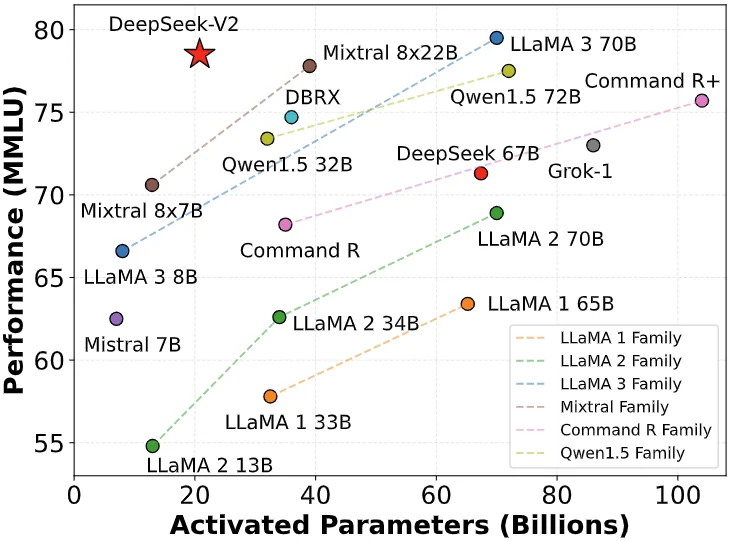
DeepSeek’s economical training and efficient inference (Source: Cornell University)
DeepSeek distinguishes itself through its emphasis on real-time learning and the integration of a Mixture-of-Experts (MoE) architecture, a design that enhances computational efficiency by dynamically activating only the most relevant model components for each task. This approach allows DeepSeek to allocate resources more effectively, reducing unnecessary processing power while maintaining high performance. Additionally, the model is trained on hybrid datasets, incorporating a mix of general knowledge and domain-specific data, making it particularly well-suited for specialized industries such as healthcare and finance, where precision and contextual understanding are critical [23][24][26]. In contrast, OpenAI has built its reputation on developing large-scale natural language processing (NLP) models, most notably the GPT series. These models are trained on massive and diverse datasets, equipping them with broad linguistic capabilities that excel in conversational AI, creative content generation, and code assistance. OpenAI’s approach prioritizes versatility and adaptability, enabling its models to engage in sophisticated dialogues, generate human-like text, and assist with programming tasks. While both DeepSeek and OpenAI are pushing the boundaries of AI innovation, their strategic focuses diverge—DeepSeek optimizes for efficiency and domain-specific intelligence, while OpenAI aims for scale and general-purpose fluency in AI-driven interactions [23][25].
Regarding its performance and applicability, DeepSeek stands out for its high contextual accuracy, driven by its real-time learning capabilities, which enable it to continuously adapt to new information and evolving data patterns. This makes it particularly valuable in dynamic environments where up-to-the-minute insights are crucial, such as business intelligence, process automation, and advanced data analytics. By leveraging its ability to process fresh, contextually relevant data, DeepSeek is an excellent choice for organizations that require AI-powered decision-making, predictive modeling, and workflow optimization in rapidly changing industries [23][24]. On the other hand, OpenAI’s models are fine-tuned for natural language fluency, making them exceptional at conversational AI, creative writing, chatbot development, and programming assistance. Designed to produce polished, coherent, and structured outputs, OpenAI’s models are widely used in enterprises that prioritize customer engagement, content creation, and AI-powered software development. Whether generating sophisticated narratives, assisting with coding tasks, or enhancing user interactions, OpenAI’s technology excels in delivering intuitive, human-like communication tailored for diverse applications across businesses and creative industries [23][25].
DeepSeek takes a fully open-source approach, offering developers unrestricted access to its models, allowing them to customize and adapt the technology to their specific needs. This transparent model fosters a culture of collaboration and innovation, enabling a wide range of users—from startups to academic researchers—to leverage the power of AI without heavy financial barriers. Additionally, DeepSeek’s flexible pricing structure ensures that smaller organizations can engage with its technology, making it accessible to those who may not have extensive budgets but still require cutting-edge AI capabilities [26][27]. In contrast, OpenAI’s models are proprietary and accessible primarily through paid APIs and commercial partnerships, meaning that only entities with the financial resources to invest in such services can fully benefit from the technology. While this closed-source approach allows OpenAI to prioritize safety, security, and ethical considerations, it also creates a barrier to entry for smaller companies and independent developers. The controlled access ensures that the use of the technology is closely monitored and managed but limits the democratization of AI for those who are unable to meet the cost requirements [26][27].
Overall, although its performance hasn’t bypassed OpenAI’s yet, DeepSeek still stands out for its cost-effectiveness, versatility, and openness, offering a compelling solution for developers and industries in need of tailored AI capabilities. Its adaptability allows it to be easily customized for a variety of use cases, from specialized business intelligence tools to dynamic data-driven applications. The company’s transparent, open-source model encourages a spirit of collaboration and innovation, empowering users to tweak and enhance the technology to meet specific needs without the constraints of expensive proprietary systems. As a result, DeepSeek has become a highly attractive choice for organizations and developers looking for affordable, flexible, and performance-driven AI solutions that can be precisely aligned with their unique goals.
3.3. The Implementation Gap of Deepseek
Though Deepseek’s significant strides in reducing computational costs through innovations like mixed-precision computation and sparsity techniques have allowed it to perform efficiently even with limited resources [28], there are definitely implementation gaps within its cybersecurity, regulatory compliances, and integrations.
Cybersecurity Risks
DeepSeek, an open-source AI project originating from China, has raised significant concerns related to data security, particularly in Western nations. These concerns are intensified by the ongoing geopolitical tensions and historical issues surrounding espionage between China and Western countries. The open-source nature of DeepSeek, while encouraging innovation and accessibility, presents a heightened risk of security vulnerabilities, as it could potentially be exploited for malicious purposes [29][30].
One of the primary fears associated with DeepSeek is the possibility of hidden “backdoors” embedded in the AI model. These backdoors could serve as entry points for cyber-attacks, enabling unauthorized access to sensitive data or systems. Experts also worry about the presence of “sleeper agents”—code designed to remain dormant until activated under certain conditions, posing unpredictable threats to security. Such vulnerabilities could lead to remote code execution, where attackers gain the ability to run unauthorized commands on vulnerable systems [30].
In addition to these technical risks, DeepSeek’s Chinese origin amplifies concerns over data privacy, government surveillance, and potential influence from Chinese authorities. Its open-source nature, combined with geopolitical tensions, makes it vulnerable to both technical exploitation and political scrutiny, causing hesitation in adoption, particularly in data-sensitive industries [29][30].
Regulatory Compliances
According to the European Union, DeepSeek models have significant cybersecurity vulnerabilities, including risks of goal hijacking and prompt leakage, raising concerns under the EU AI Act. They also exhibit higher bias than their base models, which challenges compliance with the Act’s fairness and transparency requirements [31][32]. Additionally, EU regulators are investigating potential GDPR violations, as DeepSeek processes EU residents’ data but claims GDPR does not apply to it [33].
Furthermore, DeepSeek is facing increasing global restrictions due to concerns over data privacy, security, and regulatory compliance. Italy’s data protection authority, Garante, has mandated its removal from Italian app stores, citing inadequate privacy policy information and non-compliance with GDPR requirements [33]. Similarly, Australia has banned DeepSeek from federal government systems due to security risks and potential threats to national sovereignty, following a major data breach that exposed user prompts and API keys [34]. In India, the government has issued warnings over data protection concerns but plans to host the AI model on local servers to enhance security and maintain control over sensitive data [35]. These growing restrictions highlight the heightened regulatory scrutiny surrounding DeepSeek and its challenges in meeting global data protection standards.
>>> Xem thêm: Khai thác tiềm năng đổi mới sáng tạo xanh trong khu vực công: Lợi ích, thách thức và bài học cho doanh nghiệp Việt
Integration Challenges
Although DeepSeek is highly efficient, its integration into existing business operations poses challenges due to its distinct architecture and lower user-friendliness when compared to more established models like Google’s Gemini. The differences in design and functionality make it harder for businesses to adopt and smoothly incorporate DeepSeek into their workflows [29][36].
Furthermore, while DeepSeek excels in AI reasoning, utilizing its capabilities through APIs can be a complex process. This adds an extra layer of difficulty for developers, hindering the seamless integration of DeepSeek into a variety of applications. As a result, businesses may face obstacles in fully leveraging its advanced AI capabilities within their systems [37].
Lastly, though DeepSeek offers a clean and intuitive interface, making it user-friendly in its simplicity, it lacks advanced features and ecosystem integration, which are present in competitors like ChatGPT and Google Gemini [38][39][40]. Thus, these features make the latter more appealing to users seeking a seamless, feature-rich experience.
3.4. Development Opportunities for DeepSeek
DeepSeek’s focus on efficiency, cost-effectiveness, and open-source collaboration presents significant opportunities for its continued development. By leveraging innovative techniques such as Mixture-of-Experts (MoE) and reinforcement learning, DeepSeek can further enhance performance while reducing computational costs, making AI more accessible and affordable for businesses across industries [41][42]. Additionally, its open-source nature fosters global collaboration, enabling startups and smaller companies to build upon DeepSeek’s platform, driving rapid innovation and broadening its adoption [43]. This openness not only democratizes access to AI but also promotes technological growth, particularly in resource-limited regions where such advancements can have a transformative impact. With a focus on sustainable AI models, DeepSeek has the potential to attract environmentally conscious investors, creating new market opportunities while addressing the growing demand for eco-friendly technology solutions.
4. CONCLUSION
In conclusion, the emergence of DeepSeek marks a pivotal moment in the AI industry, highlighting the potential for more sustainable AI development. Despite its current shortcomings, it is without a doubt that by focusing on efficiency, reducing computational costs, and integrating environmentally conscious practices, DeepSeek sets an example for how AI can be developed in a way that balances innovation with sustainability. This shift toward sustainable AI presents significant opportunities for countries like Vietnam to join the industry. With its growing tech ecosystem, Vietnam has the potential to adopt similar principles, harnessing cutting-edge AI technologies while prioritizing environmental responsibility. By leveraging DeepSeek’s open-source model and fostering local innovation, Vietnam can play a key role in the global AI landscape, contributing to a more sustainable and inclusive future for the industry.
———-
Tuan Kiet
BambuUP has a network of resources ready to support businesses seeking expertise from industry leaders in artificial intelligence to implement AI initiatives effectively.
We have partnered with leading companies such as EVN, Heineken Vietnam, FASLINK, DKSH Smollan, etc., in launching open innovation challenges. BambuUP is proud to be a trusted strategic partner, always supporting businesses in their innovation activities and strong green transition processes.
To stay updated with the latest weekly news on Green Innovation in Vietnam, you can:
SCHEDULE A 1:1 CONSULTATION SIGN UP FOR THE NEWSLETTER