📖 TABLE OF CONTENTS 📖
- 1. From “population burden” to a golden mine of growth: The moment the world reconsiders aging
- 2. Asia enters the “silver-hair era”: When the growth spotlight shifts East
- 3. The new demand landscape of older adults: Breakthrough opportunities for global businesses and startups
- 4. When governments act as ‘market architects’: Notable silver economy models worldwide
- 4.1. Japan
- 4.2. South Korea
- 4.3. China
- 4.4. Italy
- 5. Vietnam at the ‘threshold of silver’: Following welfare inertia or unlocking the silver economy?
Population aging is quietly reversing the global growth logic. When older people not only live longer but are also healthier, more independent, and possess increasingly powerful purchasing power, “old age” is no longer merely a social welfare narrative. From this shift, the Silver Economy has emerged, opening up a vast new space for innovation, investment, and long-term sustainable development.
1. From “population burden” to a golden mine of growth: The moment the world reconsiders aging
Population aging is occurring on a global scale at an unprecedented speed. World population growth is projected to decline from 1.1% per year before the Covid-19 pandemic to nearly 0% during 2080–2100, while the global median age is expected to rise by about 11 years compared to 2020 [1].
This structural demographic shift was once viewed as a “drag” on economic growth, due to a shrinking workforce and rising pressure on public budgets.
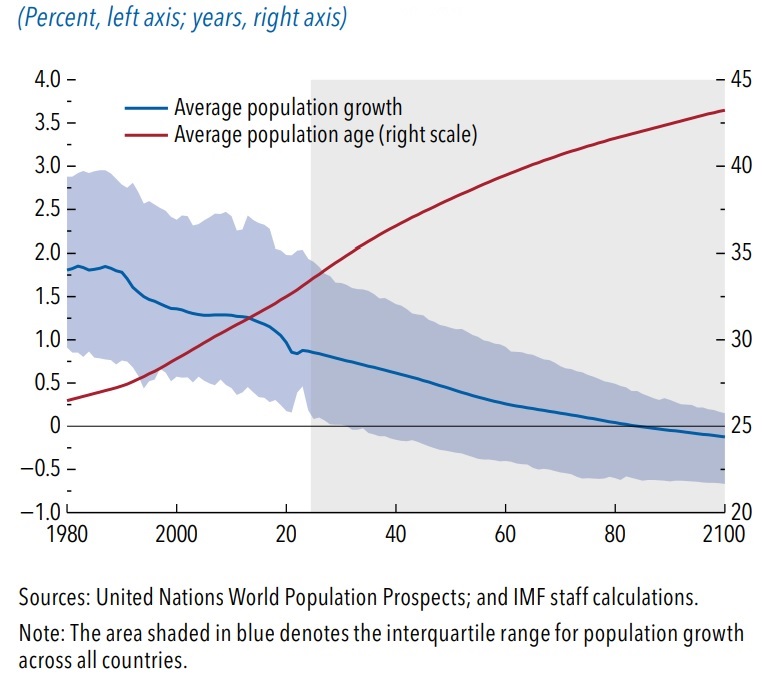
Global population growth chart 1980-2100 (Source: IMF)
However, recent analyses from the International Monetary Fund (IMF) paint a very different picture: aging is not only a challenge - it is creating an entirely new economic space: the Silver Economy.
The Silver Economy is not limited to healthcare or elderly care alone. It is a comprehensive economic ecosystem centered on older adults as active consumers, workers, and asset accumulators - encompassing healthcare, housing, retirement finance, tourism, nutrition, digital technology, lifelong learning, and flexible employment models.
In many countries, the physical and especially cognitive capabilities of people over 50 have improved markedly across generations. In fact, “a 70-year-old today is cognitively equivalent to a 50-year-old from two decades ago” [1]. This fundamentally changes the economic role of the older population.
The combination of longer lifespans, improved health, and greater asset accumulation has propelled the Silver Economy forward through market-driven consumption, rather than reliance on public subsidies.

The economic role of the elderly population is gradually changing worldwide (Source: Internet)
On a global scale, this market is projected to reach approximately $15 trillion by 2033, growing at a compound annual rate of about 5.5% from 2025-2033. Notably, this growth is driven by consumer spending, private investment, and innovative business models - not merely expanded welfare [2].
More broadly, the Silver Economy marks a fundamental shift in the global growth paradigm. As the working-age population slows, economic momentum no longer depends solely on expanding the labor force, but increasingly on effectively harnessing the purchasing power, capabilities, and economic longevity of older adults.
Aging, therefore, is no longer synonymous with economic decline, it has become a “new market frontier” where consumption, innovation, and long-term investment intersect.
2. Asia enters the “silver-hair era”: When the growth spotlight shifts East
If the Silver Economy is emerging as a new global growth engine, then Asia is its epicenter. The region currently has approximately 642 million people aged 60 and above - 3.5 times larger than Europe - and is aging at a record pace [3].
By 2040, Asia-Pacific is projected to account for nearly 60% of the world’s population aged 65 and over [16], reflecting a profound and long-term demographic transformation.
Asia, home to the world’s largest older population, is becoming the global center of the Silver Economy (Source: Internet)

According to World Data Lab, the total purchasing power of the 60+ age group in Asia is expected to surge by about 103% by 2030, reaching $8.6 trillion [3].
Additionally, Euromonitor data shows that the average gross income of consumers aged 65+ is projected to grow faster than the overall population in major Asia-Pacific markets between 2024-2040 [16].
Purchasing power of older consumers is growing rapidly in Asia-Pacific (Source: Euromonitor)

This signals the emergence of a generation of older adults with independent financial capacity, no longer primarily dependent on family support or public subsidies.
In this landscape, China plays the central role, accounting for nearly 31% of total elderly spending in the region, with its Silver Economy market expected to grow from $1.3 trillion today to $3.2 trillion by 2030.
Meanwhile, India is emerging as the fastest-growing market, projected to reach nearly $1.4 trillion by 2030 - an increase of approximately 142% [3].
Singapore also ranks among the countries with the highest potential for Silver Economy development, thanks to strong spending power from older adults (both personal savings and family support). The country’s Silver Economy is forecasted to reach $72.4 billion by 2025 [4].
In Southeast Asia, aging is accelerating rapidly: Indonesia’s population aged 60+ is expected to rise from over 29 million today to 74 million by 2050, while Thailand has officially become an aged society and is positioning healthcare and tourism for older adults as priority economic sectors.
Aging is accelerating simultaneously across Southeast Asian countries (Source: BambuUP)

In this context, Vietnam stands out as an emerging yet highly promising market. Since 2011, Vietnam has entered the aging phase and is now among the countries with the fastest aging speed in the world. In 2024, the number of people aged 60+ reached 14.2 million - a sharp increase from a decade ago - and is projected to approach 18 million by 2030 [5].
These figures demonstrate that aging is no longer a localized phenomenon but a structural trend across the entire region, laying the foundation for a clearly emerging Silver Economy market.
3. The new demand landscape of older adults: Breakthrough opportunities for global businesses and startups
Built upon this expanding demographic base and purchasing power, the Silver Economy is rapidly transforming into a concrete market with increasingly clear demand structures.
According to Euromonitor, older consumers - whose global spending is estimated at $107 trillion in 2020 [15] - are shifting strongly toward products and services that support health maintenance, simplify daily living, and extend independent self-care.
This shift reflects a fundamental change in older adults’ expectations: not just living longer, but maintaining high quality of life and autonomy throughout their lifespan.
From a market perspective, the core demands of the Silver Economy can be grouped into six main categories: nutrition, health, safety monitoring, user-friendly interfaces, convenience, and hygiene.
On this foundation, numerous high-growth segments are emerging rapidly, including remote healthcare, wearable medical devices, smart homes, rehabilitation, assistive robots, and specialized tourism.
When market demand becomes clear and sufficiently large, opportunities open up for deep-tech businesses and startups. Japan - the global leader in technology applications for aging populations - perfectly illustrates how Silver Economy needs are converted into high-tech consumer products.
From soft-food processors that retain shape and flavor for those with chewing difficulties, to AI air conditioners that automatically adjust temperature to prevent heatstroke, and smart home devices that allow family members to remotely monitor daily routines [15], Japan’s Silver Economy has evolved into a complete consumer market - far beyond traditional welfare-based care.
In this wave of innovation, Austra Vita, an Australian health-tech startup co-created and supported by BambuUP as a “venture builder,” exemplifies the global potential of technology shaping the Silver Economy. Austra Vita has developed a non-camera, non-wearable AI fall-detection and alert system that protects the privacy of older adults living independently at home.
Austra Vita develops AI-based fall detection and alert technology (Source: BambuUP)

This solution demonstrates how “invisible but essential” technologies can simultaneously address deeply human caregiving needs while creating scalable business models in the global elderly care ecosystem.
In terms of consumer behavior, older adults are considered high-value, long-term customers. They exhibit strong brand loyalty [5] and stable consumption habits with lower risk tolerance. When approached correctly, businesses not only expand their customer base but also build enduring, high-lifetime-value relationships.
At the same time, the stereotype of passive older adults is changing. In South Korea, the 55–69 age group is increasingly proficient with smartphones and physically active [6]. In Singapore, digital payment adoption among older adults surged from 38% to 78% between 2018-2022 [5], unlocking massive opportunities for digital solutions and fintech tailored to this demographic.
Smartphone proficiency among older adults is rising rapidly (Source: Internet)

For businesses and startups, the Silver Economy therefore offers not only new revenue streams but also significant social value, enabling older adults to live healthier, more independent lives while continuing to participate actively in the economy.
4. When governments act as ‘market architects’: Notable silver economy models worldwide
Many governments worldwide have recognized the economic value of aging populations and are pioneering long-term strategies.
4.1. Japan
With approximately 30% of its population aged 65 and above [6], Japan is the world’s most aged society and one of the earliest to integrate aging into national development strategy. Rather than viewing aging as a welfare burden, Japan sees it as a strategic pillar for innovation and long-term productivity.
A major policy turning point came with the 5th Science and Technology Basic Plan (2016-2020), which introduced the vision of Society 5.0 - a super-smart society driven by science, technology, and innovation [7].
Unlike previous industrial strategies focused on maximizing output, Society 5.0 aims to optimize quality of life in a deeply aged society.
Digital technologies - from AI, IoT, robotics to big data - are used to connect physical and digital spaces, redesigning services for older adults: continuous healthcare, daily living assistance, personalized public services, and consumption tailored to the life cycle [8].
The Japanese government’s vision of “Society 5.0 - a super-smart society” to adapt to deep aging (Source: Internet)

A core policy focus is supporting older adults to age in place within familiar communities, rather than relying on centralized care facilities.
Japan has heavily invested in age-friendly housing, independent living technologies, remote health monitoring, and revitalizing aging suburban neighborhoods where traditional commerce and healthcare are declining. This approach simultaneously reduces pressure on long-term care systems and creates large markets for multi-sector businesses.
To realize this vision, Japan emphasizes triple-helix collaboration between government, industry, and academia, along with institutional reforms to promote open innovation. The state acts as the “ecosystem architect”: setting priorities, funding R&D, standardizing platforms, and creating sandboxes for social experimentation, while the private sector handles commercialization and scaling [7].
As a result, Japan’s Silver Economy is not merely a response to aging - it has become a long-term socio-economic development strategy in the era of 100-year lifespans, offering highly valuable lessons for rapidly aging countries like Vietnam.
4.2. South Korea
Like Japan, South Korea is entering super-aged society status, with over 20% of its population aged 65+ as of 2024, creating immense pressure on labor markets, pension systems, and public spending.
In response, the Korean government approaches the Silver Economy not as a standalone sector but as an integral component of long-term socio-economic stability. Priorities include expanding social security, pension reform, increasing labor participation among older adults and women, and piloting immigration solutions to offset labor shortages.
On labor, South Korea has raised the minimum retirement age to 60, introduced performance-based pay systems, and launched subsidies for companies rehiring workers aged 60+.
The government also promotes tripartite dialogue among the state, employers, and unions to gradually raise the effective retirement age to 65. The goal is to retain older workers in more flexible roles such as part-time, consulting, training, or less physically demanding positions rich in experience [9].
Alongside labor policy, South Korea has built a multi-pillar pension and elderly finance system - combining national pensions, corporate pensions, individual retirement products, and innovative models such as housing pensions - to ensure stable income and maintain older adults’ purchasing power.
South Korea builds a multi-pillar pension and elderly finance system amid its transition into super-aged society (Source: Internet)

A standout initiative is Long-Term Care Insurance (LTCI), launched in 2008, which has become the foundation for the elderly care services market. Services are allocated based on a standardized 52-criterion assessment system, enabling cost control and creating a transparent environment for private and social organizations to participate.
Since 2018, South Korea has aggressively promoted the “Comprehensive Community Care” model, integrating healthcare, welfare, and long-term care at the community level with participation from local governments, social organizations, and businesses [10]. This approach reduces reliance on centralized facilities while activating local service ecosystems.
Despite cultural barriers such as rigid corporate hierarchies, traditional gender roles, and uneven welfare distribution, current reforms are expected to lay the foundation for a sustainable Silver Economy ecosystem - reducing social burdens while expanding new markets in the long term [11].
4.3. China
In 2024, China had approximately 220 million people aged 65+, accounting for 15.6% of the population, and is projected to enter super-aged society around 2034. In this context, the Chinese government is shifting its policy mindset: from “compensating for the costs of aging” to harnessing the purchasing power, service demands, and economic role of older adults.
A major milestone was the issuance of the “Opinions on Developing the Silver Economy and Improving the Well-being of the Elderly” in January 2024 - the first national-level document dedicated to the Silver Economy. It aims to upgrade the entire value chain - from products, services, and infrastructure to financial models - to build a “multi-layered, diverse, and high-quality” Silver Economy market [12].
Alongside sectoral policies, China views pension finance as a critical lever to activate the market. At the 2023 Central Financial Work Conference, pension finance was listed among the five major priorities of the financial system, alongside technology, green finance, and inclusive finance.
China views pension finance as a key lever to activate the Silver Economy market (Source: Internet)

The state is accelerating the completion of a three-pillar pension system, with the third pillar (individual pensions) rolled out nationwide from late 2024, allowing citizens to invest in banks, insurance, and funds.
Tools such as preferential credit, government guidance funds, long-term care insurance (LTCI), and infrastructure REITs for elderly care are being used to mobilize private capital into underfunded Silver Economy sectors [12].
At the local level, China encourages flexible policy experimentation: tax incentives for Silver Economy businesses, subsidies for home retrofitting, public-private partnerships in elderly care facilities, and integrated community-based healthcare, care, and welfare services.
4.4. Italy
Italy is one of Europe’s fastest and deepest aging societies, with the proportion of people aged 65+ projected to rise from 25.1% in 2025 to 36.7% by 2075 [6].
In response, the Italian government has adopted a balanced approach between social protection and market development, with three core pillars: pension system reform, promotion of active aging, and support for businesses developing products suited to older adults [13].
On social protection, Italy has built three parallel layers: national pensions, a Guaranteed Minimum Pension, and social assistance programs such as shopping vouchers for low-income seniors aged 65+.
This approach aims to maintain a minimum standard of living while creating a financial foundation for older adults to remain economically and socially active.
Italy has established a three-pillar social protection system to maintain a minimum living standard and provide a financial foundation for the elderly (Source: Internet)

Alongside social protection, the government has invested significantly in home-based care solutions through programs such as Active and Assisted Living (AAL) and the Smart Specialization Strategy (SNSI).
These programs enable businesses and research institutions to develop ICT solutions for elderly care, health monitoring, and daily living support - thereby expanding the market for home-care technology and related services [13].
At the regional level, at least 10 Italian regions have enacted specific laws on active aging, accompanied by initiatives in vocational training, sports, tourism, and social participation for older adults. Nationally, the government funds research on long-term social protection modeling to ensure fiscal sustainability amid changing demographics and employment patterns [13].
During 2021–2027, a large portion of Italy’s EU Recovery and Resilience Facility budget has been allocated to these programs. At the same time, pension reforms have helped raise the effective retirement age and reduce fiscal pressure, while long-term care spending is projected to rise from 1.9% to 2.7% of GDP by 2070 [14].
5. Vietnam at the ‘threshold of silver’: Following welfare inertia or unlocking the silver economy?
The development of Vietnam’s Silver Economy requires a coordinated approach among the state, businesses, and society - moving beyond fragmented, short-term welfare policies.
In recent years, the government has begun to recognize this need by emphasizing the importance of completing institutional frameworks to pave the way for the Silver Economy, including removing bottlenecks related to land, taxation, and investment to encourage businesses to participate in services for older adults [8].
At the policy level, recent academic and practical discussions have laid important groundwork, highlighted by the first national-level scientific conference on the Silver Economy - the “Silver Economy in Vietnam in the New Era” workshop held in November 2025.
The conference called for the development of a National Silver Economy Strategy, with specific targets on GDP contribution, development of age-friendly urban and healthcare infrastructure, and flexible labor policies, skills retraining for older workers, and tax/investment incentives for businesses serving this demographic.
However, to achieve real transformation, Vietnam must move from piecemeal directives to a comprehensive, integrated policy on older adults aligned with broader economic development goals. This policy should prioritize key areas such as geriatric medicine, long-term care, therapeutic tourism, and independent living support services, while introducing appropriate financial instruments to stimulate private investment and innovation.
In the long term, the greatest challenge lies not only in resources but in a fundamental shift in development mindset. Vietnam must move from viewing older adults as “objects of care” to recognizing them as a valuable social resource rich in experience, knowledge, and purchasing power.
This requires a change in policy design: from passive care to empowerment, enabling older adults to participate actively in consumption, flexible employment, lifelong learning, and community engagement. Only when older adults are treated as economic agents can the Silver Economy truly develop on market-driven momentum, rather than relying primarily on public budgets.
At the enterprise level, early signals indicate that Vietnam’s Silver Economy ecosystem is gradually forming. Banks, insurance companies, healthcare providers, real estate developers, and tech firms are beginning to see long-term growth opportunities from older customers and are actively seeking innovative solutions from startups and social organizations.
However, the market remains in its early stages and requires clearer incentives - tax breaks, credit support, policy sandboxes, and public-private partnerships - to encourage bolder investment, product development, and business models tailored to the diverse needs of Vietnam’s older population.
-----------
Phượng Lê
BambuUP is an one-stop open innovation platform to facilitate meaningful connection between Innovation Seekers & Innovation Providers.
We have partnered with leading companies across multiple industries, such as Shinhan, EVN, Heineken Vietnam, FASLINK, DKSH, Smollan, Talentnet, and others, to launch open innovation challenges and connect suitable technology solutions to the operational needs of enterprises and corporations.
BambuUP is proud to be a trusted strategic partner, consistently supporting businesses in their innovation initiatives and driving strong green transformation efforts.
To stay updated with the latest weekly news on Innovation and Green Transformation in Vietnam and globally, you can:


