📖 TABLE OF CONTENTS 📖
- “What’s next?”: Being the Managing Director of a Global market research Giant wasn’t the final destination
- Innovation: It doesn’t have to be a revolution
- From Closed innovation to Open innovation: When internal strength is no longer the ‘ultimate weapon’
- The Open Innovation Platform: The bridge connecting corporations and startups
In 2020, 70-80% of global companies’ innovation came from inside their own organizations. By 2025, that ratio completely flipped. The right approach isn’t to do everything yourself or outsource everything - it’s about opening the doors at the right moment, with the right solutions, and the right partners.
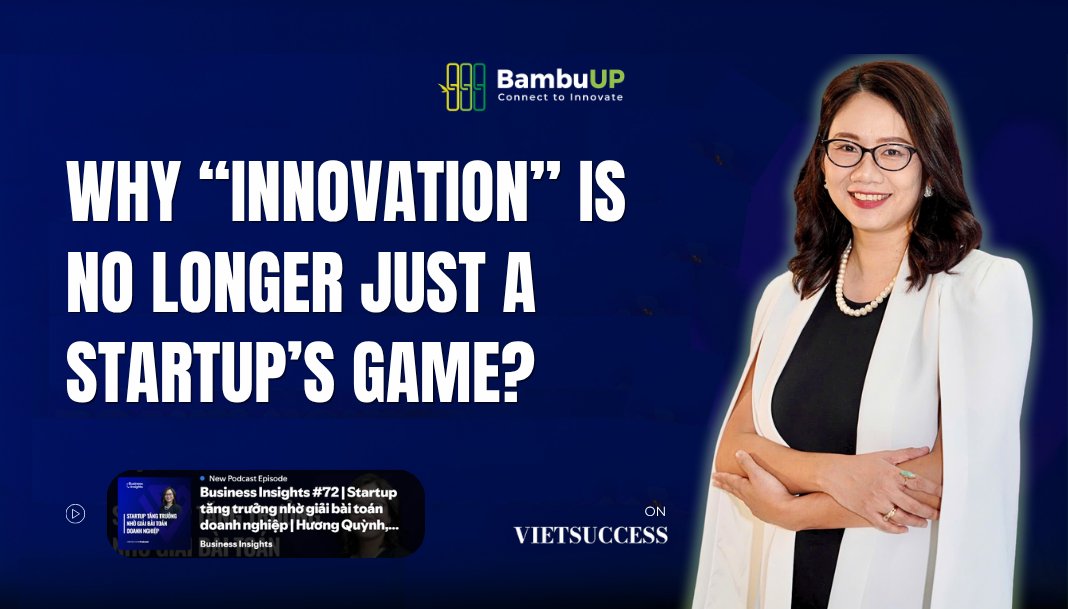
In an exclusive interview with Vietsuccess, Ms. Nguyễn Hương Quỳnh, CEO of BambuUP and former General Director of Nielsen Vietnam & Cambodia, shared candidly about her journey from leading a global corporation to building an entirely new model for Vietnam’s innovation ecosystem.
“What’s next?”: Being the Managing Director of a Global market research Giant wasn’t the final destination
Host: From your high-level leadership role at a global corporation, what drove you to step into the world of innovation and entrepreneurship?
Ms. Nguyễn Hương Quỳnh: My background is in market research, a field that trained me to constantly ask, “What’s next?” for businesses, for markets, and for myself.
As I watched technology accelerate at breakneck speed, I noticed a paradox: while technology was speeding up, many large corporations were actually slowing down because of their heavy internal optimization processes.
This raised a big question - does the traditional growth model still work in today’s environment?
On a personal level, “What’s next?” wasn’t just about career advancement. It became a question of relevance and the value I could create for society in the future. That’s what pushed me to leave my comfort zone and dive into the innovation ecosystem.
Ms. Quỳnh constantly asks, “What’s next?” - for businesses, for the market, and for herself

Innovation: It doesn’t have to be a revolution
Host: In your view, what does “innovation” really mean? The term is used everywhere, but people interpret it in very different ways.
Ms. Nguyễn Hương Quỳnh: Interestingly, when the term “innovation” first appeared in the 15th-16th centuries, it had nothing to do with technology. It showed up in legal documents and even carried a negative meaning, associated with rebels, heretics, and people who refused to follow the established order.
It wasn’t until the late 18th-19th centuries that the word became linked to science and technology and took on the meaning we recognize today. For something to truly qualify as innovation, it needs three elements: a new idea, actual implementation, and the creation of new value for the business or its customers. If any one of those is missing, it’s not innovation.
Equally important, many people assume innovation must be something groundbreaking or earth-shattering. That’s not true. There are three levels:
Level 1 – Incremental Innovation (Continuous Improvement): This accounts for 70-80% of all innovation activity in every company. Don’t dismiss it just because it sounds “small.” A foldable phone is incremental innovation, new features that are better and more convenient, but don’t overturn the market.
Level 2 – Breakthrough Innovation: Moving from a keypad phone to a touchscreen is breakthrough innovation. It significantly changes user behavior and opens up new business models, but it doesn’t completely destroy the entire industry.
Level 3 – Disruptive Innovation: The shift from landline rotary phones to mobile phones is disruptive innovation. It wiped out the old business model and gave birth to an entirely new industry.
Even the world’s top corporations allocate about 70% of their innovation budget to incremental innovation, 20% to breakthrough, and only 10% to disruptive research, because disruptive projects often take many years and have no guaranteed timeline for results.
This is a useful benchmark for Vietnamese companies when planning their innovation strategies.
From Closed innovation to Open innovation: When internal strength is no longer the ‘ultimate weapon’
Host: So, what is Open Innovation?
Ms. Nguyễn Hương Quỳnh: In the past, when companies talked about innovation, most thought: “I have an R&D department, I have talented people - they’ll come up with new ideas.” In other words, we closed the doors and relied primarily on internal resources. That’s called closed innovation.
Open innovation means opening the doors, welcoming ideas from outside, and being ready to collaborate with partners to co-design and co-create new solutions and new value.
The statistics are striking: In 2020, roughly 70-80% of companies’ innovation came from inside. By 2025, that has completely reversed: 70-80% now comes from outside. This isn’t just a trend; it’s inevitable.
When a company masters the right way to innovate, it can increase labor productivity and the speed of innovation rollout by at least 3 times, while reducing investment costs by 20-30%.
Open innovation is not just a trend; it’s a survival strategy

The Open Innovation Platform: The bridge connecting corporations and startups
Host: Open Innovation is already very common worldwide, but it’s still quite new in Vietnam. When implementing this model here, what differences do you see compared to existing platforms?
Ms. Nguyễn Hương Quỳnh: When I researched open innovation platforms around the world, I noticed a clear gap: most of them focus primarily on connecting startups with investors.
In other words, the main emphasis is on funding to help startups scale faster. However, the core challenge for a startup isn’t just money. To survive and grow sustainably, they need real customers and real markets.
And who are those customers? They are precisely the corporations and enterprises operating out there today. That’s the real demand side - the place where innovative solutions can be tested, implemented, and create lasting value.
In Vietnam, with nearly one million active enterprises, the need for innovation is constant and increasingly urgent. This creates an enormous market, not only for innovation itself, but also for the sustainable development of startups.
The question is: how do we bring these two sides together effectively? How can corporations find the right solutions, and startups reach the right customers?
That’s why, when we built the Open Innovation Platform, we took a different approach. It can’t just be a funding channel. It must be a “three-legged stool” made up of enterprises, startups, and the connecting platform.
BambuUP is that bridge - connecting corporations and enterprises with startups to create a stable 3-legged foundation for the entire innovation ecosystem.

In this model:
- Enterprises are the demand creators
- Startups are the solution providers
- The platform acts as the catalyst that brings the two sides together, helps them collaborate, and co-create value
Only when these three elements work together does Open Innovation truly deliver results, helping both sides not just “meet,” but actually “get things done together” and deliver solutions that directly serve the real needs of businesses.
So, what are the most common forms of co-creation in the market today?
We invite businesses to read the next article in the series: Episode 2 – “5 Co-Creation models and the language gap between startups & corporations.”
Because in reality, it’s already difficult for startups and corporations to find each other, but working effectively together is even harder. One side operates on quarterly rhythms, formal processes, and risk control; the other moves hour by hour, prioritizing speed and experimentation.
Follow BambuUP for more practical, real-world insights on innovation - designed for enterprises and corporations seeking transformation, and for startups looking for the right door to walk through.
—-----------
Phượng Lê
BambuUP is an one-stop open innovation platform to facilitate meaningful connection between Innovation Seekers & Innovation Providers.
We have partnered with leading companies across multiple industries, such as Shinhan, EVN, Heineken Vietnam, FASLINK, DKSH, Smollan, Talentnet, and others, to launch open innovation challenges and connect suitable technology solutions to the operational needs of enterprises and corporations.
BambuUP is proud to be a trusted strategic partner, consistently supporting businesses in their innovation initiatives and driving strong green transformation efforts.
To stay updated with the latest weekly news on Innovation and Green Transformation in Vietnam and globally, you can:
