
 One platform connecting startups, corporations, research institutions, regions and investors












 Playbook & Handbook · February 6, 2026
Winning Accelerator Playbook 2026 by BambuUP
 RETAIL E-COMMERCE: AI AND REAL-TIME DATA ARE TRANSFORMING HOW RETAIL BUSINESSES OPERATE

RETAIL E-COMMERCE: AI AND REAL-TIME DATA ARE TRANSFORMING HOW RETAIL BUSINESSES OPERATE
While e-commerce platforms leverage real-time data to optimize business operations, many physical stores still face challenges in inventory management, loss prevention, and customer behavior analysis. To address these challenges, Retail Tech startups are integrating AI in retail with sensor technologies and real-time data analytics to improve operational efficiency, personalize shopping experiences, and drive corporate innovation.
Retail E-commerce platforms can track individual website visits, orders, and customer purchasing behavior almost instantly. Meanwhile, many physical stores still struggle to accurately locate products, control inventory losses, and turn customer data into timely business decisions.
According to figures cited by RADAR in its 2026 announcement, approximately 80% of global commerce still takes place in physical stores, highlighting the potential for technology to improve data management and operational visibility in traditional retail (Source: Business Wire). Retail Tech startups are on their way to developing smart solutions that combine artificial intelligence (AI), sensors, and real-time data processing technologies to help businesses manage inventory, reduce product losses, optimize ordering, and personalize customer experiences. These innovations are opening up new opportunities, enabling businesses to use real-time data to optimize in-store operations.
RADAR: REAL-TIME INVENTORY TRACKING WITH RFID SENSORS
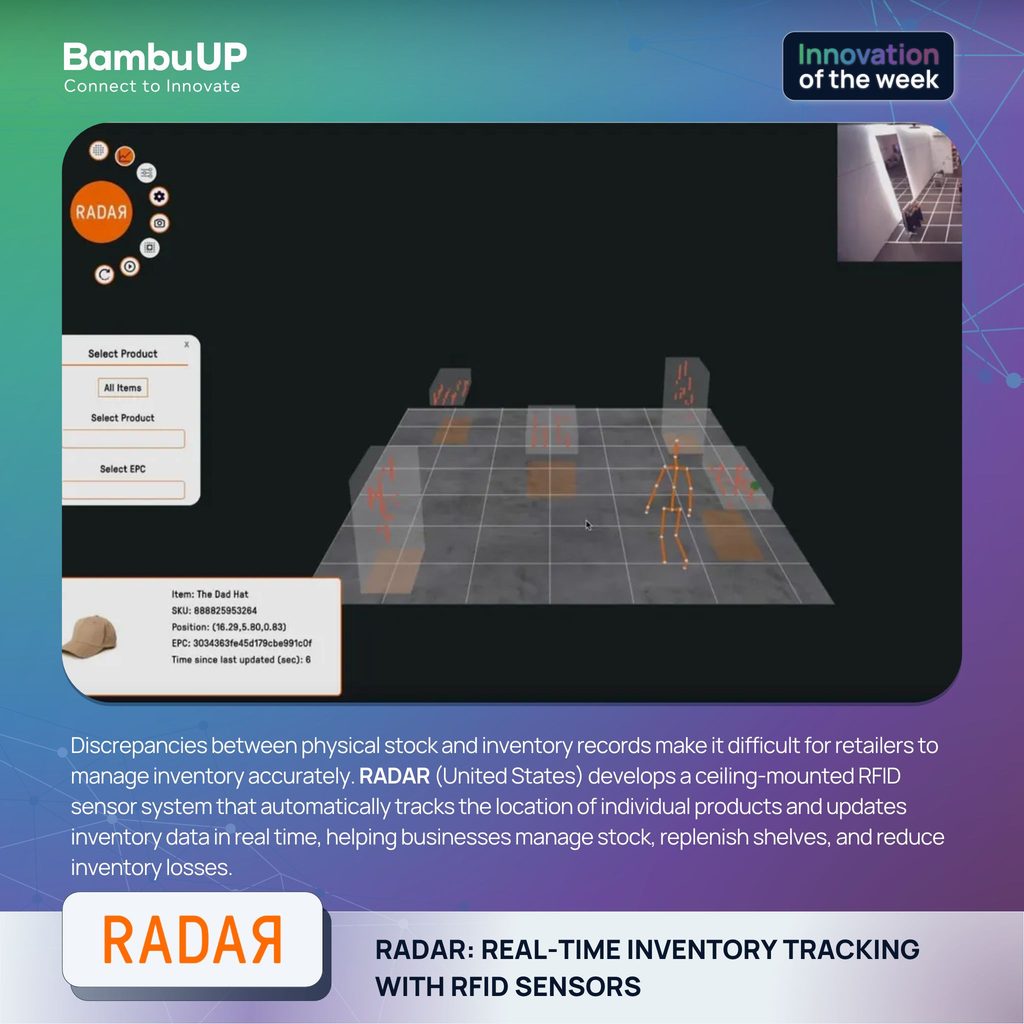
One of the key challenges in traditional retail is the discrepancy between inventory records and actual stock levels. Products may remain in storage without being displayed on shelves, while employees spend significant time manually counting or locating items to fulfill online orders.
RADAR (United States) develops a system combining ceiling-mounted sensors, software, and data analytics to track product locations in real time. The technology uses RFID (Radio Frequency Identification) to read signals from tags attached to individual products, identifying whether items are located on the sales floor, in storage areas, or in fitting rooms (Source: Business Wire).
RADAR’s key differentiator is its ability to automatically update inventory data at the individual-item level, rather than relying on periodic stocktaking. According to the startup, the system can generate a complete store inventory update every eight seconds. This data is then translated into actionable insights, including restocking alerts, omnichannel order fulfillment support, loss prevention notifications, and merchandising optimization (Source: Business Wire).
In May 2026, RADAR raised $170 million in Series B funding, reaching a valuation of $1 billion. The company reported that its technology had been deployed across more than 1,400 stores, including American Eagle Outfitters and Old Navy, achieving 99% inventory accuracy. According to RADAR’s figures, the platform also processes over 100 billion item-level data events daily (Source: Business Wire).
For Vietnamese businesses, this model highlights opportunities to apply RFID technology to inventory management, particularly among fashion, footwear, and retail chains handling a large number of product SKUs. Piloting the technology in selected stores could help businesses evaluate its effectiveness in reducing inventory discrepancies before scaling across their networks.
EDGIFY: USING EDGE AI TO REDUCE IN-STORE LOSSES
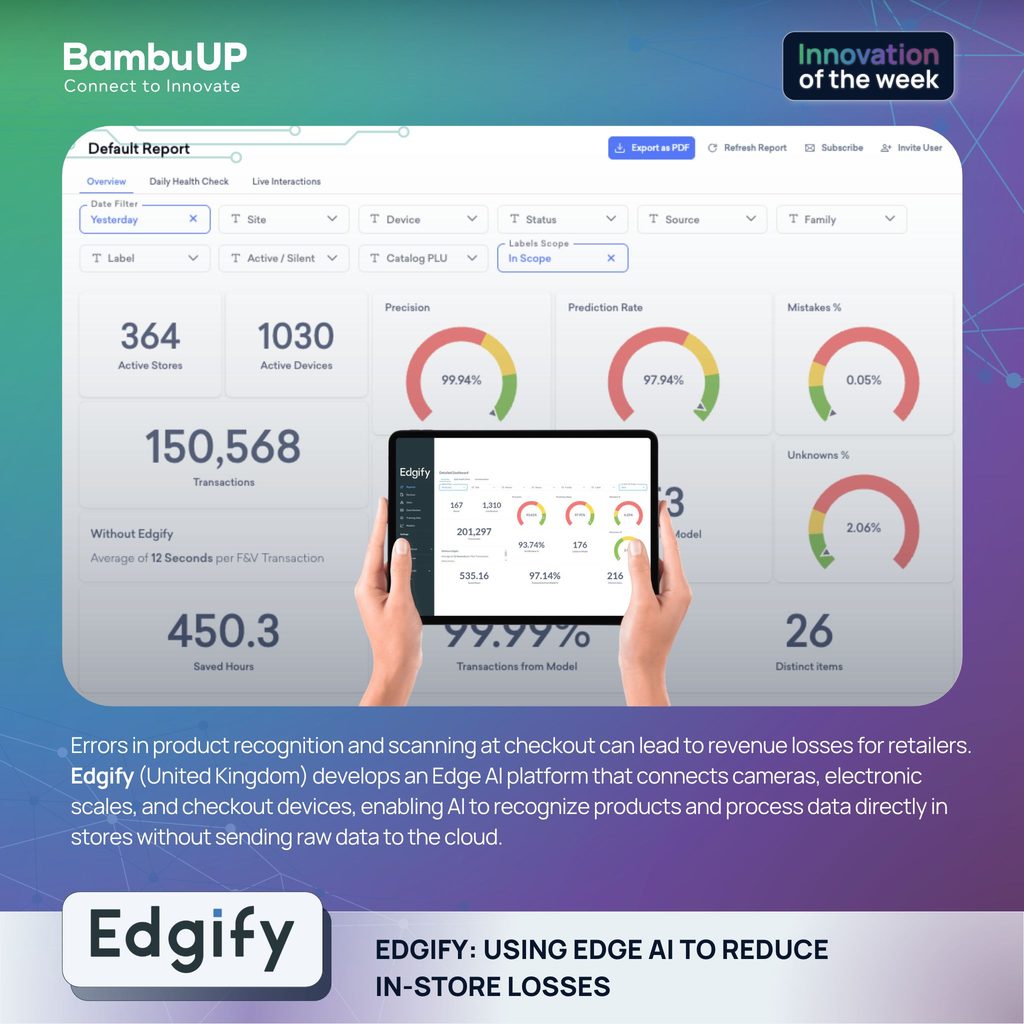
At self-checkout counters, incorrect product recognition, missed scans, or fraudulent transactions can result in revenue losses for retailers. Meanwhile, cloud-based AI image processing systems may introduce additional data transmission costs, latency, and concerns over customer privacy.
Edgify (United Kingdom) develops a platform powered by Edge AI, a technology that enables AI to process data directly on local devices rather than transmitting all information to cloud servers. The platform connects devices such as cameras, electronic scales, self-checkout counters, and Point-of-Sale (POS) systems into an AI network that supports product recognition and transaction monitoring (Source: UKTN).
Edgify’s innovation lies in enabling devices to learn and share insights without transferring raw data to the cloud. According to the company, this approach helps reduce latency, minimize infrastructure costs, and keep customer image data within stores. Instead of investing in separate AI systems for individual devices, retailers can leverage their existing device networks to implement product recognition and loss prevention capabilities (Source: Edgify).
In August 2026, Edgify raised $9 million in Series A+ funding, bringing its total funding to $25 million. According to the company, its technology has been deployed on more than 8,000 active devices across 2,042 stores in 12 countries. Edgify is also expanding its applications into quick-service restaurants, distribution centers, and the fashion industry (Source: Edgify).
In Vietnam, Edge AI could offer a promising technological approach for supermarket and convenience store chains seeking to improve the efficiency of automated checkout systems. Local data processing also gives businesses another option when implementing AI in environments with strict customer data protection requirements.
AFRESH: AI-POWERED ORDERING OPTIMIZATION AND FOOD WASTE REDUCTION
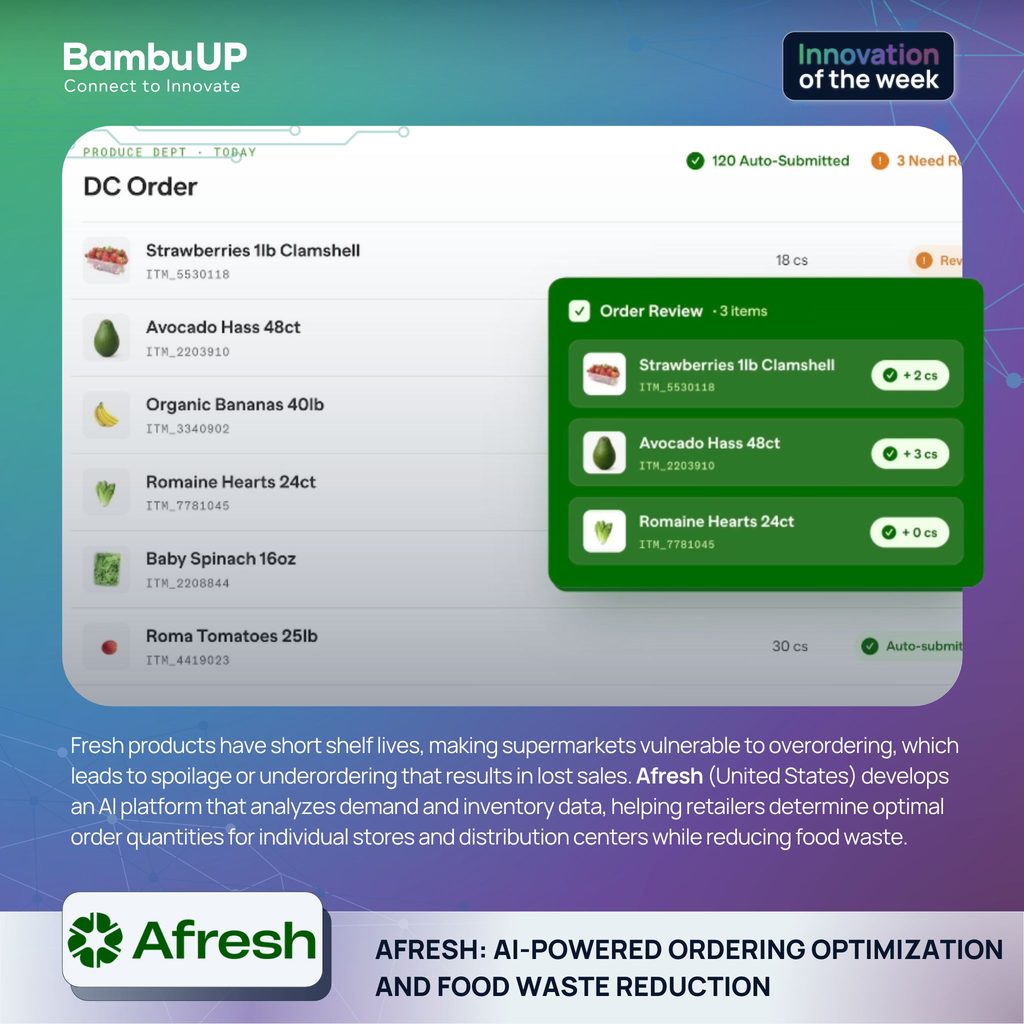
For supermarkets, managing fresh food inventory is particularly challenging due to short shelf lives and constantly fluctuating consumer demand. Overordering can lead to excess stock and spoilage, while underordering may result in product shortages and lost sales opportunities.
Afresh (United States) develops an AI platform that helps retailers forecast demand and determine appropriate order quantities for individual stores and distribution centers. Initially focused on fresh food categories, the platform was designed to address challenges related to expiration dates, demand fluctuations, and inventory data, enabling businesses to make more informed ordering decisions (Source: Afresh).
Afresh differentiates itself through its ability to apply AI directly to purchasing and replenishment decisions, rather than simply providing demand forecasts. Originally developed for fresh food, the platform has expanded to additional product categories, including frozen foods, packaged goods, and general merchandise. The system supports store-level ordering, production planning, and procurement at distribution centers (Source: Fruitnet).
In April 2026, Afresh announced an additional $34 million in funding and reported that its platform had been deployed across more than 12,500 departments in 40 US states, serving retailers including Albertsons Companies, Meijer, and Wakefern. According to company-reported figures, the technology has helped prevent more than 200 million pounds of food waste, equivalent to approximately 90,000 metric tons, while helping some retailers reduce product shrinkage by up to 25% (Source: Afresh).
For the Vietnamese market, Afresh’s technology highlights opportunities to apply AI to fresh food management, agricultural products, and retail supply chains. Rather than implementing AI across all product categories simultaneously, businesses could begin with categories experiencing high levels of waste, measure improvements in inventory efficiency and spoilage reduction, and gradually expand adoption.
REPLENIT: AI-POWERED PERSONALIZED DECISION-MAKING FOR RETAIL CUSTOMERS
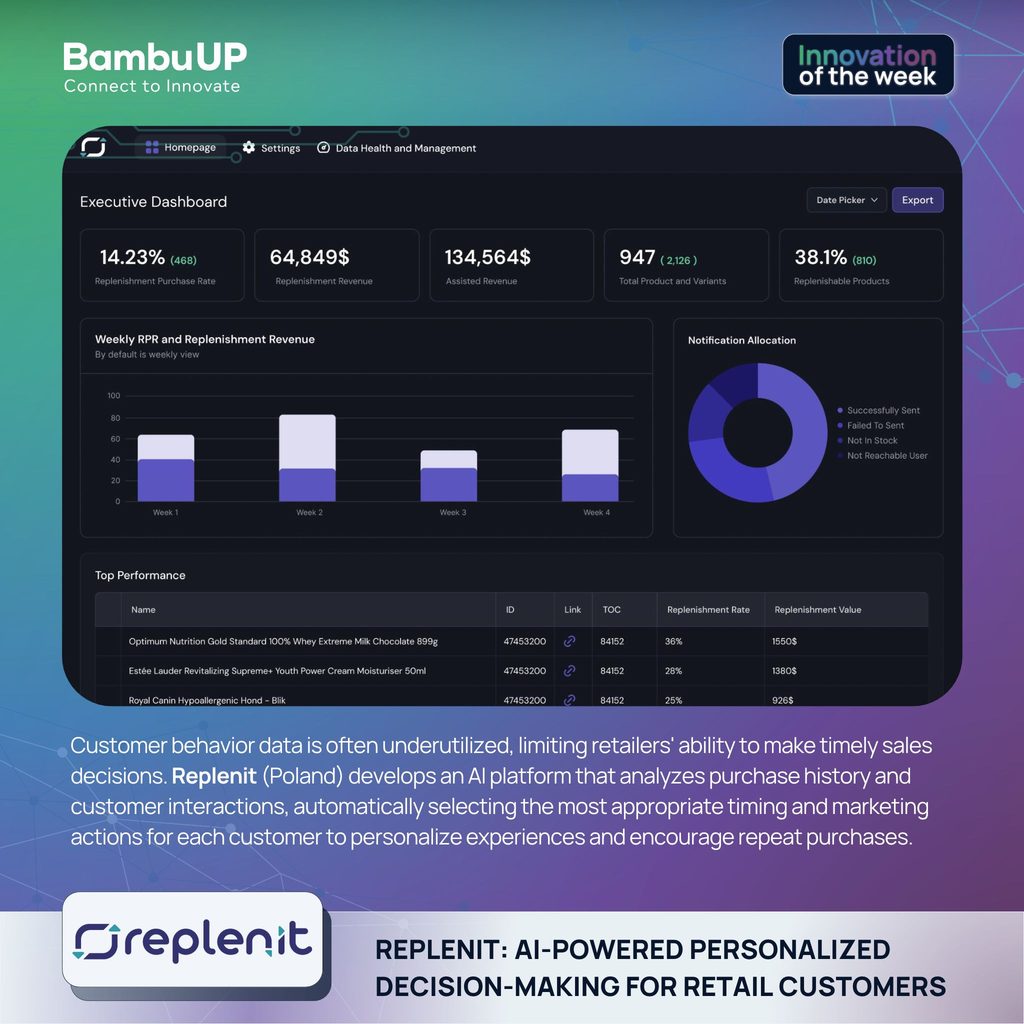
Many retailers already collect data on purchase histories, website visits, and customer interactions. However, translating this information into relevant marketing actions often relies on predefined rules, limiting businesses’ ability to respond promptly to changing customer needs.
Replenit (Poland) develops an AI Decision Engine, a system that uses artificial intelligence to analyze customer signals and select appropriate actions in real time. The technology can identify when customers are likely to need to repurchase products, determine suitable product recommendations, and select the optimal timing for engagement to encourage repeat purchases (Source: Tech.eu).
Unlike RADAR, Edgify, and Afresh, which focus more heavily on inventory and store operations, Replenit specializes in the decision-making layer built on customer data. The platform integrates with existing enterprise systems such as Salesforce, Databricks, Braze, Bloomreach, and Klaviyo, enabling businesses to introduce AI-powered personalization without replacing their existing technology infrastructure (Source: Tech.eu).
In April 2026, Replenit raised $2.5 million in pre-seed funding, co-led by Movens Capital and Vastpoint. Its technology has been applied to customer management activities at several retail brands, including L’Occitane en Provence. According to a case study published by Replenit, the brand achieved a 235% increase in revenue generated through post-purchase automation after implementing the platform (Sources: Retail Technology Innovation Hub and Replenit).
On November 18, 2026, the startup introduced Maestro 2.0, an AI-powered solution designed to manage the customer lifecycle by automatically selecting and executing engagement activities based on predefined business objectives. This development illustrates how AI in retail is evolving from customer behavior analysis toward proactively executing personalized commercial decisions (Source: MarTech360).
For Vietnamese retail brands, particularly those operating both physical stores and e-commerce channels, Replenit’s model demonstrates the potential to extract greater value from existing customer data. Businesses already using Customer Relationship Management (CRM) systems could consider integrating AI tools to optimize customer engagement and increase repeat purchase rates.