
 One platform connecting startups, corporations, research institutions, regions and investors







 Playbook & Handbook · February 6, 2026
Winning Accelerator Playbook 2026 by BambuUP
 4 CLIMATE TECH STARTUPS RESHAPING THE GLOBAL RACE TO DECARBONIZE

4 CLIMATE TECH STARTUPS RESHAPING THE GLOBAL RACE TO DECARBONIZE
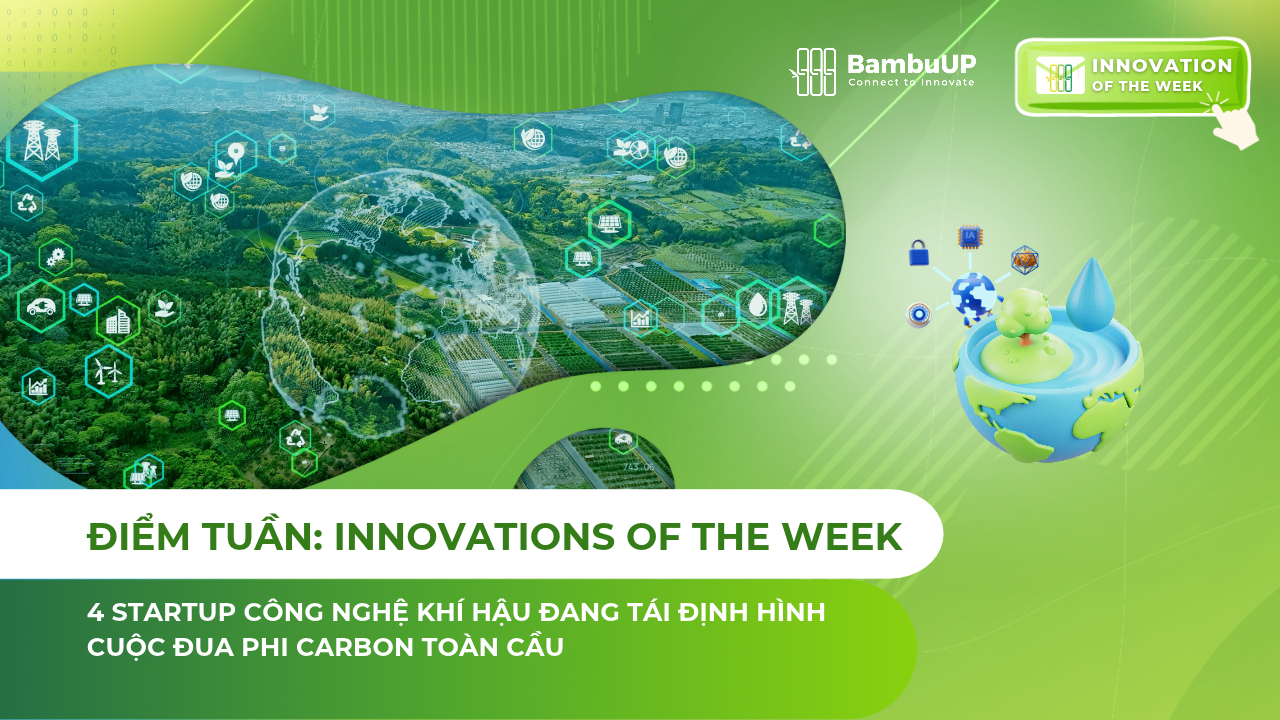
Climate tech startups are showing that cutting emissions can start with practical solutions. CarbonCure locks CO2 into concrete, GoodLeap finances green home upgrades, Twelve makes fossil-free jet fuel from CO2, and Watershed delivers audit-grade carbon accounting. These four models offer lessons for Vietnam’s manufacturing and export businesses.
CarbonCure Technologies – Turning CO2 Emissions into a Strengthening Ingredient for the Concrete Industry

CarbonCure has developed technology that injects captured CO2 directly into fresh concrete during the mixing process. The CO2 is permanently converted into minerals within the concrete, locking in carbon while increasing compressive strength, enabling producers to reduce the amount of cement required.
The cement industry accounts for approximately 7-8% of total global CO2 emissions, primarily from the high-temperature calcination of limestone (Source: AZoBuild). At the current pace of urbanization, the world’s building floor area is projected to double by 2060 compared with today (Source: Architecture 2030), meaning annual concrete production will continue to rise. If the construction industry does not change how it produces this foundational material, the global Net Zero target will be nearly impossible to achieve.
Founded in 2012 in Halifax, Nova Scotia (Canada), CarbonCure did not pursue an entirely new type of cement but instead focused on retrofitting existing concrete plants. The idea originated from the engineering research of founder Robert Niven at McGill University on the benefits of introducing CO2 into fresh concrete (Source: Global CO2 Initiative).
CarbonCure’s technology operates through carbon mineralization: CO2 captured from industrial emission sources is injected as a gas into concrete during mixing. Upon contact with the mixture, the CO2 reacts chemically and converts into solid minerals, permanently locked within the structure rather than escaping back into the atmosphere. This mineralization process also increases compressive strength, allowing producers to reduce the amount of cement, the most costly and carbon-intensive component, while maintaining product quality (Source: Global CO2 Initiative).
To date, CarbonCure’s solution has been deployed across more than 800 concrete plant systems worldwide, helping to reduce and lock away hundreds of thousands of tonnes of CO2 (Source: CarbonCure). The company also made headlines by winning the USD 7.5 million NRG COSIA Carbon XPRIZE, a global competition for technologies that convert CO2 into valuable products (Source: XPRIZE).
For Vietnam, where the construction materials industry remains heavily dependent on traditional cement, CarbonCure’s model points to a practical path forward: without replacing entire production lines, businesses can still reduce emissions by refining their processes. This is a form of practical innovation well suited to enterprises facing pressure from green building standards and ESG certifications.
GoodLeap – A “Lightning-Fast” Financial Technology Platform Removing Barriers to Green Home Upgrades

GoodLeap is a financial technology (fintech) platform specializing in financing sustainable home upgrades such as solar power, battery storage, and high-efficiency air conditioning systems. GoodLeap’s credit approval technology operates at the point of sale, significantly shortening contractors’ sales cycles.
One of the biggest barriers keeping households from installing solar power or upgrading to energy-efficient equipment lies not in environmental awareness but in the upfront cost, while traditional bank lending processes often take several days to approve, long enough for many prospective customers to abandon the idea.
Founded in 2003 by Hayes Barnard together with co-founders Jason Walker and Matt Dawson (previously operating under the names Paramount Equity Mortgage and Loanpal), GoodLeap officially adopted its current name in 2021 to reflect its mission of expanding across the entire sustainable home upgrade ecosystem, rather than remaining limited to solar energy (Source: Forbes).
GoodLeap’s core differentiator is a technology platform that enables digital credit approval at the point of sale. Rather than customers submitting applications on their own, contractors can propose financing packages directly at the time of consultation, significantly shortening decision-making time (Source: GoodLeap).
To date, GoodLeap’s software and financial toolkit has helped more than 200,000 contractors and manufacturers deliver solutions to end users, contributing to more than USD 63 billion in credit outstanding and bringing the company to a valuation of USD 12 billion in the private market (Source: GoodLeap). More recently, the company has also developed GoodGrid, a virtual power plant network that connects battery storage systems from thousands of households to supply energy back to the regional grid during peak hours, giving users an additional source of income (Source: GoodLeap Blog).
For Vietnam, where rooftop solar and household energy-saving solutions still lack flexible financing mechanisms, GoodLeap’s model suggests a path forward: innovation in the green transition requires not only hardware technology but also a redesigned financial journey that narrows the gap between the desire to “go green” and the ability to pay.
Twelve – Turning CO2 Emissions into Fossil-Free Jet Fuel and Petrochemical Feedstocks

Twelve has developed CO2 electrolysis technology that uses electricity to convert CO2 emissions and water into synthesis gas, which is then refined into fuels, chemicals, and materials traditionally produced from petroleum. Its most prominent product is E-Jet, a fossil-free jet fuel that can directly replace conventional petroleum-based jet fuel without requiring any changes to aircraft design.
The aviation industry emits approximately 1.2 billion tonnes of CO2 each year and is considered one of the hardest sectors to decarbonize, as the challenge of energy density makes electrifying long-haul aircraft technically almost impossible (Source: Chemical Engineering). Meanwhile, most carbon capture technologies today stop at burying CO2 underground or locking it into rock, rather than turning it into something that can be reused.
Founded in 2015 in Berkeley, California, originally under the name Opus 12, Twelve was established by three co-founders, Etosha Cave, Kendra Kuhl, and Nicholas Flanders, after they met as doctoral researchers at Stanford University in the laboratory of chemical engineering professor Thomas Francisco Jaramillo. The name “Twelve” is inspired by the Carbon-12 isotope, the most common form of carbon on Earth (Source: Green Car Congress).
Unlike approaches that bury carbon, Twelve treats CO2 as a commercializable asset. The company’s core technology uses an electrochemical reactor with a proprietary catalyst to “electrify” CO2 and water, converting them into synthesis gas (comprising CO and H2). In partnership with Emerging Fuels Technology, a specialist in Fischer-Tropsch conversion technology (a chemical process that uses catalysts to transform a mixture of synthesis gas, consisting of carbon monoxide and hydrogen, into liquid hydrocarbons such as synthetic fuels and waxes), Twelve refines this synthesis gas into E-Jet fuel, a product that can be poured directly into existing aircraft engines without changing design or operating standards (Source: DCVC; Medium – Twelve).
In 2021, Twelve announced the world’s first batch of E-Jet fuel produced from CO2 through a collaboration contract with the U.S. Air Force, marking an important step in bringing this technology out of the laboratory (Source: PR Newswire). In September 2024, the company successfully raised USD 645 million, comprising USD 400 million in project equity led by TPG Rise Climate, USD 200 million from a Series C round, and USD 45 million in green credit, one of the largest funding packages to date in the e-fuels sector, to be used to build its first commercial-scale sustainable fuel plant in Washington State (Source: ESG Today; PR Newswire).
For Vietnam, where the aviation and export logistics sectors are under growing pressure from international carbon offsetting and reduction mechanisms for aviation, Twelve’s model points to a different path: rather than focusing solely on cutting emissions, businesses can turn the CO2 generated in industrial production into feedstock for chemicals, materials, or fuels, opening up a circular carbon economy model rather than treating carbon merely as a mandatory cost to be reduced.
Watershed – A Carbon Accounting Platform Helping Businesses Measure and Report Emissions to Audit-Grade Standards
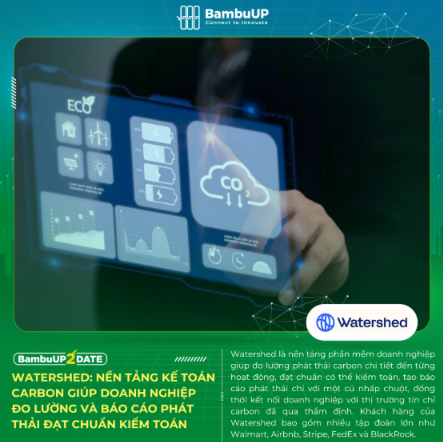
Watershed is an enterprise software platform that measures carbon emissions down to the level of individual activities to an auditable standard, generates emissions reports with a single click, and connects businesses with a marketplace of vetted carbon credits. Watershed’s customers include major corporations such as Walmart, Airbnb, Stripe, FedEx, and BlackRock.
Before carbon disclosure regulations such as the European Union’s CSRD (Corporate Sustainability Reporting Directive) or the U.S. Securities and Exchange Commission’s climate disclosure rules became mandatory, most large enterprises had no reliable way to accurately measure their emissions, particularly indirect emissions from the supply chain, which typically account for the largest share yet are the most difficult to measure.
Watershed was founded in 2019 in San Francisco by three former Stripe employees: Taylor Francis, Avi Itskovich, and Christian Anderson. All three had contributed to building the Stripe Climate program before leaving the company to pursue their own path in the climate sector (Source: Contrary Research; Trellis).
Rather than stopping at calculating emissions data, Watershed has built a comprehensive integrated platform: it measures emissions down to the level of individual activities to an auditable standard, generates regulatory compliance reports with a single click, simulates emissions reduction scenarios, and connects with a marketplace for buying and selling quality-vetted carbon credits. According to co-founder Taylor Francis, 100% of Watershed’s customers have passed carbon reporting audits, a key metric at a time when many businesses worry that self-prepared emissions data is not reliable enough for official disclosure (Source: Trellis).
To date, Watershed has raised a total of USD 370 million, reaching a valuation of USD 1.8 billion following its USD 100 million Series C round with participation from Sequoia Capital, Kleiner Perkins, and Greenoaks Capital. The company’s client list spans Walmart, Airbnb, Stripe, FedEx, BlackRock, and Klarna, as well as Canva, Pinterest, and Shopify (Source: Trellis; Crunchbase – Watershed). The company has set a goal of helping remove 500 million tonnes of CO2 equivalent from the atmosphere each year by 2030, equivalent to roughly 1% of current total global emissions (Source: Silicon Valley Investclub).
For Vietnamese manufacturing and export enterprises, particularly suppliers to multinational corporations that already use platforms like Watershed to manage emissions, this model highlights a clear reality: emissions reporting based on manual Excel files will soon no longer meet the requirements of international partners. Digitizing emissions data at the factory level, even without a sophisticated platform like Watershed, will be a necessary preparatory step so that Vietnamese businesses are not excluded from global supply chains due to a lack of carbon data transparency.