 One platform connecting startups, corporations, research institutions, regions and investors












 Playbook & Handbook · February 6, 2026
Winning Accelerator Playbook 2026 by BambuUP
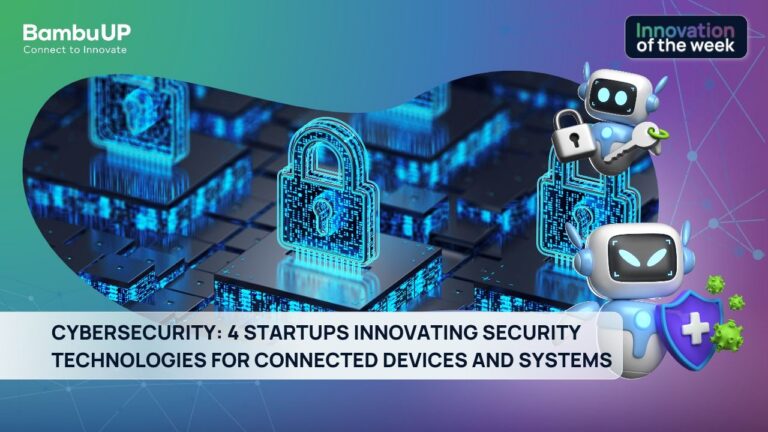 CYBERSECURITY: 4 STARTUPS INNOVATING SECURITY TECHNOLOGIES FOR CONNECTED DEVICES AND SYSTEMS

CYBERSECURITY: 4 STARTUPS INNOVATING SECURITY TECHNOLOGIES FOR CONNECTED DEVICES AND SYSTEMS
Cybersecurity and IoT/OT security are becoming critical priorities as cyberattacks increasingly threaten not only sensitive data but also the operation of connected devices and industrial systems. Addressing these industrial cybersecurity challenges, four cybersecurity startups-Corsha, Frenos, Asimily, and Test of Things-are leveraging AI in cybersecurity, Zero Trust security, and digital simulation technologies to identify vulnerabilities, control unauthorized access, and strengthen connected device security across modern industrial environments.
In October and early November 2026, numerous supermarkets across Europe experienced cybersecurity incidents involving their refrigeration systems. Hackers reportedly interfered with remote temperature controllers, causing refrigerators and freezers to enter defrost mode and forcing retailers to dispose of spoiled food (Source: Reuters). These incidents demonstrate that cybersecurity risks are no longer limited to data theft but can also directly disrupt business operations and the functioning of physical equipment.
As Internet of Things (IoT) devices and Operational Technology (OT) systems become increasingly connected to corporate networks and the Internet, securing these connections has become essential. In response, cybersecurity startups are developing advanced security platforms that leverage AI, digital simulation, and Zero Trust technologies to identify vulnerabilities, control access, and minimize the risk of cyberattacks.
CORSHA: MACHINE IDENTITY AUTHENTICATION AND INDUSTRIAL CONNECTIVITY SECURITY
In industrial environments, machines, sensors, and control software continuously exchange data to maintain production operations. However, inadequate authentication mechanisms between devices can create uncontrolled access points, increasing the risk of unauthorized intrusion and lateral movement across operational networks.
Corsha (USA) has developed an Industrial Identity Security platform that enables businesses to identify and authenticate machine identities while controlling access between industrial systems. Its Machine Identity Provider (mIDP) technology enables identity-based connection authentication and implements Zero Trust principles, under which every connection must be verified rather than automatically trusted (Source: Corsha).
A notable innovation is Folio, a module introduced in September 2026 that automatically maps connections and data flows within OT environments based on real operational data. This allows businesses to identify unusual changes, maintain up-to-date system documentation, and support risk assessments without relying entirely on manual network inventories (Source: Corsha).
In terms of commercialization, Corsha announced in April 2026 that it had been awarded an Indefinite Delivery/Indefinite Quantity (IDIQ) contract with a maximum value of $50 million by the U.S. Defense Logistics Agency (DLA) to deploy Zero Trust connectivity solutions across critical operational systems. The contract allows orders to be placed as needed and does not mean that its full value has already been disbursed (Source: Corsha).
FRENOS: AI-POWERED CYBERATTACK SIMULATION USING DIGITAL TWINS OF INDUSTRIAL SYSTEMS
Industrial facilities and critical infrastructure must maintain continuous operations, making direct penetration testing potentially disruptive to production. Meanwhile, conventional vulnerability scanning methods do not always reveal how attackers could exploit multiple weaknesses to gain access to critical equipment.
Frenos (USA) has developed a simulated penetration testing platform that combines AI with Digital Twin technology to recreate industrial network environments. Within these virtual models, the system can simulate attacker behavior, analyze potential attack paths, and identify exploitable vulnerabilities without directly affecting operational systems (Source: Frenos).
Its key differentiator is SAIRA, an AI agent capable of analyzing relationships between network configurations, access permissions, and security weaknesses to assess potential attack scenarios. In July 2026, Frenos introduced SAIRA Co-Work, which assists cybersecurity professionals in investigating and evaluating risks using data from digital twins of OT environments (Source: Frenos).
At the S4x26 event, Frenos reported that its platform conducted approximately 154,000 attack-path simulations in 17 minutes, identifying 18 potentially exploitable attack paths within a test environment. The startup also secured an additional $1.52 million in funding in 2026, bringing its total funding to $6.4 million (Source: Frenos). The event highlighted Frenos’ technological capabilities not because of the conference’s scale, but because participating companies were required to validate their solutions in a simulated real-world OT environment against specific evaluation criteria.
ASIMILY: AI-POWERED NETWORK SEGMENTATION FOR IOT/OT DEVICE SECURITY
The number of IoT and OT devices within enterprises continues to grow, ranging from sensors and cameras to manufacturing equipment and building control systems. However, when multiple devices share the same network infrastructure, attackers may exploit a single vulnerability to expand their access across connected systems. Manually configuring security policies for individual devices is also complex and difficult to maintain as networks continuously evolve.
Asimily (USA) has developed the Proactive Cyber Asset Defense platform, leveraging AI to identify connected devices, analyze network activity, and assess vulnerabilities based on real-world risk levels. Rather than simply generating lists of potentially vulnerable devices, the platform helps businesses identify connections requiring additional controls and implement appropriate security measures (Source: Asimily).
A significant technological advancement is Segmentation Orchestration, introduced in June 2026, which can automatically recommend, simulate, and deploy network segmentation policies based on actual device communication patterns. The system uses AI to identify high-risk devices, evaluate the potential impact of access policy changes before implementation, and continuously update policies as network configurations evolve. This approach helps organizations limit attackers’ ability to move laterally between devices following an intrusion (Source: Asimily/GlobeNewswire).
Regarding real-world applications, Asimily reports that its solutions have been deployed across manufacturing, healthcare, and critical infrastructure organizations. In one case involving a food and beverage manufacturer, the platform helped identify devices embedded within industrial control networks, detect security vulnerabilities, and recommend risk mitigation measures without disrupting production operations (Source: Asimily).
TEST OF THINGS: AI-POWERED AUTOMATED SECURITY TESTING FOR IOT DEVICES
Connected devices such as smart cameras, industrial sensors, and building controllers may contain security vulnerabilities from the earliest stages of development. However, security testing and compliance documentation often require significant manual effort, making the process costly and difficult to scale as product portfolios expand.
Test of Things (Finland) has developed an AI-powered cloud platform that automates security testing and compliance management for IoT devices. The solution helps manufacturers analyze software components, identify vulnerabilities, and generate documentation required to meet cybersecurity standards (Source: Test of Things).
Its key innovation lies in integrating security testing throughout the entire product development lifecycle, rather than assessing devices only before they enter the market. The platform supports product architecture modeling, monitors newly disclosed vulnerabilities, and uses AI to evaluate the relevance of each identified risk to actual systems. Testing results can be translated into actionable tasks for development teams and documentation for compliance assessments (Source: Test of Things).
In March 2026, the startup announced that it had secured €1.2 million in pre-seed funding led by Vendep Capital. The investment will support expanding its engineering team and accelerate the development of its automated cybersecurity testing platform for connected device manufacturers (Source: Test of Things).