 One platform connecting startups, corporations, research institutions, regions and investors








 Playbook & Handbook · February 6, 2026
Winning Accelerator Playbook 2026 by BambuUP
 4 Cold Chain Models Vietnamese Exporters Should Consider

FROM NATURAL RESOURCES TO ADVANCED MATERIALS: 4 STARTUPS REINVENTING PACKAGING TECHNOLOGY
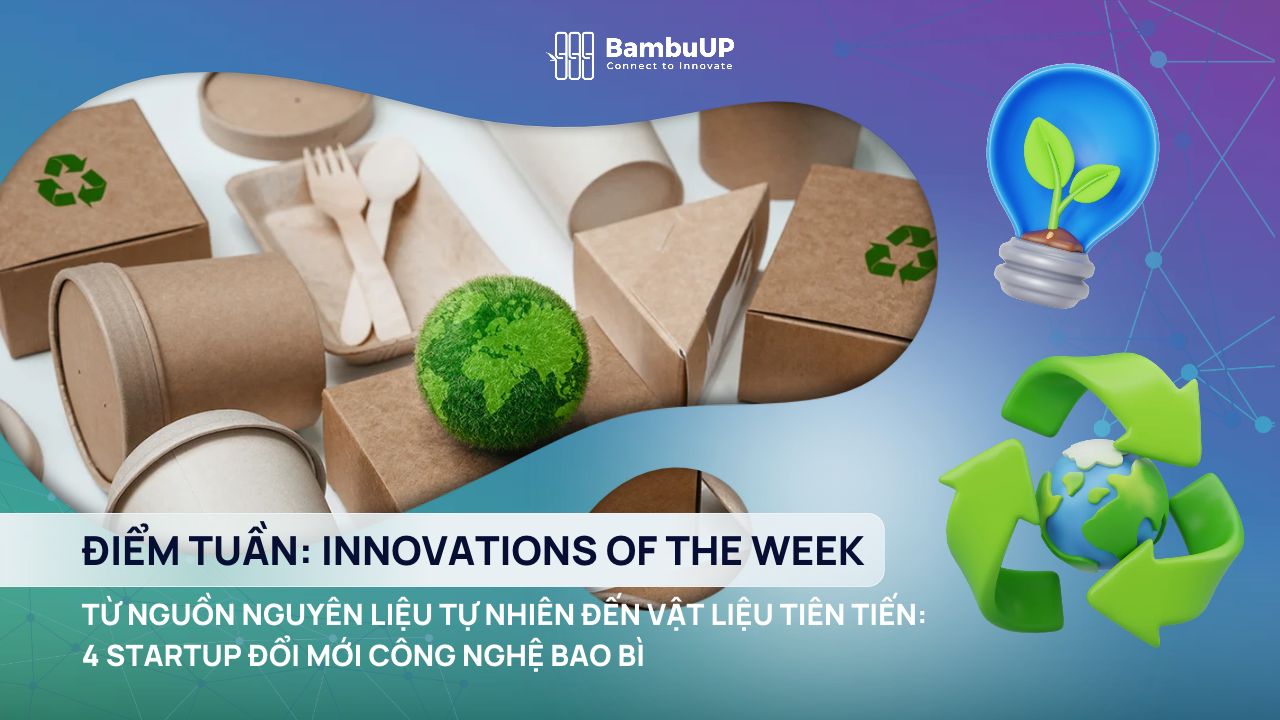
Can paper be made water- and grease-resistant without traditional plastic coatings? Advances in advanced materials technology are opening new pathways for the packaging industry, as nanostructures, plant proteins, and seaweed are used to create functional coatings. Discover how Papkot, Xampla, Kelpi, and Notpla are bringing next-generation materials from research to real-world applications, helping reduce reliance on plastic in packaging production.
Papkot: Harnessing Nanostructured Coatings to Transform Paper into a Water-Resistant Alternative to Plastic
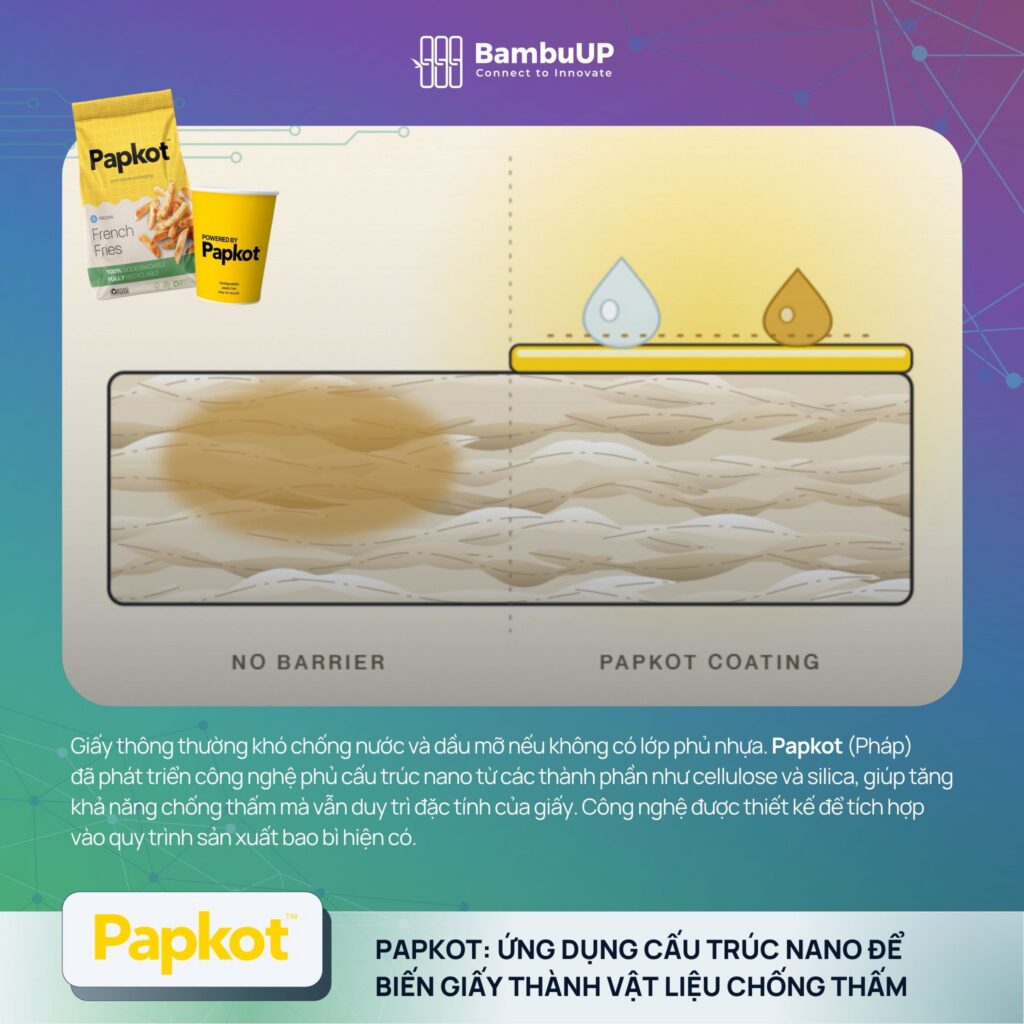
Paper is increasingly being adopted as an alternative to plastic in the packaging industry. However, the material still faces limitations in its resistance to water, grease, and other liquids. To meet product protection requirements, many paper-based packaging products rely on polyethylene (PE) coatings or other barrier chemicals, making recycling more complicated. For manufacturers, the challenge goes beyond finding environmentally friendly materials. They must also ensure product protection, cost efficiency, and compatibility with existing production lines. (Source: Papkot)
Addressing these challenges, Papkot, a French advanced materials startup founded in 2020, has developed a nanostructured coating platform using components such as cellulose and silica to enhance the barrier properties of paper. Instead of relying on conventional plastic films, Papkot leverages the arrangement of material components at the nanoscale to create a protective layer capable of limiting the penetration of water, grease, and certain other liquids. The technology can be applied to various types of paper, including virgin and recycled fibers, and is designed to integrate with existing packaging manufacturing processes. Papkot’s key innovation lies in modifying the surface properties of paper through nanomaterials technology, expanding its potential applications to products that traditionally require plastic coatings. (Source: Papkot – Technology; Papkot – About)
Moving beyond laboratory-scale development, Papkot has expanded its manufacturing activities through processing partners in France, the United States, and China, while providing solutions to brands in the food and consumer goods industries. Its technology has been tested on multiple paper grades, with potential applications ranging from disposable food packaging and wrapping paper to paper cups and packaging requiring enhanced barrier performance. However, the company has not publicly disclosed detailed commercial production volumes or the number of finished packaging products incorporating its technology. (Source: Fedrigoni)
In February 2025, Fedrigoni, an Italian multinational specializing in specialty papers and packaging materials, announced an equity investment in Papkot to accelerate industrialization and expand the international adoption of its coating technology. The partnership combines the startup’s materials research capabilities with Fedrigoni’s global manufacturing infrastructure and customer network, creating opportunities to integrate nanostructured coatings into large-scale packaging production. This collaboration illustrates the potential of open innovation, where emerging materials technologies are brought closer to commercialization through partnerships between specialized startups and established industrial companies. (Source: Fedrigoni – Investment Announcement)
Xampla: Transforming Plant Proteins into Plastic-Free Barrier Coatings for Food Packaging
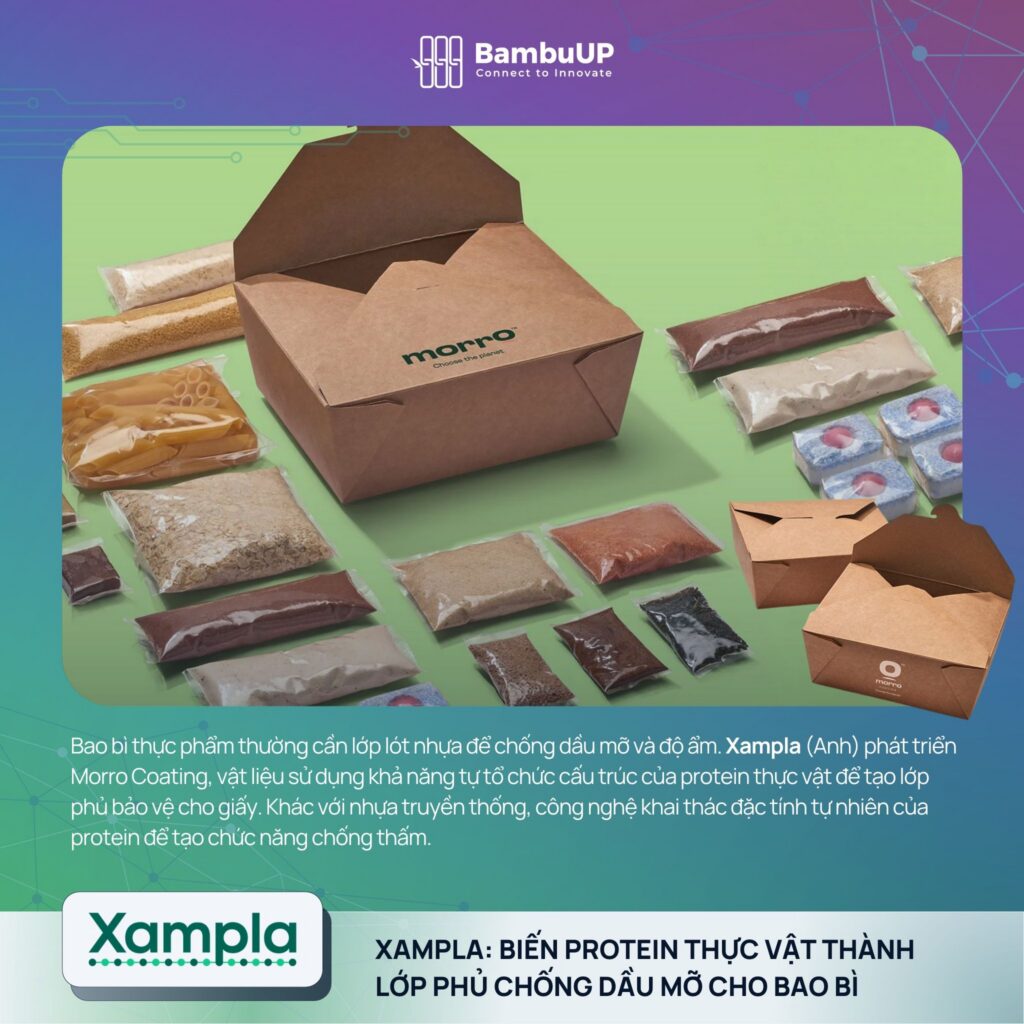
In the takeaway food industry, paper-based packaging must meet several requirements simultaneously: resisting moisture, grease, and heat without losing its structural integrity or protective properties. This is why many paper food containers still rely on plastic linings or barrier chemicals. As markets increasingly introduce measures to reduce single-use plastics, packaging manufacturers face growing pressure to develop alternative materials that maintain performance while integrating into existing production systems without significantly increasing operational complexity. (Source: Xampla – Morro Coating)
Founded in the United Kingdom in 2018, Xampla has developed a biomaterials technology based on the natural self-assembly properties of plant proteins. By processing and reorganizing protein structures, the startup has created Morro Coating, a barrier material designed to provide resistance to grease, water, and oxygen without chemically modifying the proteins using additional cross-linking agents. Originating from protein research at the University of Cambridge, the technology harnesses the inherent properties of natural materials to deliver protective functions comparable to certain conventional plastic coatings. Rather than simply replacing the ingredients used in plastics, Xampla focuses on developing a functional barrier coating that can be incorporated directly into existing paper and paperboard manufacturing processes. (Source: Xampla – Technology)
The commercialization of Morro Coating has been accelerated through partnerships with companies across the packaging supply chain. In 2024, Huhtamaki and 2M Group of Companies entered into a multi-year supply agreement to incorporate Xampla’s coating technology into takeaway food packaging products. By July 2025, the material had also entered Bunzl’s distribution network in the United Kingdom and Ireland, enabling restaurants, hotels, and foodservice providers to access packaging products incorporating the new coating. These partnerships demonstrate how Xampla is progressing beyond materials development to integrate its technology into established packaging production and distribution networks. (Source: Xampla – Huhtamaki Partnership; Xampla – Bunzl Partnership)
In March 2026, Xampla, together with Huhtamaki and Just Eat Takeaway, expanded food containers featuring Morro Coating into 10 European markets, including Germany, Italy, the Netherlands, Spain, and several other countries. The packaging is designed to maintain its structural strength and heat-retention properties when holding greasy or moisture-rich foods, while eliminating the need for conventional plastic coatings. The adoption of this material by a major food delivery platform across multiple markets indicates that the technology has moved beyond isolated trials and is increasingly addressing the practical needs of the foodservice industry. (Source: Xampla – European Expansion; Packaging Europe)
Kelpi: Developing Seaweed-Based Coatings That Enable Paper Packaging to Hold Liquids
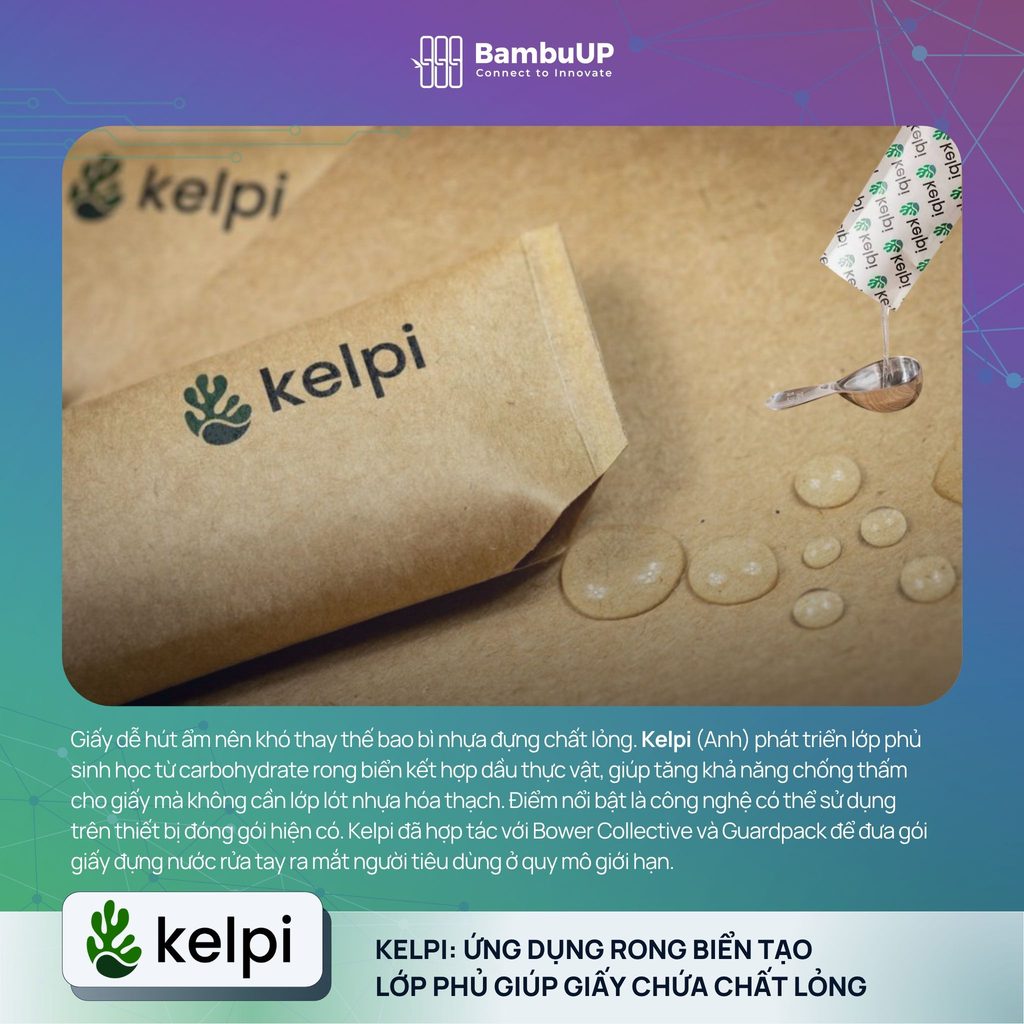
In the consumer goods industry, small sachets containing shampoo, handwash, or cosmetics are often manufactured using multiple layers of plastic and laminated materials to prevent leakage. Although these multilayer structures provide effective product protection, they also make recycling more difficult. Transitioning to paper-based packaging remains particularly challenging for liquid products, as conventional paper readily absorbs moisture, loses structural strength, and cannot adequately prevent liquid penetration. This creates a growing need for high-performance barrier coatings that do not rely on fossil fuel-derived plastic films. (Source: Kelpi)
To address this challenge, Kelpi, a UK biomaterials startup founded in 2020, has developed a seaweed-based coating technology that combines naturally derived carbohydrates with plant oils to create an ultra-thin protective layer. When applied to paper surfaces, the material enhances resistance to water and moisture, offering a potential alternative to fossil-based plastic linings in liquid packaging. Kelpi’s key innovation lies in using biologically derived compounds to deliver functional barrier properties while designing the coating to remain compatible with conventional paper recycling processes. This approach opens new possibilities for packaging materials that combine moisture resistance with the practical advantages of paper. (Source: Kelpi – Technology & Partnership)
Throughout 2026, Kelpi achieved several milestones in bringing its technology closer to commercial application. In January, the company partnered with Guardpack, a UK-based sachet packaging manufacturer, to evaluate the coating’s compatibility with industrial production lines. In June, Kelpi also announced a collaboration with Amcor, a global packaging company, to explore the integration of its seaweed-derived material into Amcor’s AmFiber paper-based packaging portfolio. Both partnerships address a critical challenge in advanced materials commercialization: proving not only that a new material performs effectively, but also that it can be processed, converted, and packaged using existing industrial equipment. (Source: Kelpi – Guardpack Partnership; Kelpi – Amcor Partnership)
A notable development followed in September 2026, when Kelpi partnered with Bower Collective to launch a paper sachet containing 5 ml of handwash, using a seaweed-based barrier coating instead of a fossil-derived plastic lining. The product was manufactured and filled by Guardpack using its existing production equipment without requiring machinery modifications. It was then distributed on a limited basis to Bower Collective customers for real-world use and feedback. Although this was not yet a mass-market rollout, the launch marked an important transition from material testing to a consumer-facing product. Earlier, in August 2026, Kelpi also announced the completion of the US FDA food contact notification process for specified conditions of use, providing additional regulatory support for the commercialization of its coating technology in the American market. (Source: Kelpi – Bower Collective Launch; Kelpi – FDA Food Contact)
4. Notpla: Commercializing Seaweed-Based Barrier Coatings for Large-Scale Food Packaging
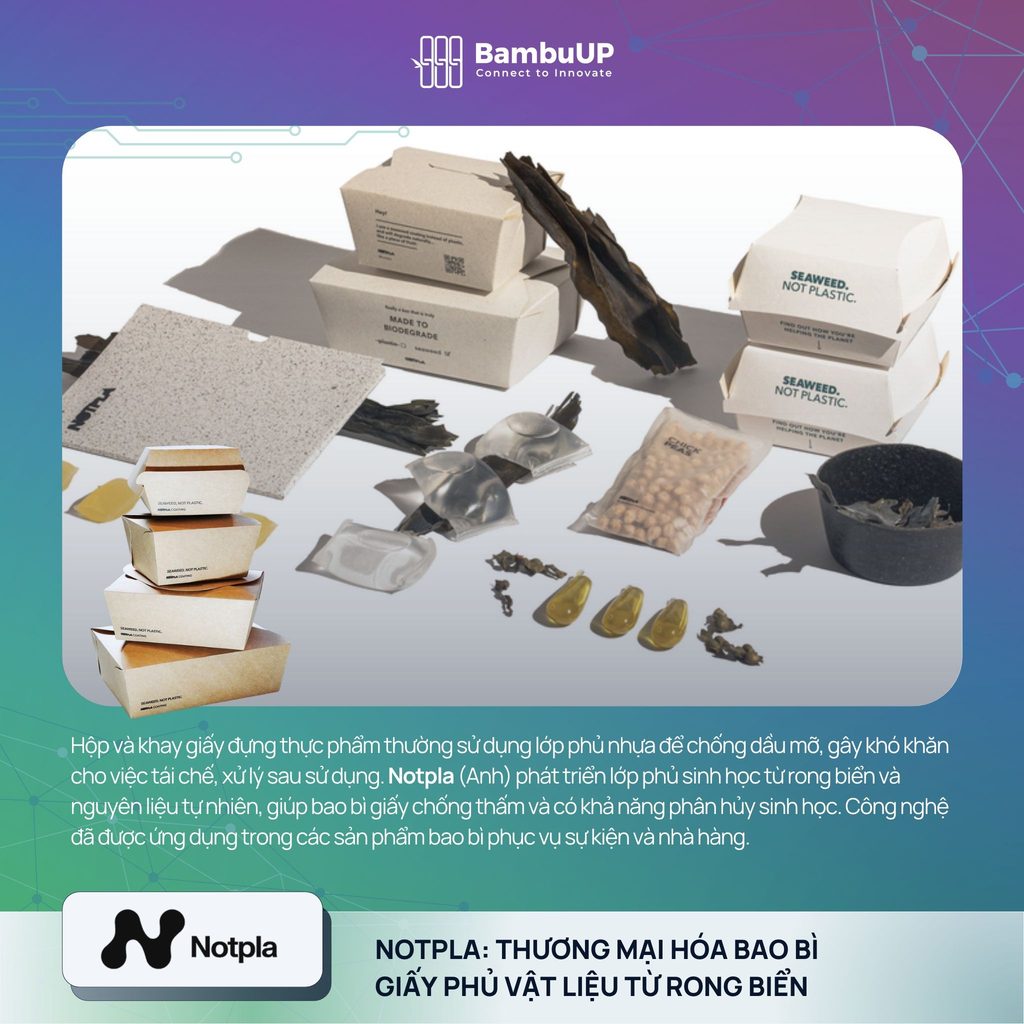
Restaurants and fast-food chains consume substantial quantities of disposable containers, trays, and packaging every day. Although many of these products are made from paper or paperboard, they often contain thin plastic coatings to prevent grease and moisture from penetrating the surface. While these coatings help packaging meet practical performance requirements, they also contribute to single-use plastic consumption and create challenges for post-consumer waste management. For large restaurant chains, replacing plastic requires more than identifying an alternative material. New solutions must also provide durability, comply with food contact requirements, and remain consistently available at commercial scale. (Source: Notpla)
Addressing this challenge, Notpla, a UK materials technology startup founded in 2014, develops packaging solutions derived from seaweed and other natural ingredients. One of its key technologies is Notpla Coating, a bio-based barrier material applied to paper and paperboard to improve resistance to grease and moisture when in contact with food. Unlike conventional plastic coatings, Notpla’s material is designed to be biodegradable without generating microplastics associated with synthetic plastic coatings. The company focuses on practical applications such as takeaway food containers, trays, and event catering packaging, where materials must perform reliably under high-volume operating conditions. (Source: Notpla – Official Website)
Unlike many emerging materials technologies still undergoing pilot testing, Notpla has progressively integrated its products into commercial supply chains. Through its partnership with Levy, a foodservice provider operating at sports venues and major events, Notpla packaging has been introduced across multiple sporting locations in the United Kingdom. According to Levy’s Climate Impact Report, the company purchased more than 1.7 million Notpla food containers in 2024, replacing packaging products that previously relied on plastic linings. Deployment in high-volume foodservice environments provides practical evidence that seaweed-based barrier coatings can meet the operational demands of commercial catering. (Source: Notpla; Levy – Climate Impact Report)
In February 2026, Notpla partnered with Conpax to introduce seaweed-coated cardboard trays for fries and snacks across 160 Kwalitaria restaurants in the Netherlands. According to estimates published at the time of implementation, the initiative could potentially eliminate approximately 6.9 tonnes of plastic and reduce CO₂ emissions by 102.5 tonnes annually compared with the previous packaging solution. Notably, the Netherlands Human Environment and Transport Inspectorate (ILT) confirmed that the packaging qualified as plastic-free under the relevant single-use plastics regulations. This development demonstrates how biomaterials innovation can progress beyond replacing conventional plastic coatings to becoming directly integrated into the daily operations of large restaurant chains. (Source: Packaging Europe – Notpla & Kwalitaria; European Seaweed Association)