📖 TABLE OF CONTENTS 📖
- 1. Vietnam’s AI market landscape: A surging momentum
- 2. National policy: Decisive moves to make AI a new growth engine
- 3. Businesses and Startups: The dynamic engine of Vietnam’s AI ecosystem
- 4. Open Innovation: Synergizing to amplify AI value
- 5. The road ahead: Great opportunities accompanied by long-term challenges
Artificial Intelligence (AI) is emerging as a new growth engine for Vietnam, showing remarkable development momentum and a rapidly expanding ecosystem. However, amid the global AI race, where does Vietnam stand on the world map?
1. Vietnam’s AI market landscape: A surging momentum
Vietnam’s AI market is among the fastest-growing in the region and is expected to continue booming in the years ahead.
According to Statista, the market size of AI in Vietnam is projected to reach USD 932 million by 2025 [15] and USD 6.91 billion by 2031, with an impressive compound annual growth rate (CAGR) of 38.97% between 2025 and 2031 [1].
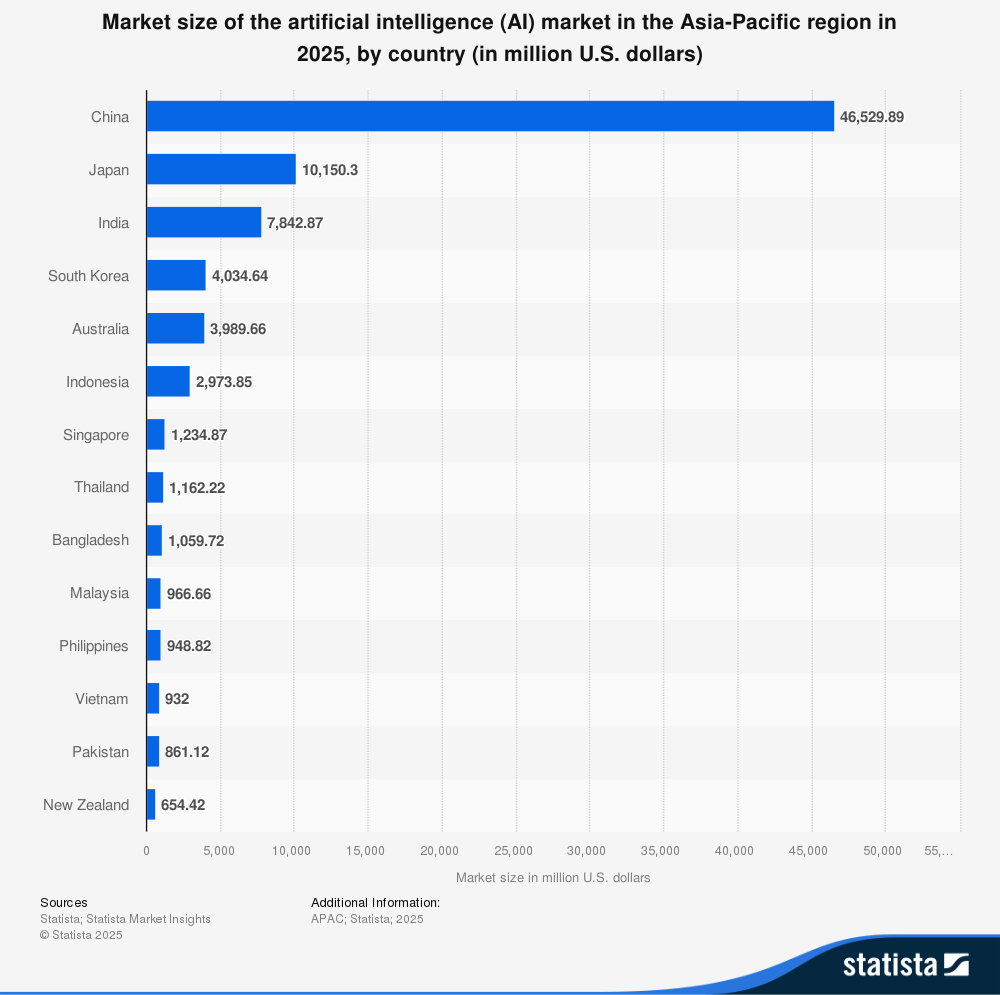
Vietnam’s AI market value is forecasted to reach USD 932 million by 2025 (Source: Statista)
AI adoption among businesses is also accelerating rapidly: approximately 170,000 enterprises (or 18%) in Vietnam have already implemented AI solutions, up from 13% the previous year. In 2024 alone, on average, five new businesses adopt AI every hour, marking a 39% year-over-year growth [2].
Vietnam has also shown significant improvements in its AI readiness. In 2022, the country ranked 55th globally and 6th among 10 ASEAN nations in the Government AI Readiness Index, climbing 7 positions compared to the previous year [13].
Notably, according to the 2024 Global AI Index by WIN, Vietnam ranks 6th out of 40 countries with a score of 59.2 - demonstrating a high level of awareness, usage, and trust in AI among its citizens. Vietnam ranks 3rd globally for public trust in AI and 5th in AI acceptance, driven particularly by the openness of urban populations - an essential foundation for scaling AI adoption nationwide [3].
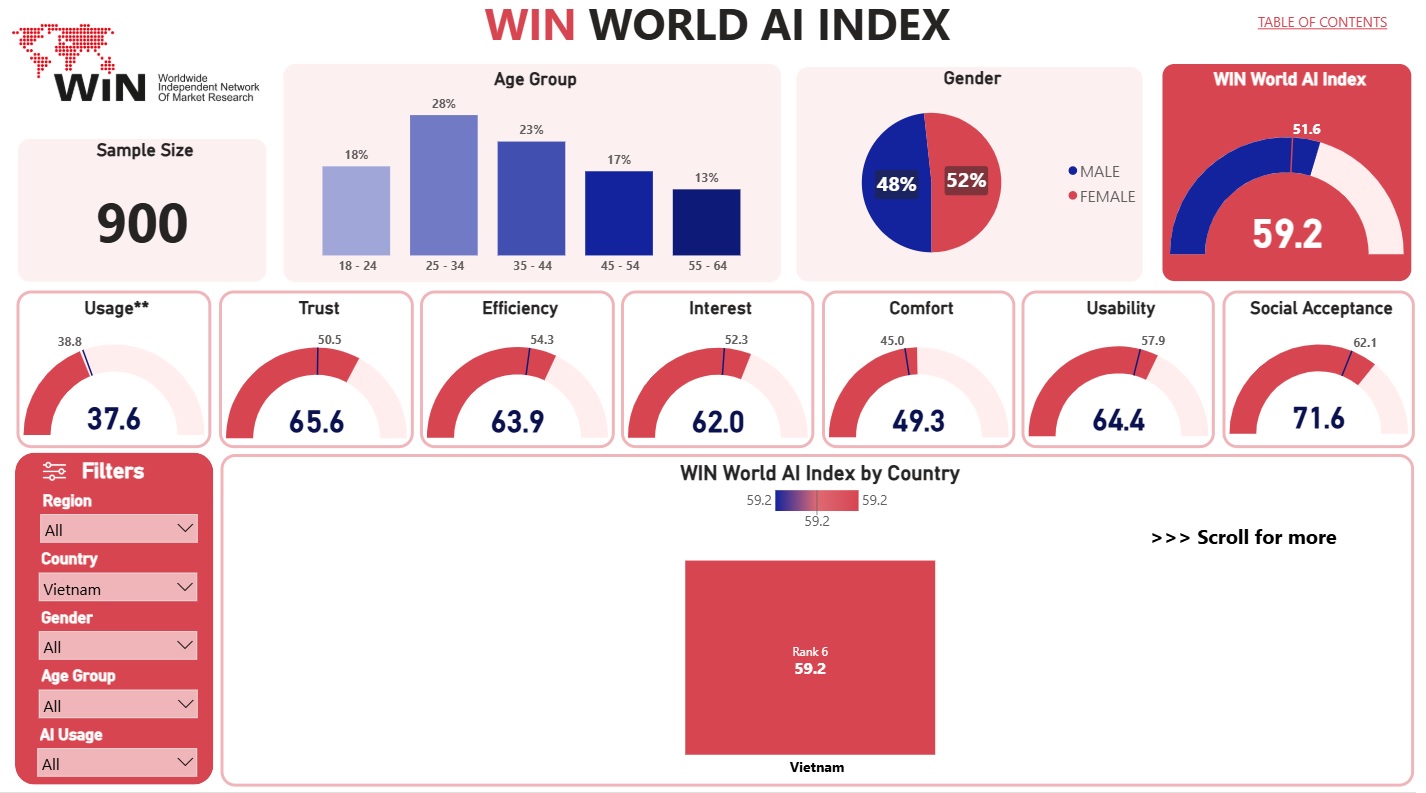
Vietnam ranks 6th out of 40 in the WIN 2024 Global AI Index (Source: WIN)
At the same time, Vietnam is making solid strides in strengthening digital infrastructure - an essential backbone for large-scale AI deployment.
In 2024, for the first time, Vietnam was placed in the “Very High” group in the United Nations E-Government Development Index, ranking 71st globally and 5th in Southeast Asia. This marks a growing national readiness for digital transformation and the systemic integration of AI technologies.
2. National policy: Decisive moves to make AI a new growth engine
To realize its vision of becoming a regional innovation hub and a global player in AI solutions and applications by 2030, the Vietnamese government has issued a series of strategic policies and key incentives.
In 2021, the government introduced the National Strategy on Research, Development, and Application of Artificial Intelligence by 2030 (Decision No. 127/QĐ-TTg). This strategy outlines a clear roadmap for establishing a legal framework, developing data and computing infrastructure, and promoting AI research and applications across economic and social sectors [4].
Artificial intelligence has also been identified as one of nine key technology sectors assigned to the National Innovation Center (NIC) by the Ministry of Planning and Investment to develop strategic visions and execution plans. Alongside AI, these include smart manufacturing, smart cities, digital content, cybersecurity, environmental tech, medtech, semiconductors, and green hydrogen - recognized as foundational pillars for national competitiveness in the coming decade [5].
Parallel to these national strategies, Vietnam is finalizing a dedicated legal framework for AI. A new AI Law is currently under development and expected to be passed by the end of this year, alongside an updated National AI Strategy, an AI Action Plan, and an AI Code of Ethics [6].

Minister of Science and Technology Nguyen Manh Hung speaking at a national scientific conference (Source: BambuUP)
From a business support perspective, Decree No. 182/2024/ND-CP provides a major boost by establishing an Investment Support Fund for priority technologies such as AI, semiconductors, and digital tech. The fund covers a wide range of R&D and tech innovation costs, easing the financial burden for businesses developing new products.
Notably, training and workforce development expenses are subsidized up to 50%, enabling enterprises to build a highly skilled talent pool in critical sectors. R&D support is also flexibly structured by project type, allowing companies more financial space to experiment, iterate, and scale strategic technologies [8].
The Digital Technology Industry Law (Law No. 71/2025/QH15), enacted in July 2025, reaffirms Vietnam’s priority for digital economy foundations.
The law emphasizes developing digital products and services, promoting R&D, and investing in critical infrastructure like data centers, cloud computing, and digital connectivity. These efforts create a favorable environment for AI, semiconductor, and digital technology firms to innovate, accelerate growth, and enhance competitiveness during digital transformation [9].
In addition to current legislation, the draft AI Law proposes establishing the National AI Development Fund - a state-financed, non-profit fund outside the national budget. Its mission is to mobilize and allocate resources for AI research, development, application, and governance in Vietnam [10].

The draft AI Law proposes the establishment of a national AI fund in Vietnam (Source: BambuUP)
Though still under discussion, this proposal reflects Vietnam’s long-term vision to invest in AI infrastructure and core capabilities, laying the groundwork for tech development in the decades ahead.
On the global stage, Vietnam is also actively participating in international cooperation mechanisms, most notably the “Friends of the Hiroshima AI Process,” joining over 50 countries in promoting a comprehensive, safe, and inclusive AI governance framework [12].
Taken together, these policies demonstrate the government’s strong commitment to building a robust AI ecosystem by improving access to capital, infrastructure, and regulatory frameworks - crucial foundations for Vietnam to accelerate AI growth and move closer to becoming a leading innovation hub in the region.
3. Businesses and Startups: The dynamic engine of Vietnam’s AI ecosystem
With strong support from government policies, Vietnam’s AI enterprise and startup landscape is accelerating rapidly. Major corporations are actively investing in AI, gradually building robust tech platforms and ecosystems.
FPT is developing its FPT.AI platform and a suite of GenAI applications for businesses. Viettel is creating a comprehensive AI ecosystem covering operations management, data analytics, digital twins, and automation. VNPT has built an AI assistant platform serving tens of millions of users, while VinGroup, through VinAI, focuses on computer vision, smart mobility, and autonomous driving technologies.
In parallel, other leading ICT companies like CMC (AI for authentication and enterprise automation), Zalo AI from VNG, and Mobifone are expanding AI integration into their customer service offerings - further enriching the AI application landscape across Vietnam.
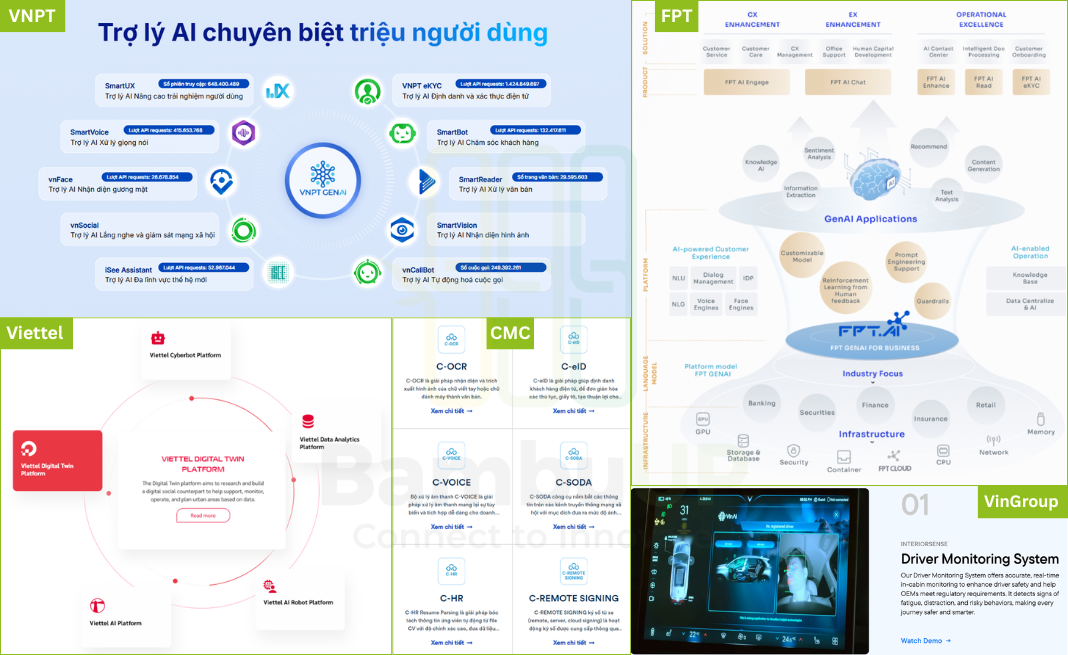
Major players in Vietnam’s AI race (Source: BambuUP)
The startup ecosystem is also gaining momentum, with AI-related venture capital steadily rising - from $3.3 million in 2017 to $25 million projected in 2025 [14]. Notable AI startups such as OKXE, MFast, Teky, Indoplus, and Jobhopin have raised impressive funding rounds [15].
In 2025, two Vietnamese startups - AI Hay (an AI-based language learning assistant) and Kamereo (AI for food supply chain management) - were recognized in Forbes Asia’s 100 to Watch, underscoring the growing regional impact and potential of Vietnam’s AI startup scene [11].
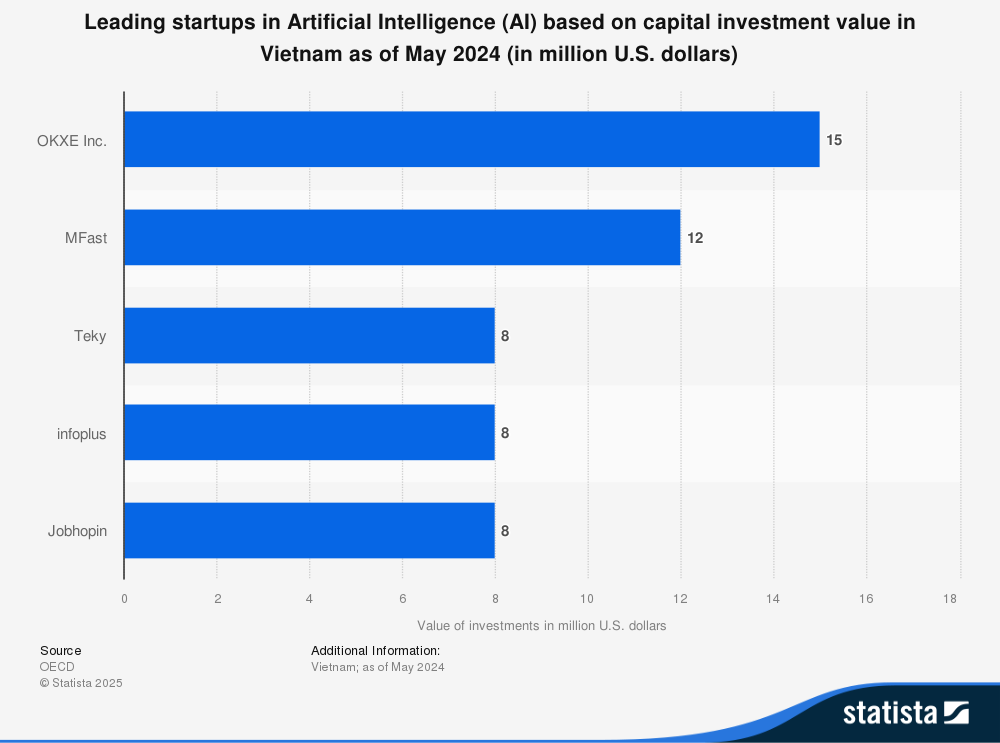
Top 5 Artificial Intelligence (AI) Startups in Vietnam by Investment Value as of May 2024 (in million USD) (Source: Statista)
Vietnam currently ranks second in Southeast Asia for the number of GenAI startups, accounting for 27% of the ASEAN total. As of 2024, AI-related startups in Vietnam had attracted a cumulative $780 million in investment [12].
This growth is further supported by a wide range of public and private initiatives such as Samsung Innovation Campus, Google for Startups Accelerator, Techfest, and the VNEI network. Investment funds and programs like VinVentures, BK Fund, and NVIDIA Inception are also providing critical resources - ranging from funding and compute infrastructure to expert mentorship - creating an ideal environment for breakthrough AI products [12].
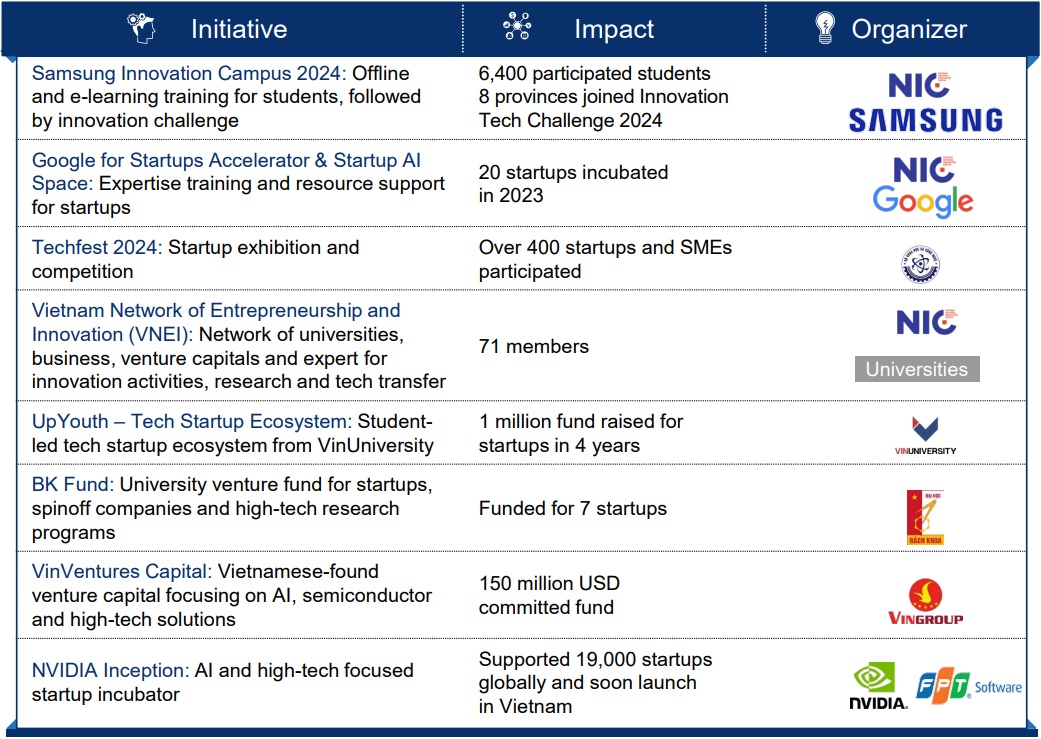
Initiatives supporting AI startup development in Vietnam (Source: Internet)
In this context, the VietLeap AI Accelerator 2025 - launched by the National Innovation Center (NIC) in partnership with Japan International Cooperation Agency (JICA), and strategically advised by Boston Consulting Group (BCG), implemented by BambuUP & 01Booster - emerges as the first dedicated accelerator program tailored for Vietnamese AI startups.
The program serves as a meaningful launchpad, helping startups scale through a comprehensive suite of activities: deep-dive workshops, personalized mentorship, and extensive market access - spanning product strategy, AI engineering, policy navigation, fundraising, and corporate collaboration both locally and internationally.
Backed by a network of 20+ experts from Vietnam, Japan, Australia, Thailand, and beyond, VietLeap AI Accelerator 2025 offers grounded, diverse perspectives tailored for sustainable growth - contributing to the continued momentum of Vietnam’s expanding AI ecosystem.

VietLeap AI Accelerator 2025 brings together a high-caliber expert network to help startups scale (Source: BambuUP)
4. Open Innovation: Synergizing to amplify AI value
Open innovation is emerging as a strategic pathway in Vietnam's AI ecosystem, as data, technology, and knowledge are no longer confined to "black boxes" but increasingly shared and co-created among government, enterprises, academia, and startups.
One of the cornerstones of open innovation is data. Vietnam is actively promoting open data initiatives, with over 10 million records published and 87% of government agencies now providing open data. However, enterprise data remains largely fragmented, used internally, and lacking connectivity and sharing mechanisms [16].
To address this, the Government issued Decree 47/2020/ND-CP, clearly defining "open government data" as data publicly released for agencies, individuals, and organizations to freely use, reuse, and share. The National Data Portal (data.gov.vn) was also established as a platform providing open datasets accessible for both commercial and non-commercial purposes. In addition, the National Data Strategy to 2030 emphasizes encouraging data sharing and utilization to support research, innovation, and technological development [16].
Alongside data, open technology - particularly open-source software - is being viewed by the Government as a key to mastering digital infrastructure. At the 2025 Vietnam Open Technology Forum, the Minister of Science and Technology emphasized that digital technology is the "oxygen" of the new era and can only become widespread when coupled with an open culture - including open source, open architecture, and open standards [17].
The Government is leading this trend by implementing open source in digital government, building a national AI supercomputing center, open data centers, and issuing open AI challenges to unlock the domestic technology market. Research institutions and universities are expected to nurture communities developing open technologies, while businesses play a central role in commercializing and scaling AI applications grounded in openness and collaboration.
In alignment with national policy, several open AI projects are also being initiated by local organizations. At AI Day 2023, VinAI officially launched PhoGPT - the first Vietnamese-language open-source large language model (LLM). Trained entirely on Vietnamese data, the model aims to achieve core technology sovereignty and provide a local alternative to global open LLMs such as Meta’s LLaMA and Mistral [19].
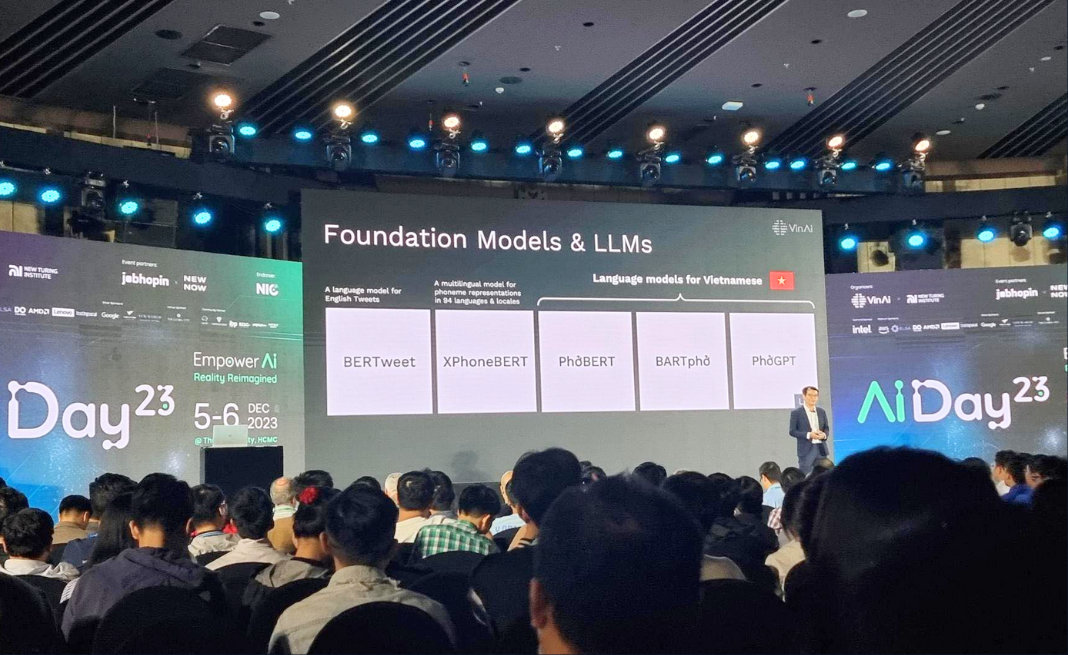
PhoGPT - the first Vietnamese-language open-source large language model (LLM) (Source: Internet)
Concurrently, the VIC 2025 (ViGen) project - a collaboration between the National Innovation Center (NIC, under the Ministry of Finance), Meta, and the AI for Vietnam organization - is developing an open-source Vietnamese language dataset for AI [18].
In June 2025, Vietnam established the "Au Lac AI Alliance" - the country's first AI alliance, comprising over 20 members from tech enterprises, academia, and government bodies. The alliance aims to develop Vietnamese-language LLMs, build AI infrastructure, and foster an open AI community where organizations and individuals can freely access public assets like data, models, and source code - even for commercial use - to realize the goal of national technological sovereignty [20].

Vietnam established the country's first AI alliance in June 2025 (Source: Internet)
Beyond technology and data, open innovation in AI is being exemplified by multi-party collaboration models among corporations, startups, and innovation support organizations. Increasingly, major Vietnamese corporations are co-developing solutions with startups to address strategic operational challenges.
For instance, in the VietLeap AI Accelerator 2025 program, facilitated by the BambuUP open innovation platform, corporations such as Heineken, Vietcombank, Talentnet, and Faslink introduced real business challenges related to operational optimization, HR data analytics, supply chain transparency, and customer experience enhancement through AI [21].
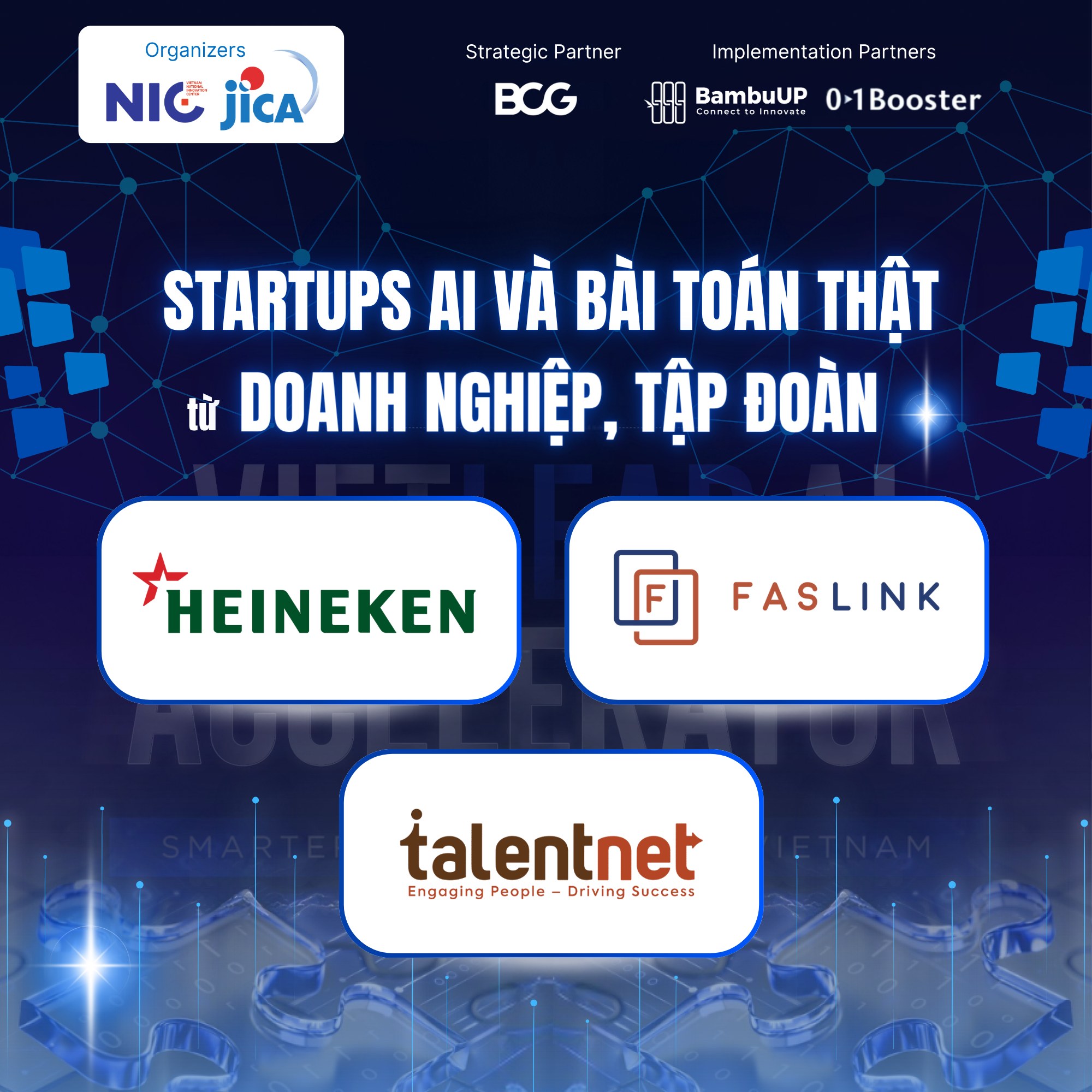
Promoting open innovation between enterprises, corporations, and startups through the VietLeap AI Accelerator 2025 program (Source: BambuUP)
Each challenge reflects the core needs of modern businesses and opens co-creation opportunities - where startups can test technologies directly within enterprise environments, helping shorten innovation cycles and deliver tangible value for both sides.
As a platform connecting open innovation information and resources for businesses, BambuUP continuously fosters linkages among corporations, startups, and academic institutions, enabling the practical application of AI solutions and generating sustainable market value.
Thus, open innovation is not just a tech trend but is evolving into a collaborative ecosystem - where every organization has the opportunity to co-create and scale the value of AI.
5. The road ahead: Great opportunities accompanied by long-term challenges
Despite rapid growth and increasing attention from both the public and private sectors, the journey of AI development in Vietnam still faces several major challenges.
First, the shortage of high-quality talent remains a critical bottleneck. Each year, around 60,000 IT students graduate, yet only about 1,000 have deep expertise in AI - and fewer than 300 are considered high-level experts [13]. The gap between market demand and talent supply delays many AI projects or leaves them understaffed.
The talent shortage remains a major bottleneck in Vietnam’s AI landscape (Source: BambuUP)
To address this, the Vietnamese government has ramped up training programs through the National Innovation Center (NIC), while the Ministry of Education and Training has approved AI and Data Science curricula at the bachelor’s, master’s, and doctoral levels to build a solid talent pipeline for the future [12].
Second, Vietnam’s computing infrastructure remains weak relative to real-world demands. The country currently lacks internationally standard AI supercomputing systems, forcing most companies to rent GPU infrastructure and cloud services from providers like AWS, Azure, or Google Cloud. High costs and dependency create barriers to training next-gen large language models.
Third, data quality and standardization are still lacking. Although data is considered the "fuel" of AI, in Vietnam it remains fragmented, with limited centralized datasets and no unified data governance framework. This hampers the training of local AI models and raises concerns about privacy and data security.
Fourth, investment in AI remains modest. Despite growth, total investment in Vietnamese AI startups in 2024 reached only $80-100 million - still modest relative to market potential.
There are few Series B deals, a limited number of tech unicorns overall, and virtually no unicorns in the AI vertical. This reflects the difficulty AI companies face in securing large-scale capital to scale operations. Meanwhile, national and private investment funds focused specifically on AI remain insufficient to drive major ecosystem breakthroughs.
Lastly, regulatory and legal frameworks are still in progress. Guidelines on pilot testing, safety standards, licensing, and AI-specific sandboxes are being drafted. This legal vacuum makes enterprises hesitant to deploy AI, especially in sensitive sectors like healthcare, finance, or public governance.
Nonetheless, Vietnam’s AI outlook remains highly promising. With a fast-growing market, a young and abundant workforce, increasingly supportive policies, and strong participation in international cooperation frameworks, Vietnam is emerging as a "golden land" for AI investment.
Domestic and foreign enterprises can seize opportunities through research sponsorships, joint ventures to build localized AI solutions, innovation centers, or direct investment in high-potential AI startups.
In the next decade, Vietnam is expected to witness a powerful wave of AI-driven investment and innovation, positioning artificial intelligence as one of the key growth engines of its digital economy.
—-------
Phượng Lê