
 One platform connecting startups, corporations, research institutions, regions and investors











 Playbook & Handbook · February 6, 2026
Winning Accelerator Playbook 2026 by BambuUP
 REGTECH: THE QUIET TECHNOLOGY GLOBAL BUSINESSES CAN’T DO WITHOUT IT

REGTECH: THE QUIET TECHNOLOGY GLOBAL BUSINESSES CAN’T DO WITHOUT IT
As Vietnamese businesses accelerate their digital transformation and expand into international markets, regulatory compliance has become a strategic challenge rather than an administrative task. From tax automation to continuous security certification and enterprise risk management, four compliance tech startups (Avalara, Vanta, Numeral, and VComply) are using AI and cloud platforms to help companies go global with confidence. Here are the innovation models Vietnamese manufacturers, exporters, and financial institutions should consider.
Avalara: All-in-One Tax and Licensing Compliance
Businesses selling across states or internationally often face a “matrix” of tens of thousands of distinct tax rates, each with its own regulations, filing deadlines, and forms. Managing this enormous volume of data manually is not only overwhelming but also prone to errors and delays, exposing companies to heavy penalties that can disrupt the supply chain.
Founded in 2004 and headquartered in Seattle, Avalara provides regulatory compliance solutions for industries ranging from manufacturing and retail to e-commerce. The company was previously listed on the New York Stock Exchange (NYSE) before reaching a landmark moment in the tax compliance software industry: its acquisition by private equity firm Vista Equity Partners for USD 8.4 billion in 2022, after which it was taken private (Source: GeekWire).
What sets Avalara apart is its core product, AvaTax, which calculates taxes in real time based on customer location and product type, while automatically completing filings for each jurisdiction. In late 2025, the platform took another innovative step by introducing Avi, a network of AI agents capable of automating complex chains of tasks such as determining tax obligations, filing returns, and validating exemption certificates. The workflow is designed with a human-approval checkpoint at the final step to ensure absolute accuracy (Source: PR Newswire).
As of October 2025, Avalara’s platform serves more than 43,000 users worldwide (Source: DataCentreNews UK). The USD 8.4 billion Vista Equity Partners transaction remains a strong testament to the startup’s leadership position in financial governance technology.
For Vietnamese manufacturers and exporters that are expanding sales through international e-commerce marketplaces or establishing subsidiaries in new markets, Avalara’s model offers a strategic insight. Rather than allowing individual departments to handle tax, customs, and licensing matters in a fragmented manner, companies should work toward building a centralized digital hub that minimizes the risk of errors when entering markets with stringent regulatory frameworks, such as the United States, the European Union, and the Comprehensive and Progressive Agreement for Trans-Pacific Partnership (CPTPP) bloc.
Vanta: Turning Security Certification into a “Living System” Instead of Paper Records

To supply B2B software or services to major partners, particularly banks and financial institutions, technology companies must demonstrate their information security capabilities through a series of security certifications. However, the traditional audit process often means months of wrestling with Excel spreadsheets, manually collecting screenshots, and enduring endless email chains between departments (Source: Forbes).
Vanta was founded in 2018 by Christina Cacioppo, a former product manager at Dropbox, together with co-founder Erik Goldman (Source: CNBC). Starting with a focus on resolving compliance pain points for startups within the Y Combinator accelerator program, the platform quickly proved its broad applicability and progressively expanded its customer base to include large enterprises.
Rather than relying on periodic reviews, Vanta integrates directly into customers’ technology infrastructure to monitor continuously and automatically collect compliance evidence, eliminating manual screenshots and cross-referencing altogether. The system now incorporates artificial intelligence to perform the first layer of security review, positioning humans as the final checkpoint who validate results before they are handed over to auditors (Source: Forbes).
This innovative solution has enabled Vanta to raise approximately USD 504 million across five funding rounds since 2018. Most recently, its USD 150 million Series D round lifted the company’s valuation by 69% in just one year, from USD 2.45 billion to USD 4.15 billion (Source: Bloomberg). Named to the 2026 CNBC Disruptor 50 list, Vanta is now a trusted partner to many prominent listed companies, including Atlassian (Source: CNBC).
In Vietnam’s market, as banks, insurers, and fintech companies expand their reach, meeting stringent standards such as ISO 27001 and personal data protection regulations has become a prerequisite for signing contracts. Vanta’s approach demonstrates that shifting from a “once-a-year” audit model to a system of continuous compliance monitoring is an essential building block for financial institutions seeking to develop sustainable information security capabilities.
Numeral – AI as a “Virtual Tax Accountant” for E-Commerce Businesses

The U.S. market currently has more than 11,000 sales tax jurisdictions, each issuing tax rates and regulations that change constantly. In particular, following the 2018 U.S. Supreme Court ruling that requires businesses to collect tax even without a physical presence in a state, most e-commerce and SaaS companies have been left “overwhelmed,” lacking the resources to track their obligations at scale (Source: TechCrunch).
This is also the difficult, real-world experience that co-founder Sam Ross encountered while running his own online stores. To resolve this challenge once and for all, in 2023, the former Airbnb product manager teamed up with Matt DuVall, who previously worked at Stripe and Notion, to officially launch Numeral (Source: TechCrunch).
At the core of Numeral’s platform is a “virtual tax accountant” that automatically scans and monitors tax nexus thresholds in each jurisdiction, then calculates taxes in real time, handles correspondence from authorities, and submits filings. The founding team believes that because sales tax rules are clearly defined and leave little room for subjectivity, this is an ideal domain to delegate to AI review with an extremely low risk of error (Source: TechCrunch).
This sharp solution has delivered rapid growth for Numeral. Just six months after completing its USD 18 million Series A, the company raised USD 35 million in a Series B round, lifting its valuation to USD 350 million. With revenue growing 3.5 times in a single year, the platform now serves more than 2,000 businesses, including Ridge, Eight Sleep, and Graza (Source: TechCrunch).
Numeral’s rise offers a timely lesson for Vietnamese manufacturers and exporters bringing goods directly into the U.S. and Europe through Amazon, Shopee, or D2C channels. The threshold for tax obligations is now triggered as soon as a business exceeds a certain sales volume in a given country or territory. Proactively applying technology to stay on top of tax thresholds will serve as a shield protecting businesses from unwarranted back taxes and penalties on their journey to global markets
VComply – A Risk and Compliance Operating System for Growing Businesses
Risk and compliance management is often seen as an administrative burden until an unfortunate incident occurs. In the past, founder Harshvardhan Kariwala himself suffered heavy penalties simply for inadvertently missing a reporting obligation at a previous company. This costly experience made him realize that fragmented, unsystematic regulatory tracking through spreadsheets is a “ticking time bomb” for any business in a phase of scaling up (Source: VComply).
From that pain point, Kariwala founded VComply, headquartered in the United States. The potential of this digital risk management solution quickly caught the eye of the renowned investment fund Accel, leading to a USD 2.5 million seed investment in 2019. This financial boost gave the startup a springboard to confidently expand into demanding regions such as Europe, New Zealand, and Australia (Source: TechCrunch).
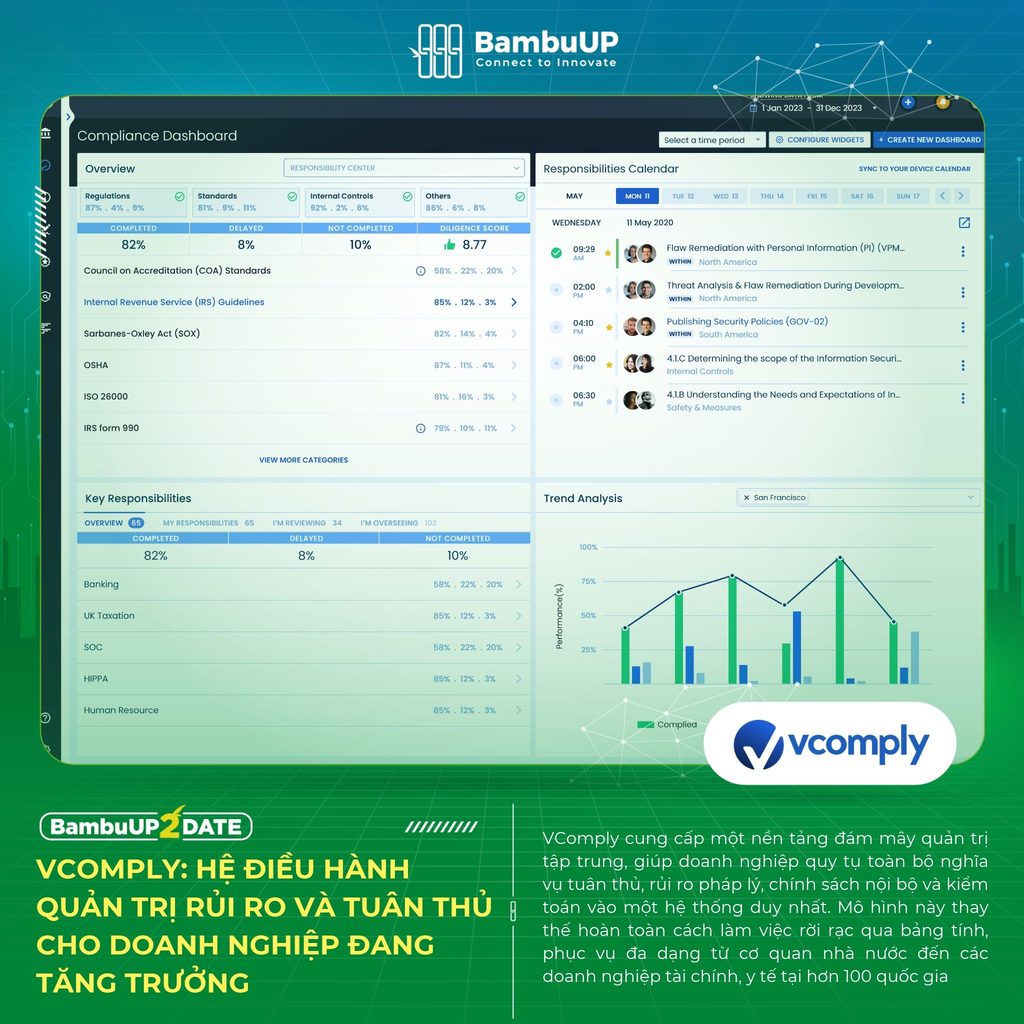
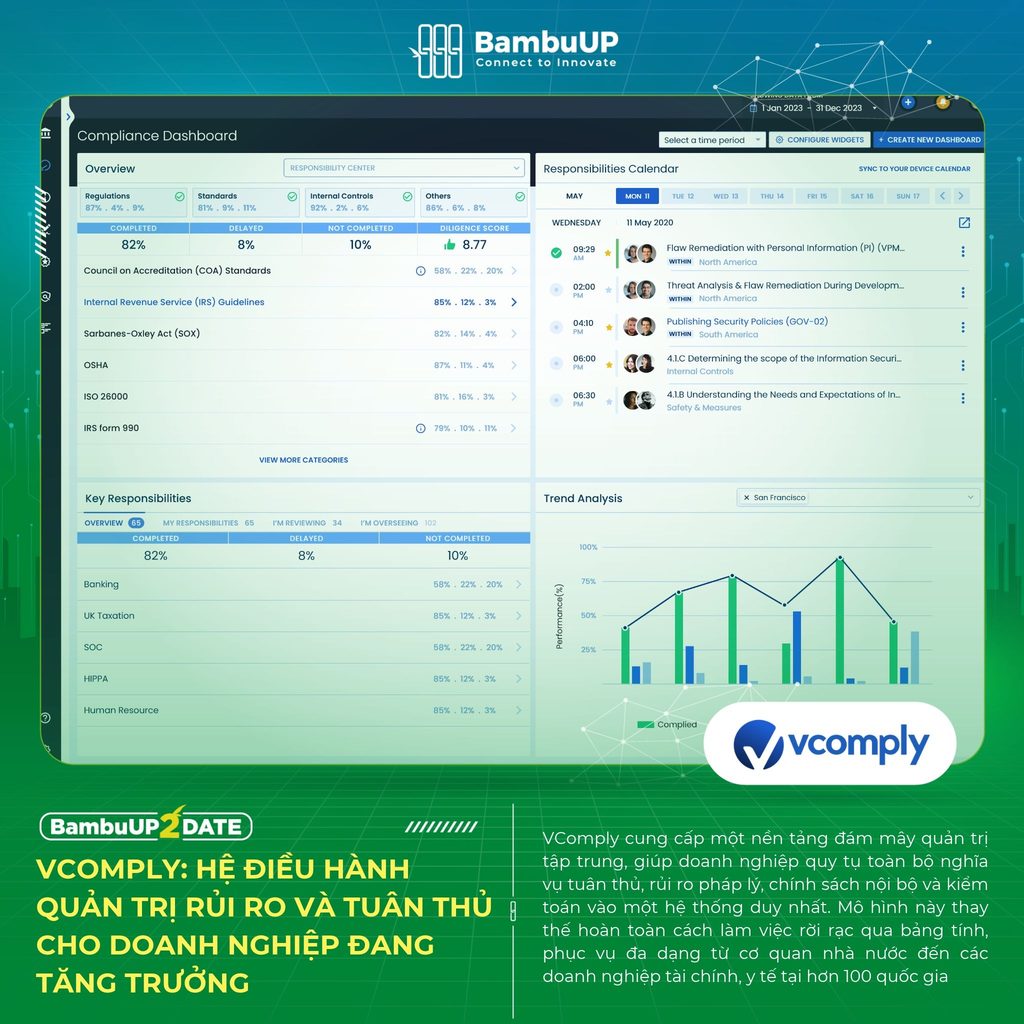
Rather than leaving regulatory requirements scattered, VComply’s cloud system enables businesses to assign compliance responsibilities clearly to each department and consolidate execution status into a central dashboard. Notably, the platform is designed so efficiently that an organization can set up, assign permissions, and begin operating the system in just 30 minutes (Source: TechCrunch).
The appeal of a clear and flexible “compliance operating system” helped VComply reach approximately 4,000 users across more than 100 countries from its earliest days. The platform has proven its ability to serve a wide range of complex sectors, with a client portfolio spanning from the global F&B chain Burger King to the UK Department for International Trade (Source: TechCrunch).
Looking at the Vietnamese market, particularly banks and insurance companies facing increasingly dense compliance pressure from State Bank of Vietnam regulations, international standards, and data security requirements, VComply’s centralized approach is truly worth learning from. Rather than letting departments operate as isolated islands handling regulatory matters independently, digitizing and consolidating them onto a single, end-to-end governance platform will be the strongest shield against the risk of oversights, just as the hard-earned lesson the founder of VComply once experienced.