
 One platform connecting startups, corporations, research institutions, regions and investors












 Playbook & Handbook · February 6, 2026
Winning Accelerator Playbook 2026 by BambuUP
 CYBERSECURITY: 4 STARTUPS INNOVATING SECURITY TECHNOLOGIES FOR CONNECTED DEVICES AND SYSTEMS

GOOGLE RELEASES TWO NEW AI CHIP SYSTEMS: A SHIFT IN THE SEMICONDUCTOR RACE
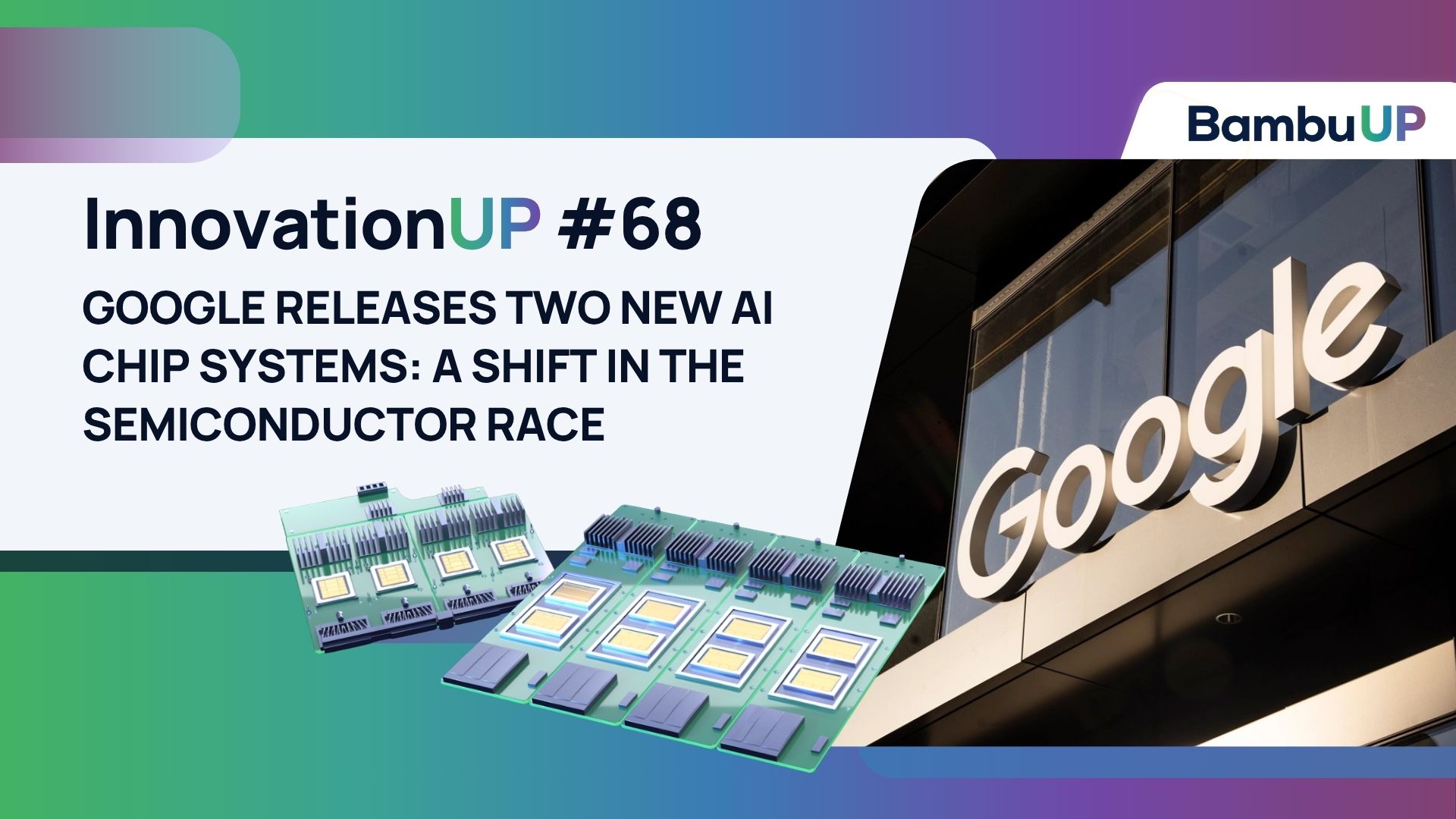
Google has released two new AI chip systems, TPU 8tx and TPU 8i Max, designed to address growing demands for data security and computing performance. The announcement highlights a shift toward specialized AI hardware in the semiconductor industry, as competition increasingly focuses on practical applications, operational efficiency, and the ability to meet diverse enterprise needs.
As artificial intelligence (AI) becomes increasingly integrated into business operations, the race to develop AI chips is no longer focused solely on increasing computing power. Growing demands for data security, complex information processing, and operational efficiency are driving technology companies to develop specialized hardware for different applications. Against this backdrop, Google has introduced two new AI chip systems, raising an important question: Will the future of the semiconductor industry be defined by the most powerful processors, or by the ability to optimize technology for specific needs?
Google Introduces Two New AI Chip Systems, Intensifying Competition with Nvidia
On November 9, 2026, Google announced two new AI processing systems, TPU 8tx and TPU 8i Max, expanding its portfolio of in-house Tensor Processing Units (TPUs). The announcement marks another step in Google’s strategy to compete with Nvidia, which currently holds a leading position in the AI chip market (Source: Reuters).
TPUs are processors designed by Google to accelerate machine learning and AI workloads. Initially, the technology primarily supported Google’s internal products, including Google Search, YouTube, and Gemini. However, the company has been gradually expanding access to its TPUs through Google Cloud and deployment options for enterprise customers (Source: Google Cloud).
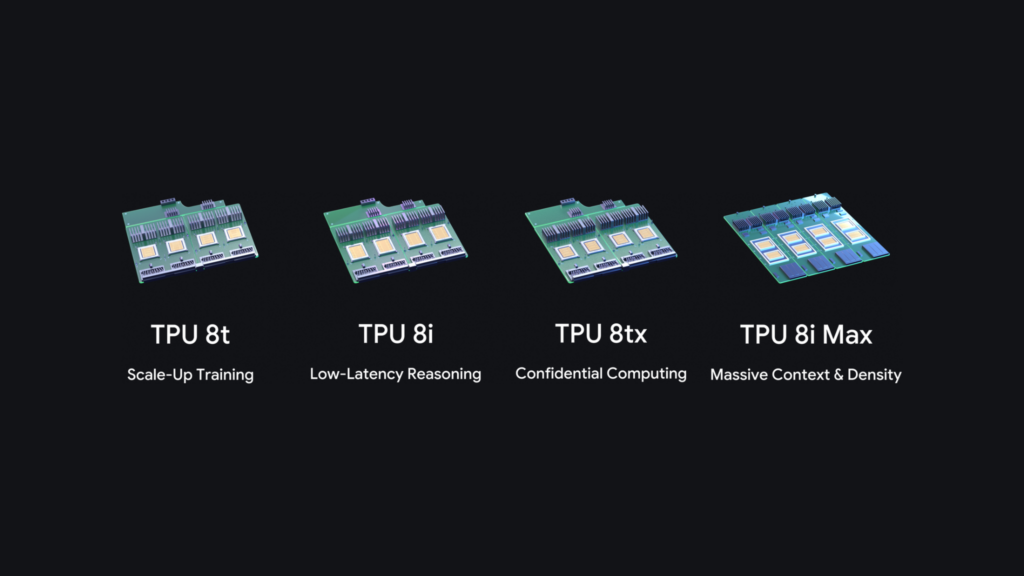
Rather than introducing two entirely new chip architectures, TPU 8tx and TPU 8i Max build on existing hardware platforms, with system configurations optimized to address specific requirements. TPU 8tx focuses on protecting sensitive data during processing, while TPU 8i Max targets AI applications that require handling large amounts of information within a single workload (Source: Google).
Google also reported that its TPU ecosystem now serves nearly 100 customers, including AI research laboratories, financial institutions, retailers, and universities. This reflects the company’s efforts to establish its proprietary chip technology as a commercial option in the AI computing market (Source: Google Cloud).
From Data Security to Large-Scale Processing: Two Directions in AI Chip Development
The key distinction between the two new systems lies in how Google addresses specific challenges businesses face when deploying AI.
Data can typically be encrypted during storage or transmission, but it generally needs to be decrypted in memory for computation. This presents a challenge for organizations handling sensitive information, such as banks, healthcare providers, and government agencies.
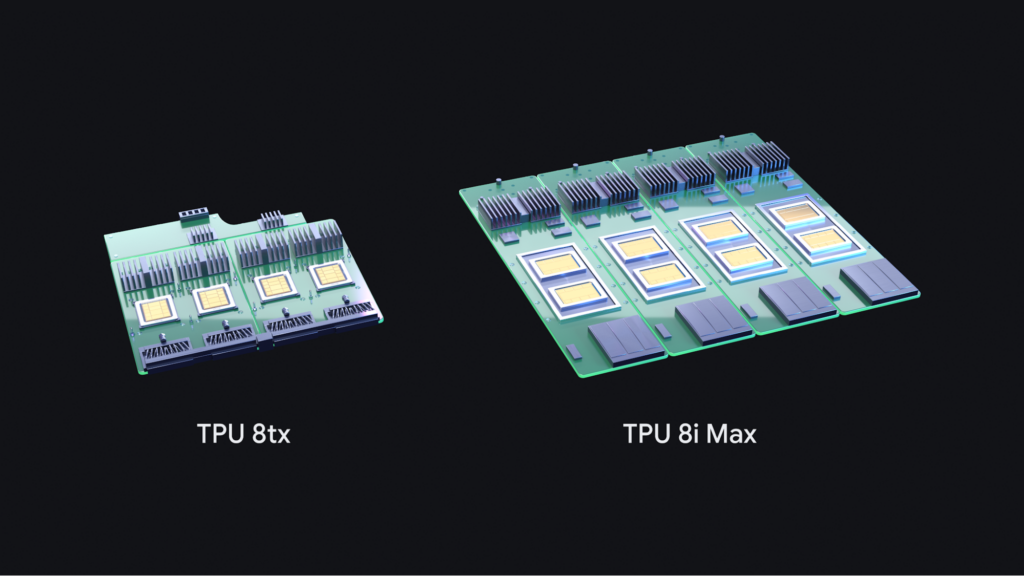
TPU 8tx builds on the TPU 8t platform, combining it with fifth-generation AMD EPYC processors, AMD’s high-performance x86-64 processor family, and hardware-based confidential computing technology. The system is designed to protect data and AI model parameters even while they are being processed, while supporting inference and model fine-tuning using an organization’s proprietary data (Source: Google Cloud).
Google states that TPU 8tx can reduce latency by up to 50% compared with TPU 8t through high-speed interconnect technology, while maintaining hardware-level security protections. However, these performance figures are based on Google’s own claims and do not necessarily indicate equivalent improvements across all real-world applications (Source: Google).
While TPU 8tx focuses on security, TPU 8i Max is designed to address memory and bandwidth limitations when processing large volumes of data. Google combines two TPU 8i chips within a single package, doubling computing capacity, SRAM capacity, and HBM memory bandwidth compared with a single TPU 8i chip. This configuration supports workloads requiring long context windows, such as analyzing large software codebases, mathematical reasoning, and pharmaceutical research (Source: Google Cloud).
Notably, rather than expanding infrastructure space in proportion to the number of chips, Google aims to integrate greater computing capacity within the same server rack footprint. This is particularly important as data centers must optimize processing performance, installation space, and energy consumption simultaneously. These developments demonstrate that semiconductor innovation is taking place not only at the chip design level but also through the integration of processors, memory, interconnect systems, and security mechanisms into comprehensive computing solutions.
The AI Chip Race Shifts from Raw Computing Power to Application-Specific Optimization
Google’s introduction of two specialized TPU configurations reflects a broader shift in the global AI chip industry. As artificial intelligence becomes more widely deployed in real-world operations, market demand is expanding beyond processors with the highest computing performance toward solutions that meet specific requirements for security, processing speed, and operational efficiency.
This shift is particularly significant as AI moves beyond content generation into more complex workflows, from enterprise data analysis to decision-making support and task automation. Each industry places different demands on computing infrastructure, encouraging chip manufacturers to develop specialized systems rather than focusing exclusively on increasing processing power through a single general-purpose platform.
For Google, expanding its TPU portfolio also carries strategic significance in its competition with Nvidia and other AI hardware providers. Rather than competing solely on performance specifications, Google is building an ecosystem that integrates processors, cloud computing infrastructure, and AI development tools. The company is also improving TPU compatibility with widely used frameworks such as PyTorch, reducing adoption barriers for developers and enterprise customers (Source: Google Cloud).
Across the industry, this trend toward specialization could provide businesses with more options while intensifying competition in the AI semiconductor market. However, the competitive advantage of any platform will increasingly depend on its ability to meet real-world application requirements, integrate with existing systems, and deliver competitive total deployment costs, rather than relying solely on published technical specifications.
This shift suggests that the AI chip industry is entering a stage where technological value is measured not only by computing power but also by the ability to deploy AI effectively and generate tangible economic value.
Rethinking Enterprise AI Adoption Strategies
The emergence of specialized AI chip systems provides businesses investing in artificial intelligence with a wider range of infrastructure options. Rather than automatically choosing hardware with the highest computing capacity, organizations need to assess the specific requirements of each application to identify the most suitable infrastructure.
For businesses in finance, healthcare, and other industries with strict data protection requirements, the ability to process sensitive information on hardware with enhanced security features may become an important consideration when selecting an AI platform. Meanwhile, companies developing large-scale document analysis systems, intelligent software, or AI agents may prioritize memory capacity and processing efficiency for long-context workloads.
However, chip selection is only one component of an effective AI adoption strategy. Businesses must also consider compatibility with existing systems, operating costs, dependence on individual technology providers, and the economic value of each solution. In particular, performance figures published by manufacturers should be evaluated against real-world workloads before investment decisions are made.
Google’s latest developments suggest that innovation in artificial intelligence is increasingly moving toward solutions tailored to practical application needs, rather than simply expanding technological capabilities in isolation. This also creates opportunities for technology companies, startups, and infrastructure providers to collaborate on developing specialized AI systems for different industries.
Conclusion:
Google’s expansion of its TPU portfolio with two new systems highlights a new phase in the AI semiconductor race, where data security, memory performance, and workload-specific optimization are becoming important competitive factors. These advancements could help accelerate AI commercialization, although their actual value will ultimately depend on how effectively they perform in enterprise environments.
In this context, BambuUP continues to strengthen its role in connecting businesses with startups, experts, and innovation resources, helping expand opportunities for technological collaboration and identify AI solutions that address practical business development needs.