
 One platform connecting startups, corporations, research institutions, regions and investors
 Southeast Asia Innovation Landscape 2026
 ESG Data-as-a-Service (DaaS) A game-changer for resource-constrained SMEs

Vietnam shows steady signs of progress in the Global Innovation Index (GII 2020)
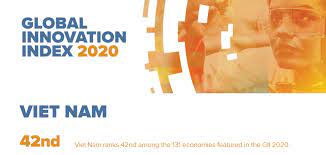
- Vietnam ranks 42nd out of 131 economies in the Global Innovation Index (GII), a measure of countries’ innovation capacity, highly correlated with more efficient businesses and growth. economy.
- Vietnam has made important strides in recent years, but more needs to be done to compete with the larger economies of Southeast Asia.
- The article provides context for the GII findings, discussing in more detail the selected indicators.
In its annual report published on September 2, 2020, the World Intellectual Property Organization (WIPO) ranked Vietnam 42nd out of 131 countries on the Global Innovation Index (GII). With a score of 37.12 out of 100, Vietnam ranks third in Southeast Asia after Singapore and Malaysia, and ninth in the Asia-Pacific region. However, we are at the top of the group of 29 lower-middle-income economies.
What does this say about Vietnam’s innovation capacity? Along BambuUP consider some impact on the business environment and the development of the country.
What is GII?
Developed by WIPO in partnership with Cornell University and INSEAD, GII ranks the innovation performance of countries around the world based on 84 indicators divided into seven areas: institutions, human capital, and research research, infrastructure, market complexity, business complexity, knowledge and technology outputs, and innovation outputs.
The indicators in the GII report show that: In 2020, Vietnam’s innovation capacity has changed significantly. So, what opportunities and challenges do these numbers show us?
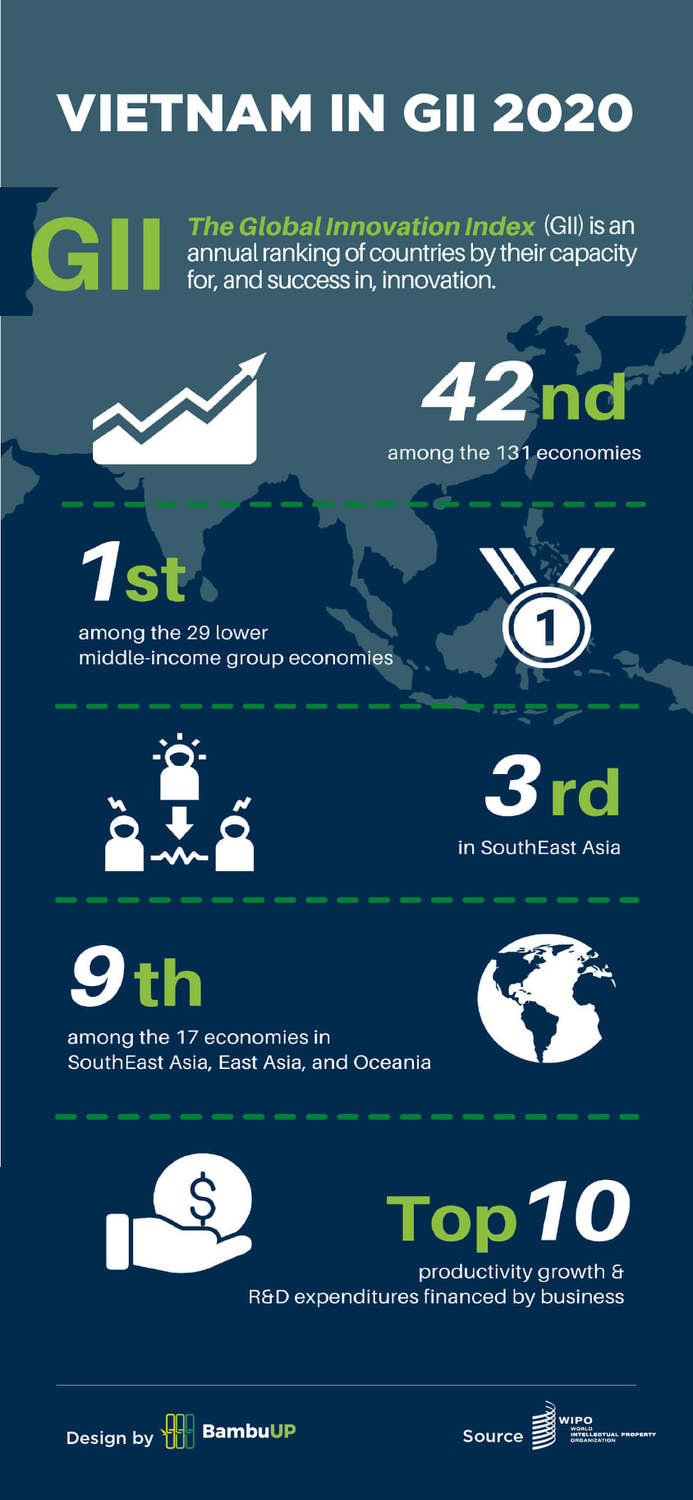
Impressive numbers of Vietnam in the GII 2020 report (design by BambuUP)
Vietnam’s strength
The GII report highlights the complexity of the market and business – these are the areas where Vietnam excels, especially in regards to access to credit and microfinance loans.
Market and business complexity are two areas where Vietnam excels
Market complexity refers to the availability of credit and an investment-supportive environment, access to international markets, competition and market size – important factors for prosperity and innovation. new.
Business complexity measures how favorable companies are to innovation. These assessments include accumulating high-quality human resources and prioritizing research activities that help businesses become more productive, competitive and innovative.
“Facilitating Government” is a guiding principle for policy, reflected in efforts to align countries with international standards and best practices with the ultimate goal of creating an enabling environment. more for business. Some of the support includes tax breaks or land-lease programs aimed at high-priority sectors such as technology and green energy.
Large multinational corporations have also established research and development (R&D) centers in Vietnam.

Large multinational corporations have also established research and development (R&D) centers in Vietnam
Vietnam is a country with a young, talented workforce with a scientific and technical background. However, we will need to devote more resources to scientific research and higher education if we are to stay ahead in the development of cutting-edge technologies.
Vietnam leads in attracting foreign direct investment and high technology (FDI). Besides, the ability to absorb and spread knowledge are also two strengths.
Mobile app creation, creative export are some of the areas related to creative output that Vietnam has done well.
In the top 10 for productivity growth and R&D spending, Vietnam also has notable improvements in access to and use of information and communication technology infrastructure. .
Challenges to be faced
Besides the progress, the GII report also points out areas where Vietnam needs improvement.
The large number of foreign students studying in Vietnam at university level plays an important role. This greatly influences the exchange of ideas and skills that drive innovation in each country. Although Vietnam has many talented young people, many of whom have been sent to study abroad, we lag behind other larger economies like Singapore in terms of attracting international students. Vietnam will need to do more to internationalize its universities, for example by offering more English-taught classes.

Besides the opportunities, Vietnam still has the challenges of the innovation process
Vietnam ranks highly for knowledge dissemination and high-tech exports. Meanwhile, labor productivity, as measured by GDP growth per hour worked, remains a weak sector.
Labor productivity is an important factor in maintaining the growth performance of each country. In Vietnam, although this figure has increased by an average of 5% annually since 2011, it is still low compared to other ASEAN countries.
For many years, Vietnam has relied on cheap labor and low raw material costs to stay competitive. However, the Government recognizes that boosting labor productivity in industry, especially in foreign direct investment (FDI) projects and in leading small and medium enterprises, is important. top importance.
Technology plays an important role in the innovation process in any country. In Vietnam, the level of imports for communication and computer services as a percentage of trade shows that the local capacity and tools are still limited in processing, sharing and storing information. digital news. To address this, the government has committed to a number of ambitious plans to digitize all aspects of society and invest in 4.0 technology.