
 One platform connecting startups, corporations, research institutions, regions and investors











 Playbook & Handbook · February 6, 2026
Winning Accelerator Playbook 2026 by BambuUP
 4 Cold Chain Models Vietnamese Exporters Should Consider

CHINA’S AI BUBBLE: FROM AN INVESTMENT SURGE TO THE PRESSURE TO COMMERCIALIZE

The sharp downturn in China’s technology market has raised concerns over China’s AI bubble, bringing renewed scrutiny to the commercialization of artificial intelligence and the effectiveness of AI adoption. As investors reassess their expectations, businesses face growing pressure to pursue innovation that delivers measurable value, from adopting the right technologies to improving operational efficiency and long-term competitiveness.
In less than four months, approximately US$480 billion in market capitalization has been wiped out as Chinese technology stocks plunged, bringing a nearly two-year rally to an abrupt halt. Amid growing concerns over valuations, market demand, and profitability, the question extends beyond whether China’s AI bubble has burst: What happens when expectations for artificial intelligence begin to outpace the economic value the technology can actually deliver?
US$480 Billion in Market Value Erased: Has China’s AI Bubble Burst?
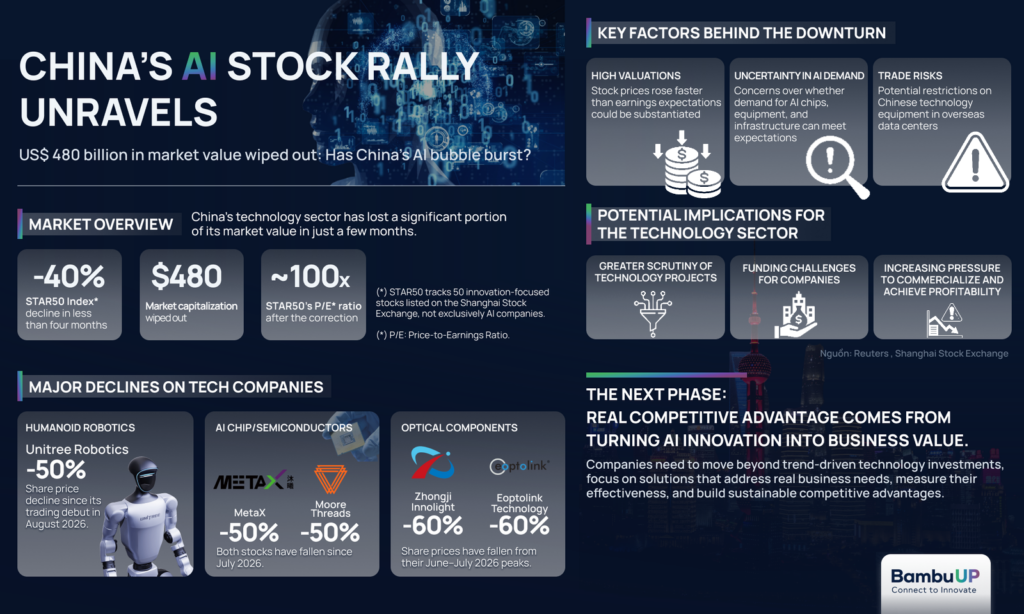
On October 26, 2026, Reuters published an analysis titled “In China, the AI bubble has already burst,” highlighting a sharp reversal in Chinese technology stocks. The STAR50 Index, which tracks 50 leading, highly liquid technology and innovation-focused companies listed on Shanghai’s STAR Market, had fallen approximately 40% from its July peak, wiping out around US$480 billion in market capitalization.
Even after the correction, the STAR50’s price-to-earnings (P/E) ratio remained at approximately 100, significantly above the Nasdaq 100’s ratio of around 30. The gap suggests that growth expectations for Chinese technology companies remain elevated, despite investors reassessing their earnings prospects. (According to Reuters)
The selloff has affected several industries widely regarded as key drivers of technological growth. Shares in robotics manufacturer Unitree have lost roughly half their value since the company began trading in August 2026. Semiconductor companies MetaX Integrated Circuits and Moore Threads Technology have also seen their shares fall by approximately 50% since July. Meanwhile, Zhongji Innolight and Eoptolink Technology, two manufacturers of optical components used in data transmission infrastructure, have declined by around 60% from their June–July peaks.
These declines do not necessarily indicate a corresponding deterioration in the companies’ technological capabilities. Rather, they reflect mounting pressure on valuations as investors question the sustainability of AI demand, profitability, and long-term growth prospects. (According to Reuters)
Beyond financial markets, technology supply chains are facing new uncertainties. In August 2026, Reuters reported that the US administration was drafting a proposal to restrict imports of certain new optical transmission equipment from China. Such equipment plays an important role in connecting chips within AI data centers.
Meanwhile, on October 23, China released a draft update to its export-control list covering 40 technologies, including AI, chip design, and other strategic fields. Although these proposals do not mean that the restrictions have taken effect, they illustrate how technological competition is becoming increasingly intertwined with trade policy and control over global supply chains. (According to Reuters and the Associated Press)
For manufacturing and export-oriented industries, these developments raise concerns extending beyond technology costs to component availability, supplier selection, and supply chain resilience. As AI becomes more deeply integrated into manufacturing operations, dependence on computing infrastructure and technological equipment is also becoming an important business risk to manage.
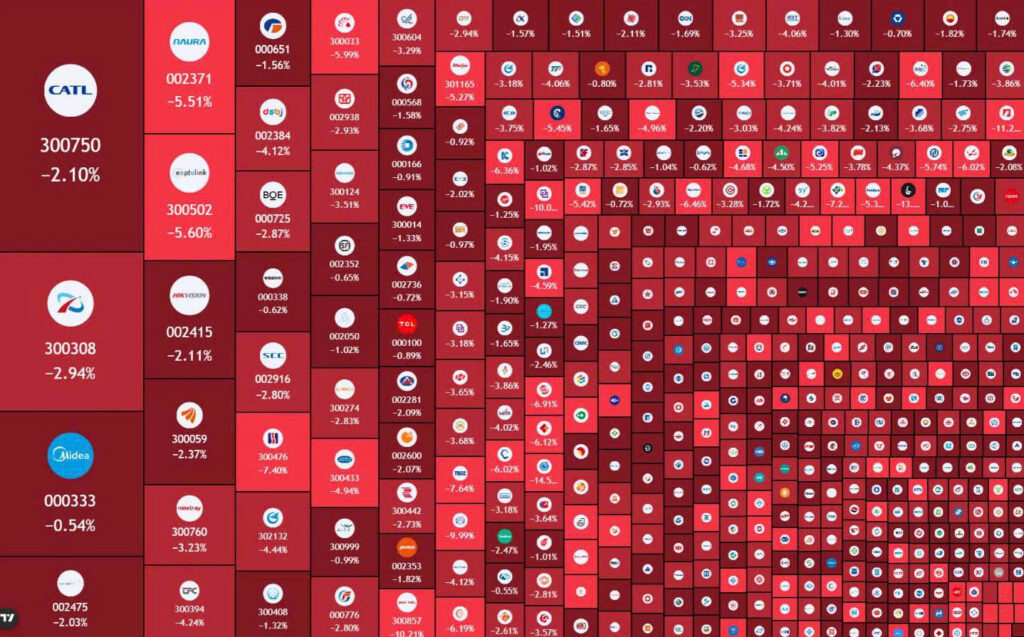
When Technology Expectations Outpace Commercial Reality
Behind the market figures lies a growing challenge for technology companies: demonstrating that advances in AI can translate into commercially viable products, sustainable revenue, and long-term profitability.
Unitree Robotics offers a notable example. After attracting retail investor subscriptions amounting to approximately 8,000 times the shares available, Unitree’s stock lost roughly half its value following its market debut in August 2026.
A similar pattern has emerged in the semiconductor industry. MetaX Integrated Circuits and Moore Threads Technology have both declined by approximately 50% since July, following highly anticipated stock market debuts. (According to Reuters)
These declines do not mean that the companies have lost their technological capabilities. They do, however, suggest that investors are reconsidering the valuations assigned to businesses expected to lead the next generation of industries.
In humanoid robotics, the gap between technical demonstrations and commercial deployment remains particularly significant. A robot capable of performing complex movements in a controlled environment may still struggle to operate reliably, safely, and cost-effectively in factories or everyday settings.
Chinese regulators have increased scrutiny of the wave of initial public offerings (IPOs) among humanoid robotics companies. One key concern is whether revenue generated through government-backed projects reflects sustainable commercial demand. (According to Reuters)
Similar pressures are emerging across the semiconductor industry and AI infrastructure. Beyond technological competition, companies face high development costs, uncertain demand prospects, and international trade risks.
Shares in optical component manufacturers Zhongji Innolight and Eoptolink Technology have fallen approximately 60% from their June–July peaks, partly amid concerns that the US could restrict Chinese equipment used in data centers.
No single factor has been identified as the definitive cause of the selloff. However, elevated valuations, uncertainty over AI demand, tax liabilities, and potential trade restrictions have all been cited as pressures weighing on the market. (According to Reuters)

The Race to Turn Technology into Business Value
China’s market correction raises a broader question about the future flow of capital into AI: As raising funds based largely on growth expectations becomes more difficult, what will technology companies need to demonstrate to sustain their growth?
AI investment may become increasingly selective. Rather than assessing companies primarily on model sophistication, research capabilities, or impressive product demonstrations, investors may place greater emphasis on revenue, actual customer adoption, deployment costs, and scalability.
This shift is particularly relevant to technology startups with lengthy R&D cycles and substantial funding requirements. As investors reassess risk, companies without clear business models may face greater difficulty securing the resources needed for their next stage of development.
At the same time, competition in AI may increasingly shift toward deployment efficiency and practical applications. For manufacturers, AI’s value is reflected in its ability to reduce equipment downtime, improve energy efficiency, and increase productivity, alongside the technical performance of its algorithms.
For infrastructure providers, competitiveness also depends on computing costs, operational efficiency, and customer retention.
The pressure to demonstrate returns on AI investment extends beyond China. Investors are closely monitoring the financial results of Amazon, Microsoft, and Alphabet to determine whether their substantial spending on AI infrastructure can generate revenue and profits that justify the investment.
Across markets, the common challenge is not necessarily a technological crisis, but growing expectations for innovation to deliver measurable economic results. (According to Reuters)
The Outlook For China’s AI Industry: Market Consolidation or a Turning Point?
Despite the sharp downturn in technology stocks, China continues to pursue its AI development strategy.
According to Caixin Global, a state-backed AI investment fund worth 60 billion yuan (approximately US$9 billion) has begun allocating capital to domestic AI model developers. The Chinese government is also promoting AI adoption across manufacturing and consumer-facing industries. (According to Caixin Global)
These developments highlight an important distinction between declining market valuations and actual technological progress. Falling share prices do not automatically mean that algorithms have become less effective, research capabilities have weakened, or demand for AI applications has disappeared.
Some investors are even identifying opportunities amid the correction. Reuters reported that Goldman Sachs continued to include companies such as Zhongji Innolight and Changxin Memory Technologies among its AI-related stock recommendations, while strategists at BNP Paribas saw potential opportunities for cautious investors. (According to Reuters)
For businesses, particularly in markets accelerating their digital transformation efforts such as Vietnam, these developments offer an important lesson about technology adoption.
AI investment should begin with a clearly defined business problem rather than pressure to follow an industry trend. Companies need to identify suitable solutions and evaluate their effectiveness after implementation.
Metrics such as return on investment, labor productivity, product quality, and operating costs can help businesses assess the practical value of technology instead of relying on a solution’s popularity in the market.
A valuation bubble may burst without bringing AI’s technological progress to an end. China’s correction could signal a period of market consolidation, during which companies face greater pressure to demonstrate their ability to translate technological advances into economic returns.
As excessive expectations are gradually revised, the central question for the AI industry may shift from how far the technology can advance to how much value it can actually create for businesses, economies, and society.
In short:
The reversal in China’s technology market highlights the risks that emerge when investment expectations outpace economic performance. Yet advances in computing infrastructure, automation, and industrial AI continue to create opportunities for innovation. Businesses therefore need to move away from trend-driven technology investments and focus on solutions that address practical needs, deliver measurable results, and strengthen long-term competitiveness.
Against this backdrop, BambuUP continues to connect businesses with startups, experts, and innovation resources, helping promising technological solutions reach the organizations that need them and creating opportunities for practical adoption and growth.
Ultimately, AI’s long-term value depends on its ability to deliver tangible business outcomes and lasting economic benefits, rather than technological breakthroughs or market expectations alone.