📖 TABLE OF CONTENTS 📖
In traditional management thinking, Innovation is often confined to laboratories or closed-door strategic meetings. However, the explosion of the Creator Economy is ushering in a new chapter: Innovation is no longer a solitary internal effort, but a synergy of intelligence from external networks.
This is not a story about communication; it's about how businesses build a new Operating System for Open Innovation strategies.
>>> Download now:
- [EBOOK] 50 Perspectives on Innovation & Green Transformation for Businesses
- Winning Accelerator Playbook 2026 by BambuUP
1. Redefining: Creators as Market Intelligence "Touchpoints"
According to the 2023 Open Innovation Report, the Creator Economy is a business layer built by over 200 million content creators, content managers, social media influencers, bloggers, and videographers who use software and financial tools to help them grow and monetize.
For large corporations, the biggest barriers to innovation are "detachment from market reality" and "slow testing cycles." The Creator Economy addresses this challenge through two core values:
Social Intelligence: Creators possess live data on user behavior, psychological barriers, and unmet needs. This is the primary and most crucial input for any strategic consulting or product development process.
>>> Read more: Silver Economy: A new growth driver in the era of aging

Creators possess valuable data on user behavior, psychological barriers, and user needs (Source: Internet)
Rapid Prototyping: Instead of spending months on feasibility studies, businesses can leverage specialized creator communities to directly and immediately validate business hypotheses.
In this context, creators are not just message conveyors; they become a "market intelligence touchpoint" between businesses and end-users.
Their led communities often focus on specific interests or professional fields, ranging from technology, education, and personal finance to manufacturing, logistics, and career development. This focus generates valuable social data, reflecting how real users think, react, and make decisions in various contexts.
From an innovation perspective, the Creator Economy can therefore be understood as a distributed market learning infrastructure.
Instead of relying entirely on traditional market research, which is often costly and slow, businesses can tap into the creator network to continuously observe demand signals, identify unresolved "pain points," and rapidly validate new development directions.
When properly integrated into the innovation process, creators become a vital input for strategic consulting, product development, and identifying new business opportunities.
2. Three pillars for integrating Creators into Corporate Innovation roadmaps
Effectively leveraging the Creator Economy cannot stop at fragmented communication collaborations. To generate real value for innovation, corporations need to view creators as a source of market knowledge and integrate them into the entire innovation lifecycle, from ideation to market expansion.
In practice, this process often unfolds through three strategic value layers:
2.1. Layer 1: Co-Design (Co-creating Solutions)
In the first layer, creators are brought into the innovation process right from the design phase.
Instead of developing products entirely internally and then trying to persuade the market, businesses invite creators, especially those with expertise or practical experience in relevant fields, to participate in problem identification, solution design, and initial testing.
>>> Read more: Vietnam’s Artificial Intelligence (AI): Shaping a distinct identity in the digital Era
Creators can be integrated into the corporate innovation process right from the design phase (Source: Collected)

This approach helps address one of the common risks of innovation in large corporations: the gap between R&D and actual market needs.
Creators, through regular interaction with their communities, are able to quickly identify problems users are facing, how they interpret those problems, and the barriers preventing them from adopting current solutions.
When integrated into the design process, these insights help businesses adjust solutions from the outset, significantly reducing the risk of developing a product that is "technically correct but market-wrong."
2.2. Layer 2: Diffusion (Promoting Adoption of Newness)
Even when a solution is well-designed, bringing it to market still faces a significant barrier: users' fear of the new. In many fields, especially technology, energy, or new business models, users often need a long period to understand and trust before they are ready to adopt.
In this context, content creators act as credible validators for innovative solutions. Thanks to the relationships they have built with their communities, they are able to explain, interpret, and place new solutions into contexts familiar to users.
>>> Read more: The comprehensive view of Japan’s artificial intelligence (AI) ecosystem
Creators act as credible validators and encourage users to adopt new things (Source: Internet)

This process helps shift adoption from early adopters to the broader market, which is often more cautious about experimenting with new things.
For corporations implementing innovation projects, the Diffusion phase is crucial for the speed of investment recovery. A solution, no matter how promising, can take years to be accepted by the market if it lacks appropriate dissemination channels.
Collaborating with reputable creators in relevant fields helps bridge the gap between innovation and the market, thereby accelerating the ROI cycle for innovation initiatives.
2.3. Layer 3: Ecosystem Building
At the highest level, the role of creators extends beyond the scope of a specific product or project.
Businesses and creators collaborate to build an ecosystem around a new trend or field, where various stakeholders, from startups, experts, researchers, to users, exchange and develop solutions.
>>> Read more: A Comprehensive Overview of Innovation in South Korea
At the highest level, creators will collaborate with businesses to build an ecosystem around a new field (Source: Internet)

In the context of major trends such as green transformation, circular economy, or artificial intelligence reshaping many industries, the market for new solutions often does not yet clearly exist.
Creators, with their ability to connect communities and lead discussions, can play a crucial role in educating the market, standardizing language, and shaping common perceptions about issues, thereby creating a "blue ocean" for corporations to provide infrastructure and solutions.
3. Risk management when integrating the Creator Economy into Corporate Innovation strategy
Integrating the Creator Economy into an open innovation strategy offers many opportunities but also poses new management requirements.
To effectively leverage resources from the creative ecosystem while ensuring organizational sustainability, strategic managers need to establish a clear governance framework from the outset.
This governance framework is not intended to restrict the flexibility of open collaboration but to create transparent principles so that all parties can participate in the co-creation process safely and effectively.
One of the most important factors is the formalization of Intellectual Property (IP) rights. In co-creation projects, ideas, methods, or even complete solutions can be formed through the contributions of many different parties.
Without a mechanism to define ownership from the outset, parties can easily fall into disputes when solutions begin to generate commercial value. Therefore, businesses need to establish clear agreements on ownership, exploitation rights, and commercialization rights for intellectual assets arising during the collaboration process.
>>> Read more: Fast fashion is being dethroned by sustainable fashion in South Korea
Brand, legal, and content ownership management issues are often overlooked in the early stages (Source: Internet)

In addition to legal issues, another challenge lies in strategic consistency. The Creator Economy and innovation ecosystems often operate at a fast pace and with diverse perspectives, while large corporations must protect their brand positioning, core values, and long-term commitments to the market.
Therefore, when selecting creative partners, including content creators, tech startups, or professional communities, businesses need to ensure that their value systems and development orientations do not conflict with the organization's strategic DNA.
A poorly considered collaboration can bring short-term benefits in terms of communication or experimentation but can pose risks to reputation or long-term direction.
Finally, open innovation governance also requires a new system of evaluation metrics. If traditional marketing metrics such as views or engagement are applied, businesses may misjudge the true value of the co-creation process.
Instead, organizations need to shift their focus to metrics that reflect the ability to learn and transform knowledge into business value. Metrics such as "learning metrics," which measure the number of hypotheses tested, the speed of market feedback, or the degree of solution improvement, can show how quickly a business is learning.
>>> Read more: Green Fintech: The express gateway for businesses to access sustainable finance
Open innovation governance in the creator economy requires a new system of evaluation metrics (Source: Internet)

At the same time, metrics such as "target market penetration rate" or the level of acceptance by professional communities will more clearly reflect the commercialization potential of innovation initiatives.
When properly designed, this governance framework helps businesses balance two seemingly opposing factors: the flexibility of open innovation and the discipline of strategic management.
This balance allows corporations to leverage the rich knowledge base from the creative ecosystem while protecting their core interests and long-term development orientation.
4. Conclusion
The Creator Economy is no longer merely a media phenomenon but has become a strategic open innovation resource.
To harness this resource, businesses need an open mindset, thorough preparation of management infrastructure, and the ability to flexibly connect business objectives with the market's creative flow.
As a pioneering innovation platform in Vietnam, BambuUP is always ready to provide information and resources to help businesses promptly update technology trends, find the right solutions, and connect with the right partners to optimally leverage the Creator Economy.
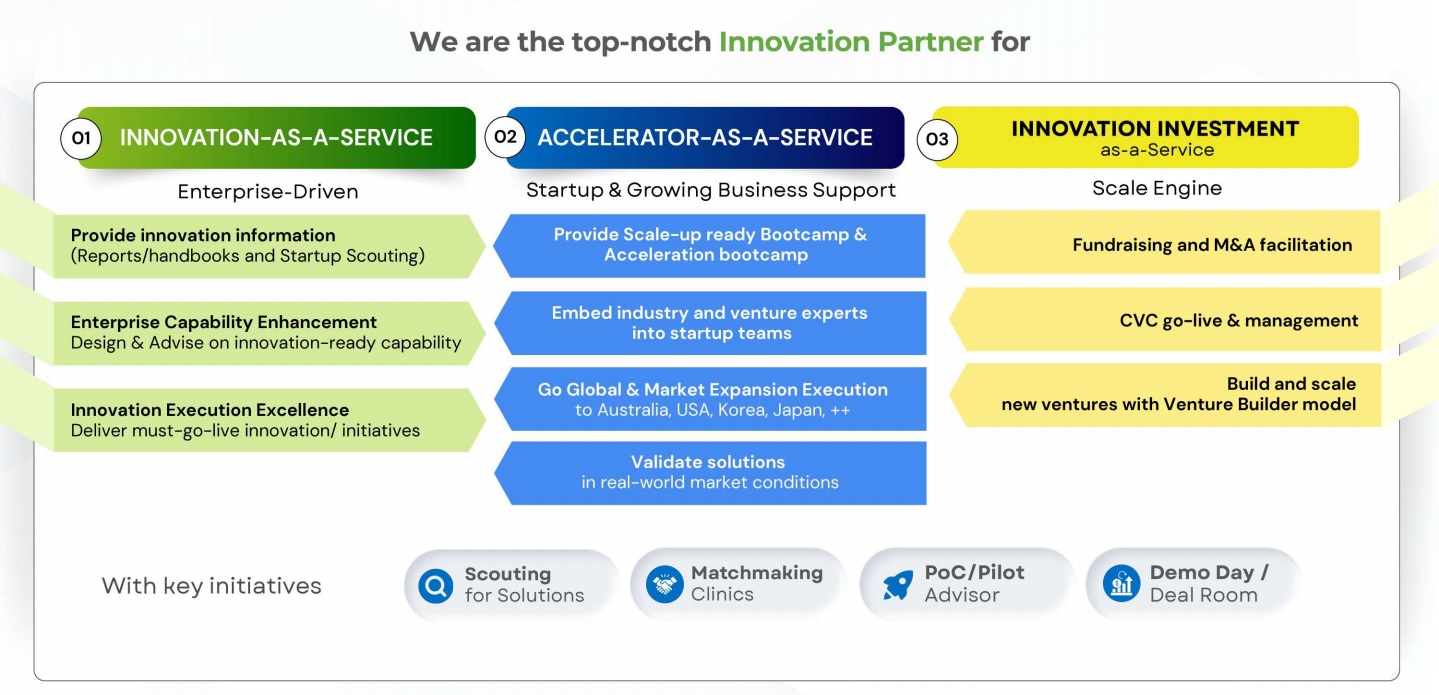
BambuUP acts as a "coordinator" in the Creator Economy space with 3 strategic solution pillars
When approached correctly, the Creator Economy not only helps businesses understand the market faster but also opens up new avenues for collaboration between businesses, startups, and creative communities.
It is at this intersection that innovative ideas have the opportunity to be tested, developed, and transformed into real value in the digital economy.
------
Phuong Le & Lien Le.
This article is part of the content series on Enhancing Innovation Capacity for Businesses, produced by the expert team from BambuUP.
>>> Relevant articles:
- Green Logistics - A Strategic Lever for Market Expansion
- Carbon: Dual benefits for businesses in the race to net-zero emissions
- Sustainable Packaging: 6 Optimal Design Strategies to Lead the Green Innovation Race
- Green Building Materials: How Japan rebuilds and confronts natural disasters
- AI, Metaverse, and IoT: Disruptive technologies powering China's global E-Commerce dominance


