📖 MỤC LỤC BÀI VIẾT 📖
- The first bottleneck in innovation: Not ideas, but organizational execution
- When the problem statement is wrong, every solution is pointless
- Startups: Stop chasing funding, build a real business
- Three core bottlenecks blocking Vietnamese startups from reaching corporations
- A good product is necessary, but not sufficient
- The mindset paradox: One side is waiting, the other can't find the door
- Deeptech in Vietnam: No time, no support system, no anchor clients
- Policy 2025-2026: A golden moment or a last chance?
Enterprises are committed to innovation but keep hitting walls during execution. Startups have solid products but can't find their way into large corporations.
The bottlenecks in Vietnam's innovation ecosystem don't stem from a lack of ideas or technology, they lie in the gap between awareness and execution capacity, in missing organizational links, and in a window of opportunity that is quickly counting down.
Episode 3, series Startups Growing by Solving Enterprise Problems, part of the Business Insights #72 podcast, Vietsuccess x BambuUP, shared by Ms. Nguyen Huong Quynh, CEO of BambuUP.
>>> Download now:
- [EBOOK] 50 Perspectives on Innovation & Green Transformation for Businesses
- Winning Accelerator Playbook 2026 by BambuUP
The first bottleneck in innovation: Not ideas, but organizational execution
Host: In practice, what are the biggest bottlenecks enterprises typically face when implementing innovation?
Ms. Nguyen Huong Quynh: For years, the market has talked extensively about "innovation mindset." But reality shows that high awareness does not equal high execution capacity.
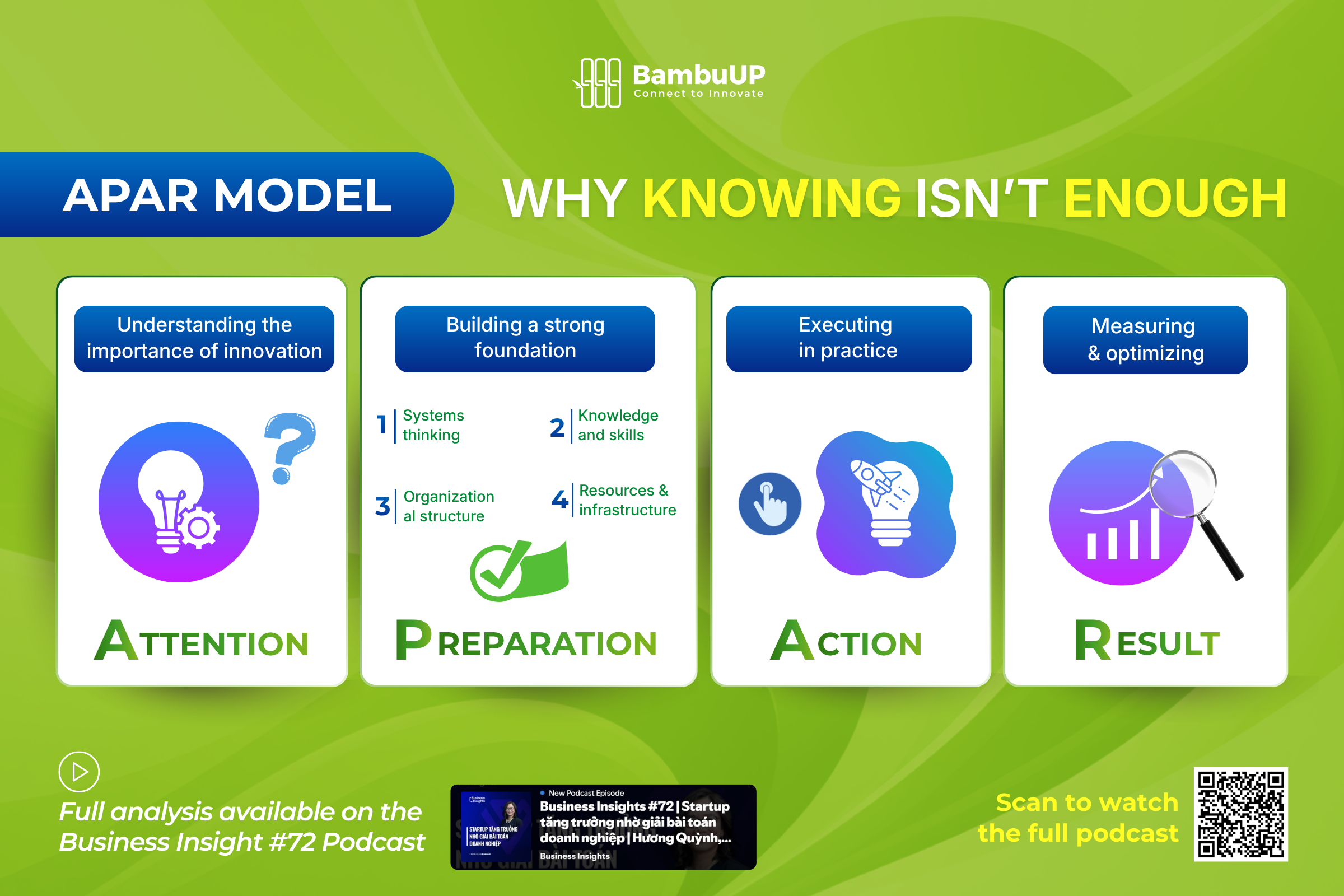
BambuUP has developed a model called APAR, comprising four stages: Attention, Preparation, Action, and Results.
What's concerning is this: according to a dual transformation report BambuUP conducted for the Department of Private Enterprise and Collective Economy Development under the Ministry of Finance, Vietnam's digital transformation index has been rising on the awareness dimension, meaning enterprises are beginning to understand the importance of integrating technology into their operations.
However, we tend to jump straight from "knowing" to "doing," completely skipping the Preparation stage in between. And that gap is precisely why so many innovation projects fail before they even get started.
>>> Read more: Why Open Innovation is key to implementing resolution 68-NQ/TW in the digital age
The APAR for effective preparations, made by BambuUP
So what does preparation actually mean?
When people think about preparation, they usually think about budgets or technology. But there are actually four pillars that need to be built simultaneously:
First: Mindset, and not just at the leadership level. This is where most enterprises go wrong. When implementing any innovation initiative, the people doing the actual work are the frontline employees. If they don't understand it, haven't been convinced, and aren't aligned in their thinking, then no matter how determined leadership is, execution will stall.
Second: Skill set, the knowledge and capability to execute. Knowing something is not the same as being able to do it. Collaborating with startups or deploying new solutions requires a certain level of competency from the internal team. Without the right training and a corresponding skills foundation, even working with a partner becomes awkward and ineffective.
Third: The right organizational structure. You cannot expect a sales employee under daily KPI pressure to suddenly carve out time for innovation activities. Depending on the type and scale of the initiative, enterprises need to clearly define: will there be a dedicated team, or will this be an added responsibility on top of existing roles? Sufficient resources must be allocated to make execution genuinely feasible.
Fourth: Infrastructure and financial resources. Innovation requires investment. There is no path where minimal investment yields significant results. More importantly, a prioritized implementation roadmap needs to be in place from the very beginning.
When the problem statement is wrong, every solution is pointless
Host: Can you give a real-life example of a case where the wrong problem was identified?
Ms. Nguyen Huong Quynh: Recently, we had a conversation with the founder of an F&B chain. She was young, ambitious, and eager to invest heavily in advertising and new customer acquisition channels, because she noticed that foot traffic to her stores was declining.
However, after listening carefully to the full business story, we realized: the problem wasn't a lack of new customers, it was that she was losing existing ones. These are two completely different problems requiring two completely different sets of solutions.
Instead of pouring budget into marketing to attract new customers, what the business truly needed was to improve the experience for current customers, strengthen the customer management system, and retain the people who had already been loyal.
>>> Read more: The Creator Economy: A new fuel source for Corporate Innovation
Ms. Quỳnh shared a real-world example of incorrectly identifying the problem that needed to be solved
This is one of the most common "thinking traps" enterprises fall into: when sales underperform, the first reaction is to blame marketing. But the real root cause may lie in operational processes, service quality, or the fact that a constantly changing sales team has no system in place to retain customer data.
The problem statement must be right before you can find the right solution.
Startups: Stop chasing funding, build a real business
Host: For startups, one of the biggest pressures is having to develop a product, find investors, and acquire customers all at the same time. How can we solve that?
Ms. Nguyen Huong Quynh: This is a classic chicken-and-egg question, and my answer starts from a more fundamental perspective.
When building a startup, think of it as a real business. Not a project built to raise funding, but a business entity with core values that is capable of surviving even without external investment.
This may sound contrary to the prevailing mindset in the market, where many people see "securing funding" as the primary benchmark for evaluating a startup. But in reality, capital is only a tool to accelerate growth, not the foundation for survival.
When a startup is built with the central KPI of "raise funding by date X," the entire operating machine will be oriented toward that goal. And in many cases, that very orientation obscures the true core of the business, the value created for customers, the ability to solve a real problem, and the resilience to survive the tough times.
A solid business must be prepared for both scenarios: if funding comes, accelerate; if it doesn't, still survive and grow. That is the only truly sustainable foundation.
>>> Read more: Silver Economy: A new growth driver in the era of aging
Three core bottlenecks blocking Vietnamese startups from reaching corporations
A good product is necessary, but not sufficient
Host: Is having a good product enough for startups to win enterprise customers?
Ms. Nguyen Huong Quynh: A good product is a prerequisite, but it's important to properly define what "good" means. No startup launches with a perfect product. The core value lies in whether the product genuinely addresses a specific pain point, or creates real value for users, even if it's still imperfect.
In practice, many products that aren't yet fully polished can still hit the right nerve for an enterprise, and that's what earns the opportunity to co-create. The actual collaboration process with enterprises helps startups continue refining their product, while simultaneously producing more targeted solutions for real operational challenges.
But to even reach enterprises in the first place, startups need two additional elements: branding and personalized outreach.
>>> Read more: Carbon: Dual benefits for businesses in the race to net-zero emissions

A good product is a necessary condition, but what matters more is truly understanding what “good” means
Many startups believe that building a brand is something only established companies do. That's a misconception. From the earliest stages, startups need to build a recognizable and credible presence, so that when they approach corporations and enterprises, which are inherently risk-averse, there is enough trust for the conversation to move forward.
In addition, the outreach approach must be tailored to each type of enterprise. There is no "one size fits all" formula when engaging with completely different audiences, from multinational corporations, to traditional Vietnamese businesses, to fast-growing SMEs.
The same solution may apply across the board, but the way the story is told and value is connected must fit each specific context.
The mindset paradox: One side is waiting, the other can't find the door
Ms. Nguyen Huong Quynh: Beyond the universal challenges, such as the fact that larger enterprises have a highly developed "risk immune system" and become more risk-averse as they grow, Vietnamese startups face an additional paradox that is unique to the local context.
In many developed countries, when the topic of "the startup and innovation ecosystem" comes up, large corporations see themselves as a natural part of that ecosystem.
They proactively seek out startups because they want access to new technologies and to maintain their competitive edge. Their default mindset is: "I need to stay close to startups if I want to move fast."
In Vietnam, the opposite is happening. When Vietnamese corporations and enterprises hear the words "startup" or "innovation ecosystem," the common reaction is: "That's not our world."
And when one side is ready and waiting while the other doesn't see themselves as belonging to the conversation, the startup's sales cycle stretches out dramatically, or never even begins.
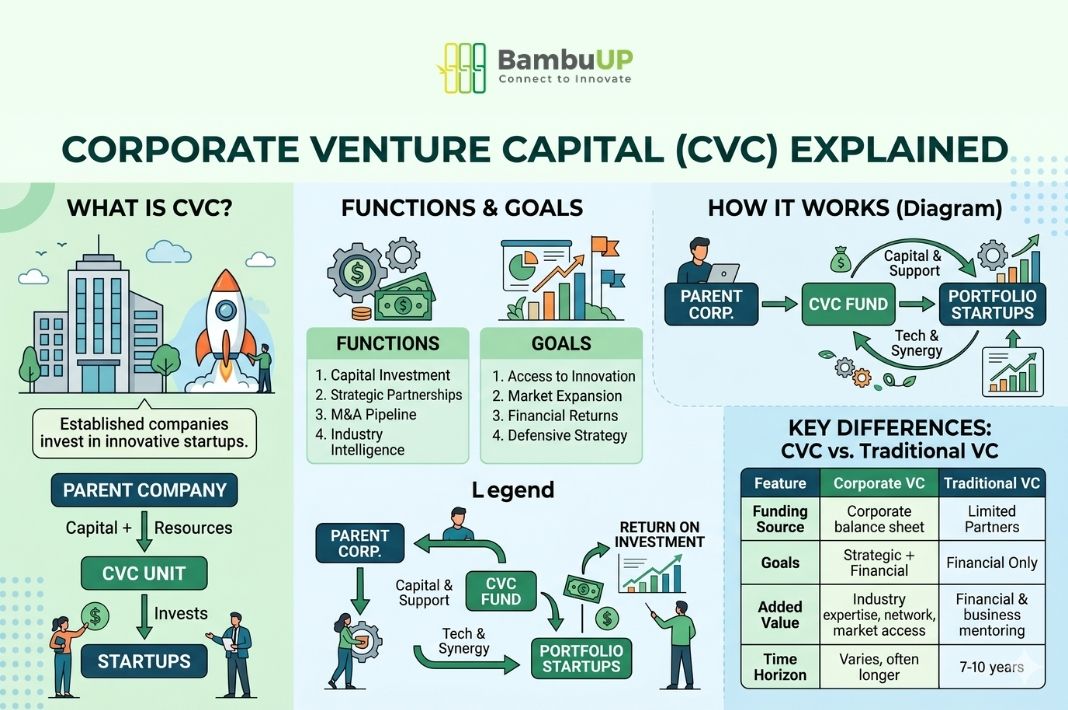
The second gap is the near-total absence of Corporate VC, venture capital funds established by the corporations themselves. In Vietnam, almost all venture capital comes from independent professional funds. Corporate VC is virtually nonexistent.
This is a significant gap, because Corporate VC doesn't just bring capital, it invests with a clear strategic direction aligned to the parent corporation's goals, helping startups leverage the corporation's ecosystem, resources, and existing customer base to grow far faster than they could alone.
>>> Read more: Is AI the GPS guiding green investment, unlocking 40 trillion dollars in ESG?
Corporate VCs provide more than just capital - they invest in alignment with the corporation’s strategic direction, enabling startups to scale much faster
Deeptech in Vietnam: No time, no support system, no anchor clients
Ms. Nguyen Huong Quynh: Another reality worth noting: Vietnam's startup map is conspicuously missing the category of startups with high scientific and technological depth, deeptech, foodtech, agritech, sectors that require long R&D cycles and cannot generate revenue quickly.
In countries with strong ecosystems, this category of startups is supported by governments and institutions in the early stages, allowing them to focus entirely on research without worrying about generating income.
>>> Read more:
- The comprehensive view of Japan’s artificial intelligence (AI) ecosystem
- Vietnam’s Artificial Intelligence (AI): Shaping a distinct identity in the digital Era
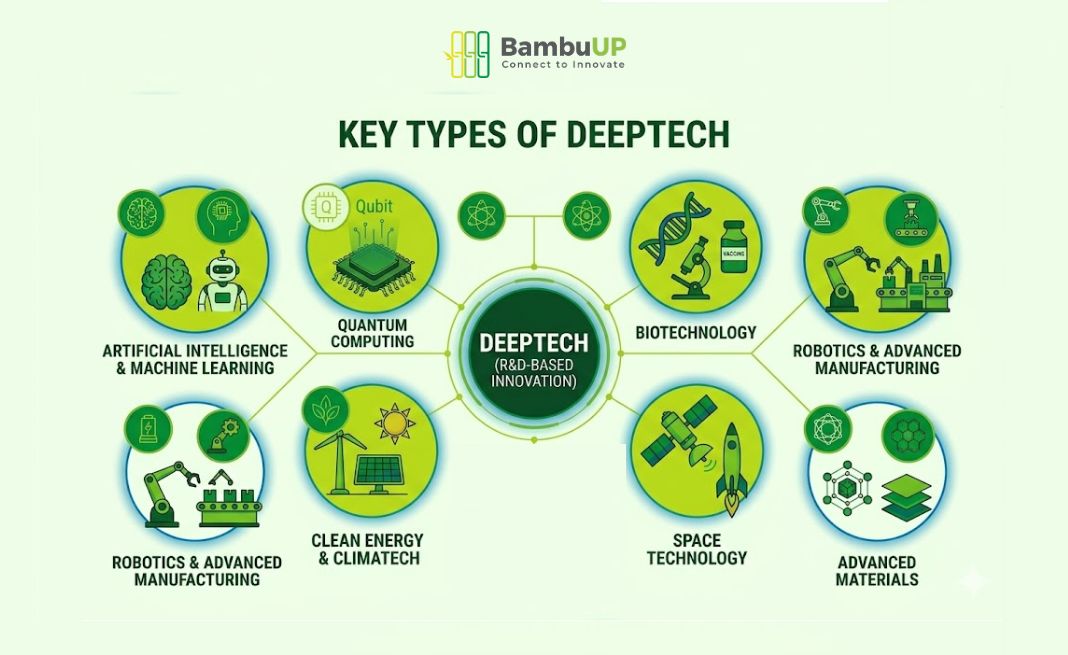
Vietnam’s startup ecosystem is still significantly lacking a strong deeptech startup segment
As a result, by the time a product is formed, they already have anchor clients, early customers ready to adopt the solution, typically the very enterprises that commissioned the research from the beginning.
Vietnamese startups face a very different reality: they must develop the product and find customers simultaneously, while those customers don't yet know they exist. This is no small reason why Vietnam remains largely invisible on the global deeptech map.
Policy 2025-2026: A golden moment or a last chance?
Host: Given the wave of new innovation-related policies being introduced, how do you see this situation?
Ms. Nguyen Huong Quynh: To be clear: with the new suite of policies and the recently amended Law on Science, Technology and Innovation, the market's response has been overwhelmingly enthusiastic, not just from startups, but from large corporations as well.
Previously, many state-owned enterprises were constrained by mechanisms that prevented them from collaborating broadly with startups, due to regulations around capital preservation and risk control. The new policy directions are gradually dismantling those barriers.
Most notably, the move to establish a state-backed venture capital fund is a powerful signal: the government is stepping up as a first mover, willing to share risk with the ecosystem. The next step is to activate the private corporate sector to follow, forming Corporate VC funds and building strategic investment vehicles tied to their own business direction.
However, there is still a gap between stated direction and actual execution. The entire market is anxiously waiting for concrete programs and visible actions that translate the resolutions into reality.
And to be frank: we only have 2026 to create breakthroughs that are significant enough to matter.
Foreign investment funds and international partners are watching Vietnam with high expectations. If 2026 fails to deliver tangible shifts, success stories that can be shared widely, actions that are bold enough to be credible, disappointment will arrive quickly. And at that point, it could take another five to ten years to rebuild that confidence.
This is not negative pressure. It is an opportunity, but one with an expiration date.
—-----
Stay tuned for the next article in the series:
Episode 4: Three mega trends shaping the future - Where should Vietnam’s Innovation Ecosystem place its bets over the next five years?
The silver economy is on track to reach the trillion-dollar mark, AI is being localized and specialized for individual industries, and value-chain alliances are enabling SMEs to compete on equal footing in global markets. These three waves are no longer distant future trends, they are reshaping the competitive landscape right now.
The world’s strongest innovation ecosystems do not chase every trend; they know where to place the right bets. For Vietnam, these are the three trends that matter most.
Follow BambuUP for ongoing practical insights on Innovation, for enterprises and corporations navigating transformation, and for startups looking for the right door to walk through.
—------
Phuong Le.
BambuUP is an one-stop open innovation platform to facilitate meaningful connection between Innovation Seekers & Innovation Providers.
We have partnered with leading companies across multiple industries, such as Shinhan, EVN, Heineken Vietnam, FASLINK, DKSH, Smollan, Talentnet, and others, to launch open innovation challenges and connect suitable technology solutions to the operational needs of enterprises and corporations.
You are looking for innovative solutions to accelerate their dual transformation journey (green & digital) in ways that best fit their organizations?


